Commercial Restoration in Virginia, Maryland & D.C.
Large-loss mitigation and reconstruction for offices, retail, multifamily, and managed properties — dedicated dispatch, business-continuity scheduling, and insurance-grade documentation across Virginia, Maryland, and D.C.
What counts as a commercial restoration loss?
Commercial restoration covers property damage to any building that runs a business or houses tenants — office suites, retail storefronts, restaurants, medical and dental practices, warehouses and light industrial space, hotels, houses of worship, schools, and the multifamily buildings a property manager oversees. The damage types are the same physics as a home loss — water, fire and smoke, storm, mold, and sewage — but the scale, the schedule pressure, and the number of stakeholders are entirely different. A burst riser on the fourth floor of an office tower does not stay on the fourth floor; it cascades down through tenant spaces, elevator shafts, and electrical rooms, and every hour it sits is an hour of lost rent, closed operations, and mounting exposure.
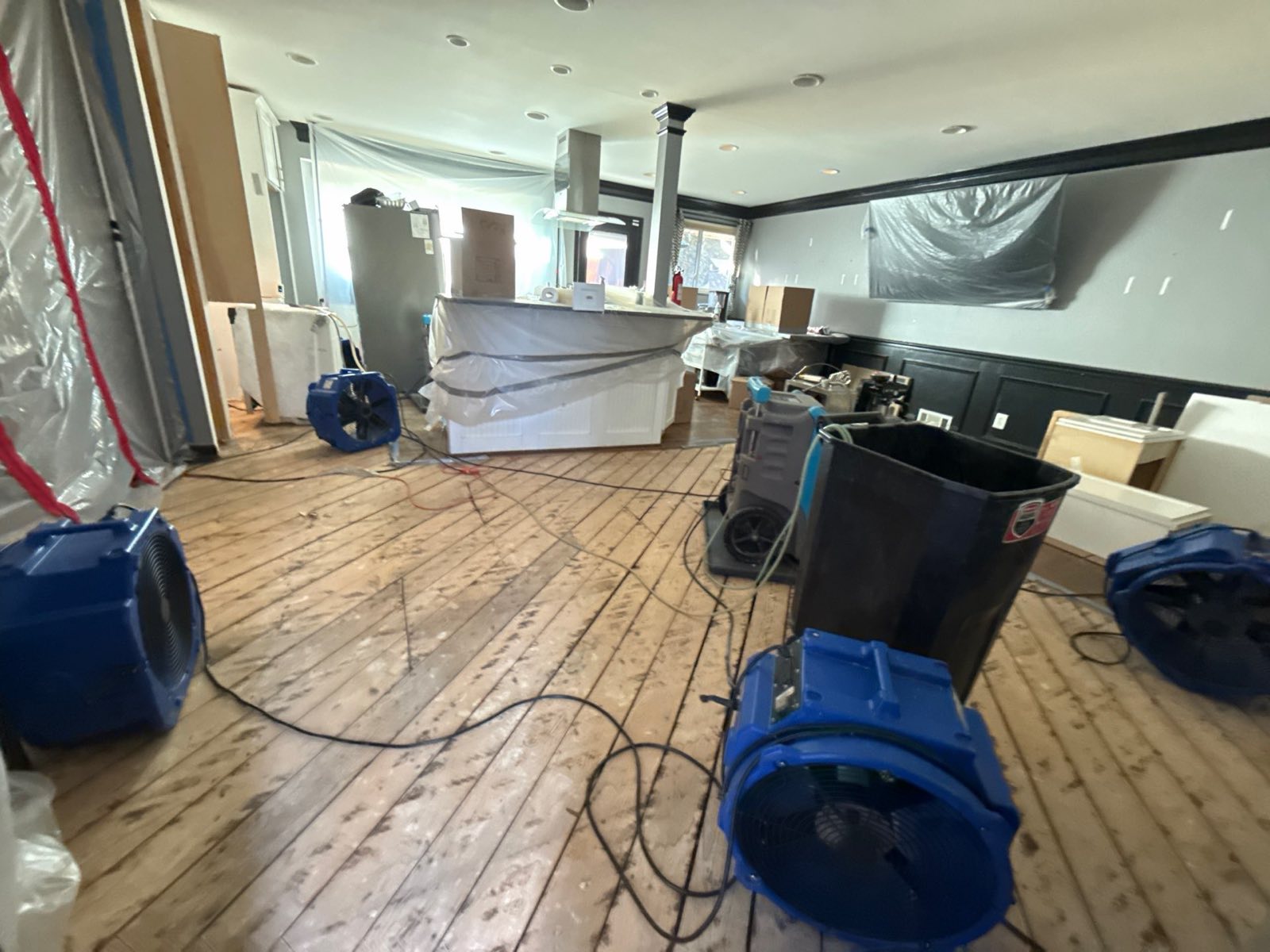
That is why commercial work is its own discipline rather than a bigger version of a residential project. The equipment footprint is larger — dozens of air movers, high-capacity LGR and desiccant dehumidifiers, three-phase power, and truck-mounted extraction instead of a couple of portables. The logistics are heavier — after-hours access, security escorts, tenant coordination, and containment that lets part of a building keep operating while another part is torn out and dried. And the documentation stakes are higher, because a commercial claim frequently involves a property carrier, a tenant's policy, a business-interruption component, and a management company that all need the same clean, defensible file.
Restoration Doctor is built for that reality. We carry the crew count, the drying fleet, and the reconstruction trades to take a large commercial loss from the first emergency call through permanent rebuild without subcontracting the accountability away — and we do it across all of Virginia, Maryland, and the District of Columbia.
How fast can you mobilize for a commercial emergency?
Speed is the single biggest lever on the size of a commercial loss, so our commercial dispatch runs 24 hours a day, 365 days a year, with a dedicated intake line that skips the general queue. Our median on-site arrival across the region is 47 minutes, and our response SLA commits to crews on site within 60 minutes across the core service area — because for a commercial building, the difference between a one-hour and a four-hour response can be the difference between drying a corridor and gutting a floor.
On the first mobilization we do three things at once: stop or isolate the source, extract standing water and stabilize the structure, and scope the loss with moisture mapping and thermal imaging so the drying plan is built on data instead of guesswork. For a large loss we can scale equipment and manpower quickly — staging additional air movers, dehumidifiers, generators, and negative-air machines as the moisture map dictates — rather than making a building wait days for a second truck. That surge capacity is exactly what a facility director or property manager is buying when they call a company built for commercial scale.
We coordinate access the way a commercial site actually works: badging in through building security, working around tenants and the public, staging equipment where it will not block egress or fire lanes, and keeping the property manager informed at each step. The goal is a mitigation that is aggressive on the water and disciplined about the building's operations at the same time.
How do you keep my business running during restoration?
For a business, the restoration is only half the problem — the other half is staying open. Every day a storefront is dark or an office is unusable is revenue lost and, for a landlord, rent at risk. Our commercial approach is designed around business continuity, not just structural drying. Wherever the loss allows, we isolate the affected area with containment barriers and negative air so the rest of the building keeps operating while we work, rather than shutting down an entire floor to dry one suite.
We schedule around your operation. That routinely means overnight and weekend work, phased mitigation that clears the highest-priority spaces first, and drying setups engineered to run quietly and safely alongside occupied areas. For retail and hospitality, where the customer-facing space is the business, we prioritize getting the public areas presentable and dry on an accelerated track while back-of-house work continues behind containment. For offices and medical spaces, we protect sensitive equipment, records, and clean environments as part of the scope.
This is where carrying reconstruction in-house pays off most. When mitigation and rebuild are split between two firms, a commercial project stalls in the handoff — and every day in that gap is a day the space cannot reopen. Because our teams cover mitigation, licensed plumbing and electrical, carpentry, and full commercial reconstruction, we compress that timeline into one accountable schedule and get the building back to revenue faster.
Property managers & multifamily: handling multi-unit and common-area losses
Multifamily and managed properties add a layer that single-tenant buildings do not: a loss almost never respects unit boundaries. A supply line that fails in an upper unit runs down through the units below and out into shared hallways, stairwells, and mechanical rooms, which means one event touches multiple residents, multiple leases, and the common elements the association or owner is responsible for. Sorting out what belongs to which policy — the master property policy, an individual tenant's contents coverage, an HO-6 unit-owner policy — starts with documentation clean enough to draw those lines cleanly.
We work multifamily losses the way property managers need them worked: a single point of contact who coordinates access to every affected unit, a per-unit and common-area breakdown of the scope, moisture readings and photos organized by location, and communication that a manager can forward to residents and owners without rewriting it. When residents need to be relocated during drying or reconstruction, we sequence the work to minimize displacement and get units back in service as quickly as the drying standard allows.
For property management companies and associations that oversee a portfolio, the real value is having a restoration partner who already knows the buildings before the emergency happens — which is what a Master Service Agreement is for.
What is a Master Service Agreement, and why set one up before a loss?
A Master Service Agreement (MSA) is a pre-negotiated relationship between your organization and Restoration Doctor that puts the terms, rates, response expectations, and points of contact in place before an emergency — so that when a pipe bursts at 2 a.m., there is no vendor search, no paperwork scramble, and no delay while someone gets approvals. You call one number, we are already an approved vendor with your building details on file, and crews mobilize immediately under terms everyone already agreed to.
As part of an MSA we build a Priority Response Plan for each property: documented shutoff and utility locations, site access and security procedures, key contacts, and the specifics of the building's construction and systems. That pre-loss knowledge shortens response time and reduces the mistakes that happen when a crew is learning a building for the first time in the middle of a flood. For portfolios, it means consistent handling and consistent documentation across every property you manage.
MSAs are a natural fit for property management companies, commercial landlords, HOAs and condo associations, multi-site retailers and franchises, healthcare and senior-living operators, and any facility where downtime is expensive. There is no cost to having the plan in place — it simply means that when the emergency comes, you are a priority call with a plan already written rather than a cold dispatch. We are glad to set one up in writing at any time.
Documentation and insurance for commercial claims
Commercial claims draw more scrutiny than residential ones because the dollar figures are larger and the parties are more numerous, so the documentation has to be airtight from the first hour. Our crews photograph every phase in CompanyCam with date and time stamps, log daily psychrometric and moisture readings, and write estimates in Xactimate — the platform commercial adjusters and third-party administrators use — with line-item notes explaining each activity. On a large loss that file may need to reconcile a property carrier, a tenant's coverage, and a management company's records, and a clean Xactimate workfile with photo and moisture support is what lets an adjuster approve scope on first review instead of kicking it back.
That same documentation is what supports the parts of a commercial claim that residential losses rarely involve — the business-interruption and lost-rent components. A thorough, timeline-stamped record of when the loss occurred, what was affected, when mitigation began, and how long spaces were out of service gives your carrier and your accountant the substantiation those claims require. We do not adjust business-interruption claims, but we make sure the restoration record underneath them is complete and defensible.
We work for you, not your insurer: you pay us directly, and we build a carrier-ready claim file and manage the documentation flow so your facility team is not buried in paperwork during an already disruptive event, and you hold the documentation your insurer asks for. From the first emergency call to the final reconstruction walk-through, a commercial loss is handled as one coordinated operation with one clean claim file — across Virginia, Maryland, and the District of Columbia.
Portfolios that cross state lines
Plenty of the property managers we work with hold buildings on both sides of the Potomac. Those losses are handled by the same company under one set of documentation standards: for a District address, ask us about commercial restoration in Washington, DC, and one project manager will carry the whole portfolio.
Built for commercial scale
What a property manager or facility director is actually buying when they call a company built for commercial losses.
A 24/7 commercial intake line with 47-minute median arrival and a 60-minute response SLA across the core service area — no general queue when your building is flooding.
Truck-mounted extraction, high-capacity LGR and desiccant dehumidification, three-phase power, and the crew count to surge equipment on a big loss instead of making a building wait for a second truck.
Containment, negative air, and phased overnight and weekend work that keeps the operating parts of your building open while the affected areas are dried and rebuilt.
Pre-negotiated terms, priority response, and a per-building emergency plan on file — so an emergency is a priority call with a plan, not a cold vendor search.
A single point of contact, per-unit and common-area scope breakdowns, and documentation a property manager can forward to residents and owners without rewriting it.
In-house mitigation, licensed plumbing and electrical, carpentry, and full commercial reconstruction — no stall in the handoff between two firms while your space stays closed.
Frequently asked
Active water, mold, fire, or sewage event?
Connect directly with the Restoration Doctor team for your region. Crews are on standby 24/7 with documented response protocols.