
Water Damage Restoration in Great Falls, VA
Water damage restoration in Great Falls, VA is estate work, and estate work has its own rules. The homes here are large custom builds on one-to-five-acre wooded lots, most drawing from a private well and draining to a private septic field, with lower levels finished into wine cellars, home theaters, gyms, and mechanical rooms full of pumps, pressure tanks, and water-treatment equipment. When a supply line lets go on the second floor of a Seneca colonial, or a well pressure tank fails in a River Bend mechanical room, the water has thousands of square feet of custom finishes to ruin and no municipal shutoff at the street to make it simple. Restoration Doctor answers those calls across Great Falls 24/7, staging crews out of nearby Vienna and McLean so the drive to a Colvin Run or Falcon Ridge address stays short.
The scale is what changes everything. A Great Falls loss is rarely contained to one small room — it moves through open floor plans, down open staircases, and into finished basements that can run the full footprint of the house. Add hand-scraped hardwood, natural stone, custom millwork, and a climate-controlled wine room, and the exposure is measured far more in what the water touches than in how many gallons hit the floor. We bring truck-mounted extraction, high-capacity and desiccant dehumidification, and specialty hardwood drying systems because portable gear and box fans simply cannot get ahead of a loss this size.
This page is written for Great Falls specifically — its well-and-septic infrastructure, its estate lower levels, and the stream valleys of Difficult Run and Colvin Run that shape how water reaches these homes — because a $2M custom home on a private well is a genuinely different restoration project than a townhouse on city water, and treating it like one is how irreplaceable finishes and collections get lost.
| Metric | Value | Notes |
|---|---|---|
| Median on-site arrival time | 47 minutes | Measured median arrival across dispatched emergency projects — the middle value, not an average. Distinct from the 60-minute response SLA below. |
| Restoration projects completed to date | 10,000+ | Aggregate count of completed restoration projects to date across the VA / MD / D.C. tri-state service area. |
| Customers who file through insurance | 83% | Share of CUSTOMERS who use insurance. Restoration Doctor works for the homeowner — you pay us directly, and we build a carrier-ready claim file documented to IICRC S500 with a line-item Xactimate estimate, which you submit to your insurer when you seek reimbursement. |
| Average structural dry-out time | 4.5 days | Average time to bring a structure to documented dry standards; monitored daily with moisture readings. Individual projects vary by saturation class. |
| Emergency response SLA (NoVA core) | 60 minutes | The PROMISED response commitment across the NoVA core — a broader guarantee than the measured 47-minute median arrival. |
| Google rating (live) | 4.9★ | 4.9★ is the verified average. The review count changes nightly and is served live at /api/reviews-summary — never hardcoded. |
How water damage behaves in Great Falls
Well systems, pressure tanks, and mechanical-room floods
In Great Falls, the mechanical room is a water risk that most homeowners never think about until it fails. A ruptured pressure tank, a leaking softener or filtration unit, a failed well pump seal, or a burst supply line at the manifold can release water continuously into a finished lower level, because unlike a city connection there is no simple curb stop to shut down the street. We locate and isolate the failure first — often at the well head, the pump controller, or the tank itself — then extract and dry, and our in-house licensed plumbers repair the component that caused the loss so the same tank doesn't flood the room again next month.
These losses are frequently discovered late. A mechanical room in a far corner of a large lower level can run water for hours or overnight before anyone notices, so by the time we arrive the moisture has already migrated into adjacent finished rooms, wicked up wall assemblies, and reached the subfloor under nearby hardwood. We map the true footprint with moisture meters and thermal imaging rather than drying only the obvious puddle, because in a house this size the water has almost always traveled farther than it looks.
Septic backups and Category 3 water
Because Great Falls homes are on private septic, a backup here is a contaminated Category 3 loss from the first minute — sewage and blackwater carry bacteria and pathogens that clean-water protocols do not address. A saturated drain field after heavy rain, a failed septic pump, or a clog in the line can push wastewater back into a lower-level bathroom or utility room, and that water requires containment, full removal of affected porous materials, antimicrobial treatment, and verified decontamination, not a mop-and-dry.
We treat septic-origin losses to IICRC S500 Category 3 standards end to end: isolate the affected area, protect the rest of the home, remove and dispose of unsalvageable materials, clean and disinfect the structure, and document the sanitation for your carrier. Estate homeowners are often surprised how quickly a septic backup crosses from a plumbing nuisance into a health hazard — moving fast and classifying the water correctly is what keeps a bad day from becoming a gut-out.
Acreage, stream valleys, and groundwater
Great Falls sits between the Potomac River and the wooded stream valleys of Difficult Run and Colvin Run, and its large lots put grading, slope, and a high seasonal water table into play in ways a small suburban lot never sees. Surface water sheeting down a wooded hillside toward a walkout basement, a swollen tributary after a storm, and saturated soil pressing against a long below-grade wall all drive water into finished lower levels that a single dehumidifier will never resolve on its own.
On a big lot the response has to identify what it's actually fighting — a plumbing failure, a groundwater intrusion, or both at once — and address the source before drying. We dry the assembly to a verified standard and, when the pattern is grading or hydrostatic pressure, flag it so it can be corrected, because treating a recurring groundwater problem as a one-time spill is how a Great Falls basement grows mold behind a finished wall between storms.
Wine cellars, hardwood, and high-value contents
The finished Great Falls lower level is full of things water destroys quickly. Wide-plank and exotic hardwood cups and crowns within days of saturation, so we deploy specialty in-place floor-drying systems to pull moisture from between the boards and the subfloor rather than defaulting to tearing out a floor that costs a fortune to replace. Climate-controlled wine cellars are sealed, cool, and humidity-sensitive by design — they trap water, and aggressive drying can harm the collection — so we dry them with controlled desiccant dehumidification and document temperature and humidity throughout.
Contents care is its own discipline at this scale. Antiques, art, hand-knotted rugs, and electronics don't survive prolonged soaking, so we move at-risk items to dry, controlled staging early and coordinate with specialty rug and art restorers when a piece warrants it. We also build a documented, photographed contents inventory, because many Great Falls homeowners carry high-limit policies with real valuables coverage, and that paperwork supports the personal-property side of the claim as cleanly as our moisture logs support the structure.
Great Falls homes and how they fail
Great Falls is one of the few truly low-density corners of inner Fairfax County. Neighborhoods like Great Falls Village, Seneca, Falcon Ridge, River Bend, and the properties along Colvin Run and Georgetown Pike are dominated by large custom single-family estates — many built or extensively rebuilt from the 1990s onward, most on wooded acreage, and the great majority served by private well and septic rather than public water and sewer. The finished lower level is close to universal: wine cellars, theaters, guest suites, and mechanical rooms built out beneath the main house, which also makes the basement the lowest point where water collects and the most expensive place for it to sit.
The infrastructure is the differentiator. A Great Falls home's water comes from a well, gets conditioned by a softener or filtration system, and is held in a pressure tank — almost always in a lower-level mechanical room — and any one of those components can fail and flood the space around it. Wastewater goes to a septic system, so a backup is a Category 3 event with no city main to blame or fall back on. And because these homes sit on large lots at the end of long driveways, a power outage during a storm can knock out the well pump and the sump pump at the same time, leaving a big below-grade footprint with no active protection. Knowing that a home runs on well and septic tells us where to look first and how to classify the water before we touch anything.
Great Falls neighborhoods we serve
Real Fairfax County communities — and the water losses we most often see in each.
Custom estates near the village center on well and septic, where lower-level mechanical-room and pressure-tank failures reach finished space.
Large wooded-lot homes where second-floor supply-line breaks travel down through multiple finished levels before anyone notices.
Riverfront and near-Potomac estate lots where groundwater and stream-valley intrusion press against big below-grade footprints.
Upscale custom homes with expansive finished basements, wine cellars, and hardwood that demand specialty in-place drying.
Properties along the Colvin Run corridor where storm runoff and a high water table drive walkout-basement intrusion.
Estate homes on acreage where power outages can knock out the well pump and sump pump together, leaving basements unprotected.
Documented Great Falls projects
Real CompanyCam-documented restoration work in this city — every project photographed with date and time stamps.
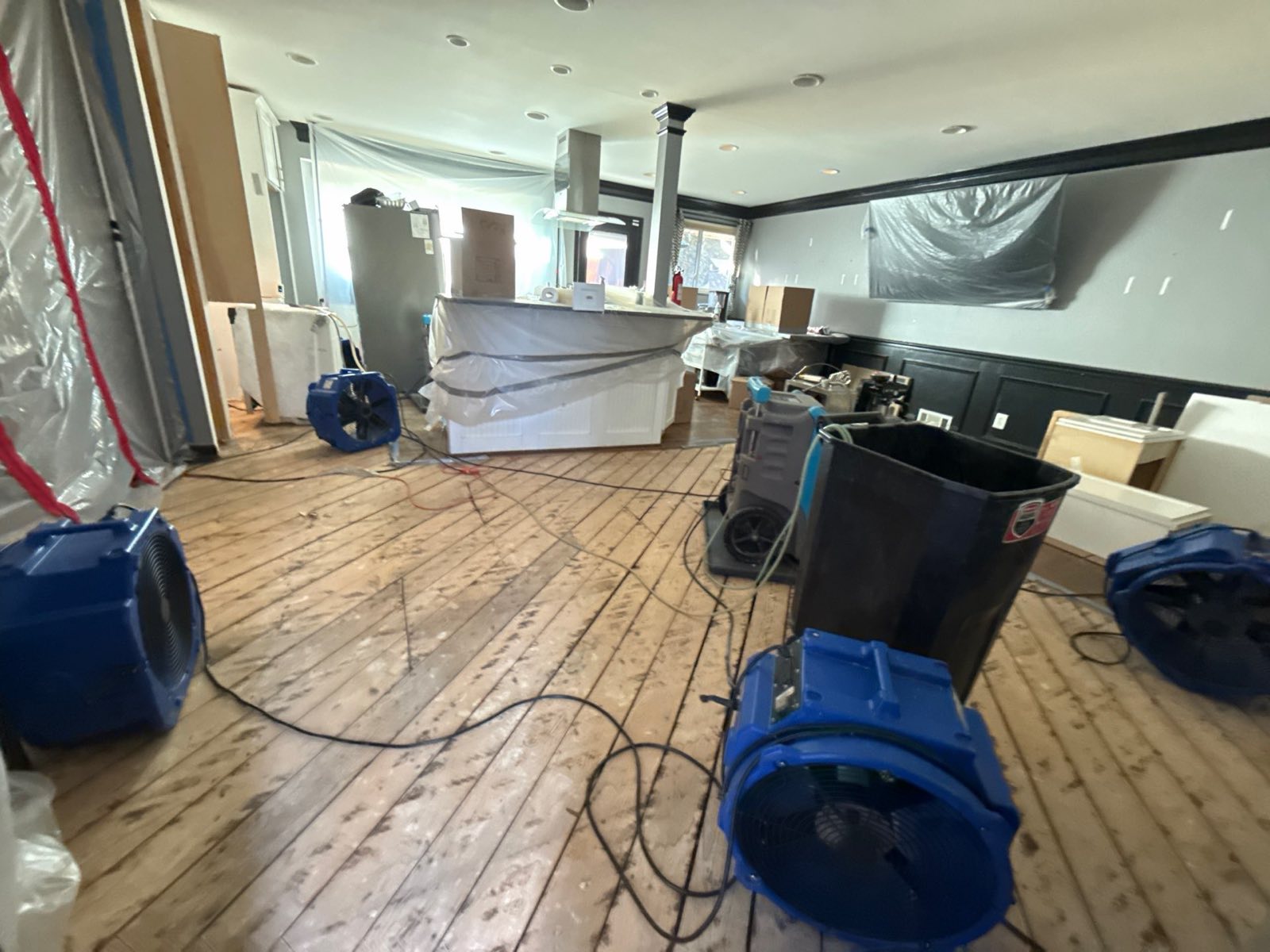
Large-home structural drying
Extraction and structural drying across a large open floor plan, with air movers and portable dehumidification staged to the full affected footprint — a documented Restoration Doctor project of the scale a Great Falls estate loss demands.
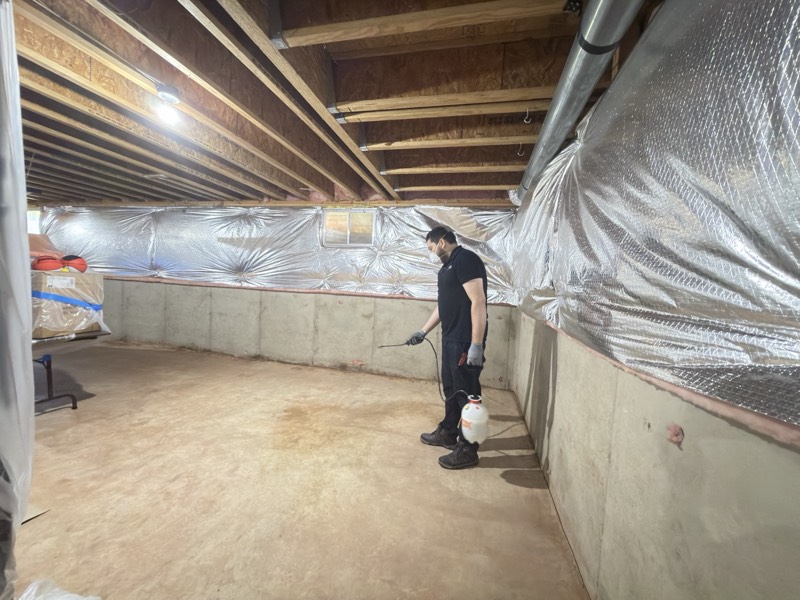
Below-grade antimicrobial treatment
Antimicrobial application across an unfinished below-grade space after a water loss — the kind of mechanical-room and lower-level decontamination Great Falls well-and-septic homes routinely need. A documented Restoration Doctor project.
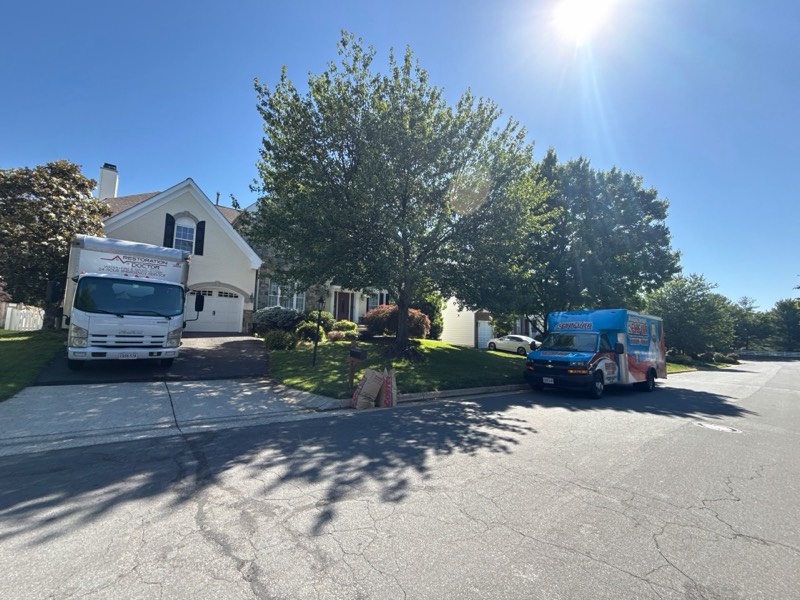
24/7 emergency response
A Restoration Doctor crew on site at a suburban single-family home — the round-the-clock dispatch that reaches Great Falls estates on their long wooded driveways when a well or supply line fails. A documented company response.
Full restoration services in Great Falls
One operation covers every category — from emergency mitigation to full reconstruction.
Water Damage Restoration
Extraction, structural drying, and moisture verification for burst pipes, appliance leaks, and basement flooding.
Fire & Smoke Damage Restoration
Soot and smoke residue removal, odor neutralization, contents pack-out, and reconstruction after a fire.
Storm Damage Restoration
Emergency tarping, water extraction, and reconstruction after wind, hail, and heavy-rain storm events.
Mold Remediation
IICRC S520 containment, HEPA filtration, safe removal, and post-remediation clearance verification.
Sewage & Biohazard Cleanup
Category 3 black-water decontamination with full PPE, safe removal, antimicrobial treatment, and verification.
Odor Removal & Deodorization
Source-based smoke, sewage, mold, pet, and musty-odor removal using thermal fogging, hydroxyl and ozone treatment, and HVAC deodorization.
Reconstruction & Repairs
Drywall, flooring, cabinetry, trim, and paint — the same in-house crew that dried the loss rebuilds it, with no handoff between mitigation and reconstruction.
What Great Falls homeowners look for
In Great Falls, a homeowner is handing over the keys to a home full of irreplaceable finishes, a wine collection, and systems most contractors have never touched. The feedback that actually matters here speaks to discretion, care with high-value contents, competence with well and septic infrastructure, and the ability to coordinate with private adjusters and estate managers — not just to run a fan and hand over a bill.
We don't reprint reviews on this page. Our verified customer reviews — including feedback from Great Falls-area estate owners — are published on our dedicated reputation hub, RestorationDoctorsReviews.com, where you can read them alongside the true aggregate Google rating and then come back here to arrange service. Keeping the ratings on a separate, source-linked hub is a deliberate honesty choice: those numbers are the real Google aggregates, not figures typed onto a marketing page.
Frequently asked
Active water, mold, fire, or sewage event?
Connect directly with the Restoration Doctor team for your region. Crews are on standby 24/7 with documented response protocols.