
Mold Remediation in Northern Virginia, Maryland & Washington, DC
Containment, HEPA filtration, source-based removal, and independent clearance verification — remediation that fixes the moisture problem instead of painting over it.
| Metric | Value | Notes |
|---|---|---|
| Median on-site arrival time | 47 minutes | Measured median arrival across dispatched emergency projects — the middle value, not an average. Distinct from the 60-minute response SLA below. |
| Restoration projects completed to date | 10,000+ | Aggregate count of completed restoration projects to date across the VA / MD / D.C. tri-state service area. |
| Customers who file through insurance | 83% | Share of CUSTOMERS who use insurance. Restoration Doctor works for the homeowner — you pay us directly, and we build a carrier-ready claim file documented to IICRC S500 with a line-item Xactimate estimate, which you submit to your insurer when you seek reimbursement. |
| Average structural dry-out time | 4.5 days | Average time to bring a structure to documented dry standards; monitored daily with moisture readings. Individual projects vary by saturation class. |
| Emergency response SLA (NoVA core) | 60 minutes | The PROMISED response commitment across the NoVA core — a broader guarantee than the measured 47-minute median arrival. |
| Google rating (live) | 4.9★ | 4.9★ is the verified average. The review count changes nightly and is served live at /api/reviews-summary — never hardcoded. |
Mold is a symptom — the moisture is the disease
Mold remediation in Northern Virginia fails most often for one reason: someone treats the mold and ignores the water that grew it. Mold is not a random infestation; it is biology responding to moisture. Spores are present in every building all the time, and they bloom into a visible colony only where they find a damp surface and enough time — the reason EPA guidance is to dry water-damaged materials within 24 to 48 hours. Kill the colony but leave the leak, the condensation, or the trapped humidity, and it comes back in the same spot within weeks.
That is why real remediation always starts with the moisture investigation, not the scrubbing. Our region's climate makes the problem worse: NoVA summers are hot and humid, basements run cool and damp, and a below-grade wall or a poorly ventilated bathroom can hold enough moisture to support mold with no dramatic leak at all. We find the water source first — a slow supply-line drip, a foundation seep, an HVAC condensation problem, a past water loss that was never dried properly — because a colony you remove without fixing the source is a colony you'll be removing again.
Contain first, so you don't spread the problem
The single most important thing a remediation crew does is contain the work area before disturbing anything. Mold that is sitting quietly on a wall releases relatively few spores; mold that is scrubbed, cut, or vacuumed without containment aerosolizes millions of them and seeds them through the rest of the house via the air and the HVAC. Careless removal doesn't shrink a mold problem — it multiplies it.
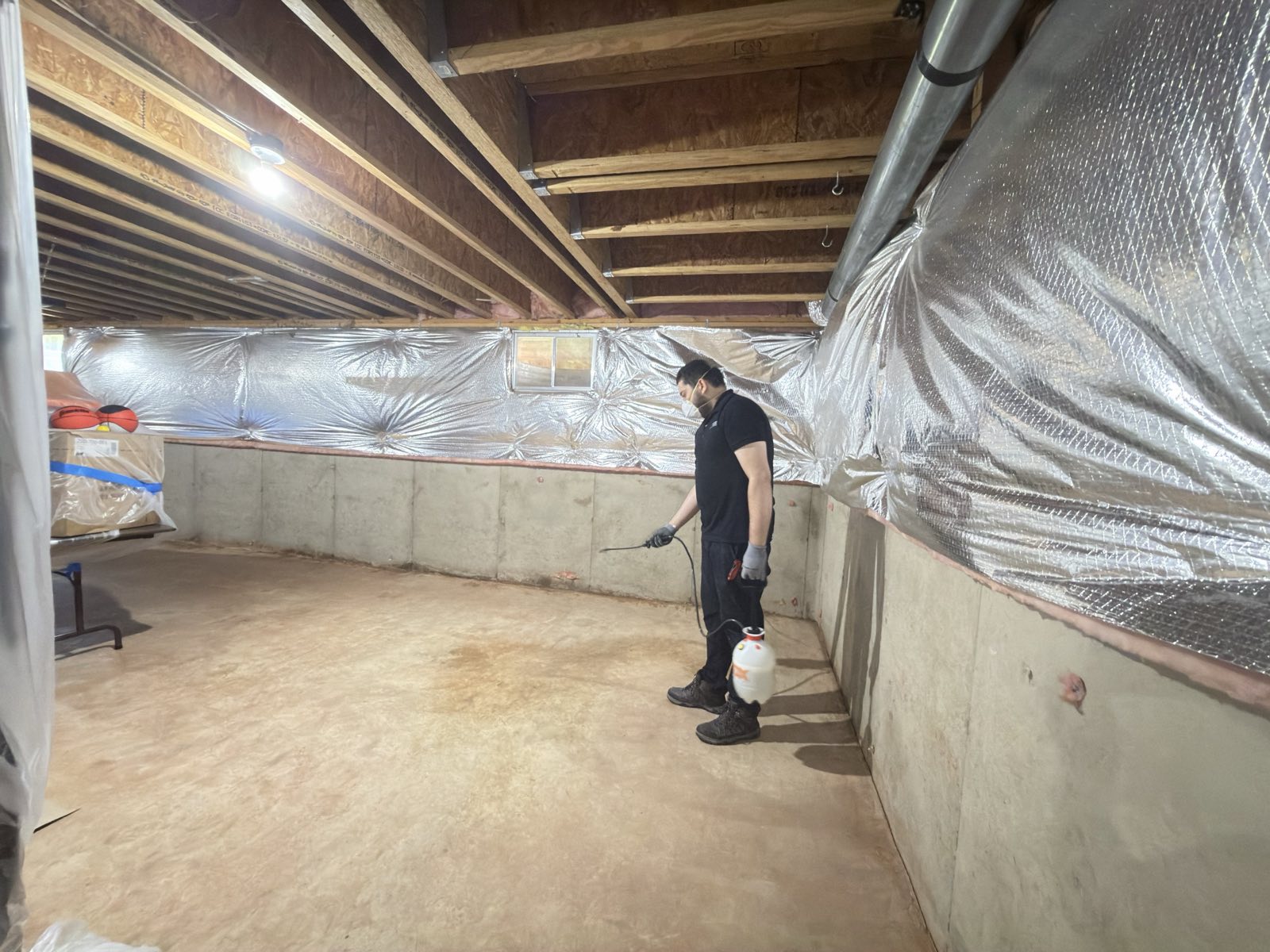
Following the IICRC S520 standard, we build physical containment with plastic barriers and run the work area under negative air pressure using HEPA-filtered air scrubbers, so airflow moves into the containment and spores can't escape. Workers use appropriate PPE, and the HVAC serving the area is shut down or isolated so it doesn't become a distribution system. Only inside that controlled envelope do we begin removal.
Removal, HEPA cleaning, and drying
Inside containment, porous materials that are colonized — moldy drywall, saturated insulation, affected carpet and pad — are removed and bagged, because mold roots into porous material and cannot be reliably cleaned off it. Non-porous and semi-porous structural surfaces like framing and concrete are HEPA-vacuumed and cleaned rather than demolished wherever they can be salvaged. We deliberately avoid the 'just spray bleach on it' shortcut: surface biocide on porous material leaves the roots behind and adds moisture, which is counterproductive.
After physical removal, we HEPA-vacuum and detail-clean every surface in the containment to capture settled spores, then dry the structure to a normal moisture level so the environment no longer supports growth. Drying is part of remediation, not an afterthought — if the assembly stays damp, the fix doesn't hold. The final state we're after is a work area that is physically clean, structurally dry, and no longer a hospitable place for mold.
Verification, not just 'looks clean'
Remediation isn't finished because a surface looks clean — it's finished when it verifies clean. Under IICRC S520, successful remediation means the moldy materials are gone, the area is visibly free of contamination and dust, and the moisture source has been corrected. For clearance, we support independent third-party post-remediation verification, including air and surface sampling by an outside hygienist, so the sign-off doesn't come from the same company that did the removal.
That independence matters for your peace of mind and for any future real-estate disclosure. When we close a mold project, you get documentation of the containment, the removal, the moisture correction, and the clearance result — and because we handle the reconstruction in-house, we can rebuild the walls and finishes we opened, returning the space to pre-loss condition under one accountable operation.
Where mold hides in Northern Virginia homes
Most of the mold we find in Northern Virginia is not the dramatic wall of black growth people picture — it is quiet, hidden, and tied to the specific ways local homes hold moisture. Below-grade basements are the usual suspect: cool foundation walls meet warm, humid summer air and condensation forms, or a minor foundation seep keeps the base of a finished wall perpetually damp. Behind that drywall, out of sight, is exactly the sustained moisture a colony needs. A finished basement can look pristine while growing mold inside the wall cavity for months.
Bathrooms and laundry areas are the next frontier, where a poorly vented exhaust fan or a slow, long-ignored supply-line weep feeds growth behind tile and under vanities. Attics are a surprisingly common site too — inadequate ventilation combined with bathroom fans that dump moist air into the attic instead of outside will grow mold on the underside of the roof deck. And any home that suffered a past water loss which was dried superficially, or not dried at all, is a candidate for hidden growth in the materials that stayed damp.
Because so much of this is concealed, the signs are often indirect: a persistent musty odor, allergy-like symptoms that ease when you leave the house, warping or discoloration on a wall or ceiling, or a history of water problems in a particular spot. When we investigate, we combine a moisture survey with those clues to find the growth and, just as importantly, the moisture pathway feeding it — because in this climate, controlling humidity and fixing the water source is the only thing that keeps mold from coming back.
Humidity control deserves its own mention, because Northern Virginia's long, muggy summers can grow mold with no leak at all. When indoor relative humidity sits high enough for long enough, condensation forms on the coolest surfaces — basement walls, the backs of furniture against exterior walls, cold-water lines, uninsulated ductwork — and that ambient moisture is all a colony needs. This is why part of a durable remediation is often environmental: correcting a basement that runs damp, adding or fixing bathroom and kitchen ventilation, making sure exhaust fans vent outside rather than into the attic, and keeping indoor humidity in a healthy range with dehumidification where the house needs it. Treating the visible mold without addressing the humidity that fed it is the single most common reason a mold problem returns, and we would rather solve the condition than be back in six months solving the same colony.
Frequently asked
Active water, mold, fire, or sewage event?
Connect directly with the Restoration Doctor team for your region. Crews are on standby 24/7 with documented response protocols.