
Water Damage Restoration in Herndon, VA
Water damage restoration in Herndon, VA spans two very different kinds of buildings, because Herndon is an incorporated town with a genuinely historic core and decades of suburban growth wrapped around it. On one block you have century-old frame homes and Victorians near the old W&OD railroad depot; a mile away you have sprawling 1970s and 1980s colonial and townhome subdivisions, and beyond those, newer development pushing toward Dulles and the Silver Line. A supply line failing in a downtown frame house and an upstairs bathroom leak in a Kingston Chase townhome are both Herndon water losses — and they are not the same project. Restoration Doctor answers both around the clock, dispatching from nearby Vienna with an arrival target measured in minutes.
Herndon's terrain shapes its water risk. The town sits on relatively flat ground near Dulles Airport, and flat terrain concentrates stormwater — it does not shed quickly. Sugarland Run and Folly Lick Branch drain the low areas and flood in heavy rain, and the basement-and-sump-pump suburban stock that dominates Herndon relies on those pumps to stay dry. We built this page specifically for Herndon homeowners and property managers because a generic 'we serve the region' pitch tells you nothing about how water behaves in a 1980s Chandon colonial with a finished basement versus a frame house near the depot with a century of settling behind its walls.
Whatever the source — a slow leak behind a townhome wall or storm water rising in a basement at 2 a.m. — the response is the same discipline: kill the source, extract before the water spreads through the assembly, dry to a verified standard, and document every step for your carrier. Here is how that plays out from downtown Herndon to its townhome subdivisions.
| Metric | Value | Notes |
|---|---|---|
| Median on-site arrival time | 47 minutes | Measured median arrival across dispatched emergency projects — the middle value, not an average. Distinct from the 60-minute response SLA below. |
| Restoration projects completed to date | 10,000+ | Aggregate count of completed restoration projects to date across the VA / MD / D.C. tri-state service area. |
| Customers who file through insurance | 83% | Share of CUSTOMERS who use insurance. Restoration Doctor works for the homeowner — you pay us directly, and we build a carrier-ready claim file documented to IICRC S500 with a line-item Xactimate estimate, which you submit to your insurer when you seek reimbursement. |
| Average structural dry-out time | 4.5 days | Average time to bring a structure to documented dry standards; monitored daily with moisture readings. Individual projects vary by saturation class. |
| Emergency response SLA (NoVA core) | 60 minutes | The PROMISED response commitment across the NoVA core — a broader guarantee than the measured 47-minute median arrival. |
| Google rating (live) | 4.9★ | 4.9★ is the verified average. The review count changes nightly and is served live at /api/reviews-summary — never hardcoded. |
How water damage behaves in Herndon
Flat terrain, Sugarland Run, and stormwater that lingers
Herndon's flat ground near Dulles is a mixed blessing. Level terrain is easy to build on, but it does not drain quickly, so stormwater pools and lingers rather than running off — and Sugarland Run and Folly Lick Branch, which thread through the town's low areas, rise and back water into nearby yards and basements during heavy rain. Homes along those corridors and anywhere the grade is shallow take on storm intrusion from the outside, under pressure, while the rain is still falling. That is a fundamentally different loss than a burst pipe, and it demands a different response.
When we scope a Herndon basement, we first determine whether the water is a plumbing failure, a stormwater and groundwater event, or both, because a storm intrusion needs the grade, drainage, and sump system addressed and needs to be treated for the category of water that entered — not simply dried with a dehumidifier in the corner. On flat ground where water lingers, that diagnosis is what separates a basement that dries clean from one that grows mold behind the finished walls two weeks later.
Basement-and-sump-pump suburban stock
The finished basement on a sump pump is the standard Herndon suburban home, and the sump is a single point of failure. When the power blips in a summer storm and the battery backup is dead, or the pump simply wears out after years of service, groundwater seeps in through the foundation — and water that has moved through soil is no longer clean Category 1 water. We treat those losses as the Category 2 seepage events they are, with proper extraction, selective removal of unsalvageable porous materials, and antimicrobial treatment.
When the loss is a clean-water plumbing failure instead, speed decides the outcome. Water pooling at the lowest point of a Herndon basement immediately wicks up into drywall, saturates carpet pad, and soaks the bottom plates of framed walls, and cool, poorly ventilated basements dry slowly and grow mold. We extract fast, then dry the carpet, pad, and lower wall assembly in place with monitored low-grain and desiccant dehumidification, verifying dryness with meters rather than guessing from the surface.
Townhome and shared-wall losses
Herndon's townhome communities turn a single failure into a shared problem. When a supply line, appliance hose, or upstairs bathroom lets go in one unit, water finds the fastest path down through the subfloor and joist bays and often migrates through the party wall into the adjoining home, soaking two or three levels and two households before anyone notices. At the ceiling these losses look small; inside the wall and floor cavities they are anything but.
We use thermal imaging and moisture meters to trace the true footprint of the water across units rather than guessing from the visible damage, then dry wall and ceiling cavities in place wherever we can and open only what genuinely has to come out. Where a loss crosses into a neighbor's unit or an HOA-governed common element, we document the affected areas cleanly for each party and each carrier, which keeps a multi-unit Herndon claim from turning into a dispute over who pays for what.
Herndon homes and how they fail
Herndon's housing splits cleanly into eras. The historic downtown around the depot holds older Victorian and frame homes, some more than a century old, with the aging plumbing, settled foundations, and older basements that come with that age — galvanized and cast-iron systems past their service life, and below-grade spaces that were never engineered for modern storms. Ringing that core are the town's suburban workhorses: Kingston Chase, Chandon, and the large 1970s and 1980s subdivisions of colonials and townhomes, nearly all built on full or finished basements with sump systems. Toward Dulles and the Silver Line, McNair and newer development add contemporary construction with modern plumbing but a fresh set of failure patterns.
The townhome is a defining Herndon building type, and it carries a defining risk. In the town's many attached-home communities, a washing-machine hose, a water-heater failure, or an upstairs bathroom leak in one unit sends water straight down — and sometimes sideways through a shared wall — into the neighboring living space, so a single failure can become a multi-unit loss. The 1970s and 1980s single-family stock, meanwhile, is now at the age where original supply lines, water heaters, and drain systems fail, and the finished basements underneath them are the most common site of serious water damage. Reading which era and which building type we are walking into is how we scope the drying correctly the first time.
Herndon neighborhoods we serve
Real Fairfax County communities — and the water losses we most often see in each.
Historic frame homes and Victorians near the W&OD depot with aging plumbing and older, unwaterproofed basements.
1970s–80s single-family and townhome community where finished-basement sump and supply-line losses are common.
Established colonials and townhomes where upstairs and appliance leaks travel down through multiple levels.
Newer development toward Dulles with contemporary plumbing and its own upstairs-to-basement leak pattern.
Newer townhomes and mixed-use near the Metro where shared-wall water migration drives multi-unit losses.
Large HOA subdivision of colonials and townhomes on basements with sump dependence and stormwater exposure.
Documented Herndon projects
Real CompanyCam-documented restoration work in this city — every project photographed with date and time stamps.
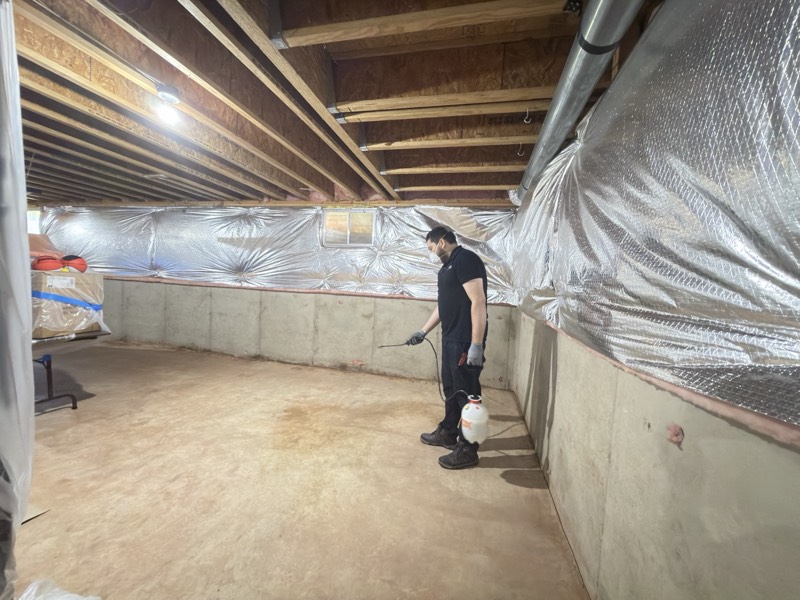
Emergency extraction & structural drying
A documented Restoration Doctor water loss with fast truck-mount extraction followed by a staged drying system sized to the affected footprint — the sequence we bring to Herndon basement and shared-wall townhome losses.
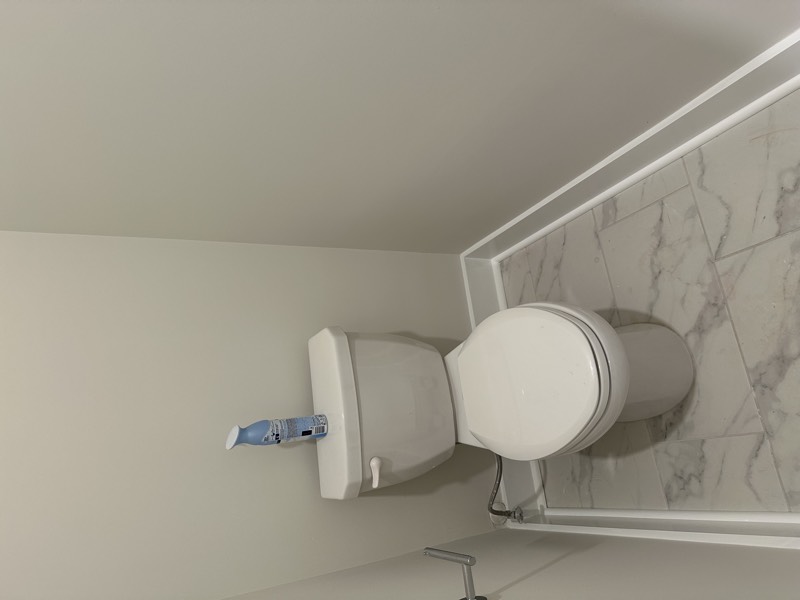
Thermal moisture mapping
Thermal imaging and moisture meters used to map hidden water behind walls and under floors so drying equipment is placed where the water actually went — critical on shared-wall townhome losses.
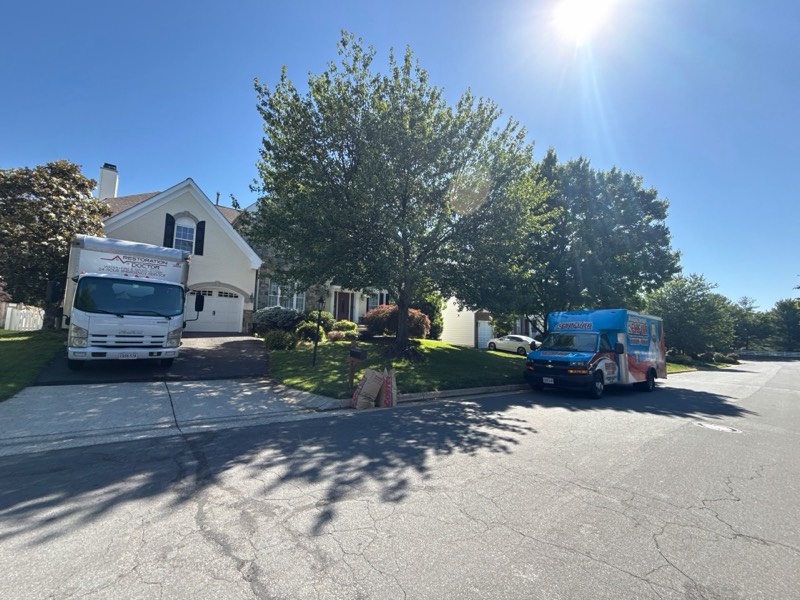
Selective demolition & cavity drying
A documented Restoration Doctor project where a saturated lower wall was opened so the framing and cavity behind it could be dried and then rebuilt.
Recent Herndon water damage projects — on video
Real jobsite footage from documented restoration projects in this city — filmed by our crews, not stock.
Water Damage in Herndon VA — Hidden Loss Mapped, Dried to Standard, Ready to Rebuild
HERNDON, VA · WHOLE-HOME WATER LOSS — MULTI-ROOM STRUCTURAL SATURATION, MITIGATION & DRYING · DOCUMENTED ON SITE
Full restoration services in Herndon
One operation covers every category — from emergency mitigation to full reconstruction.
Water Damage Restoration
Extraction, structural drying, and moisture verification for burst pipes, appliance leaks, and basement flooding.
Fire & Smoke Damage Restoration
Soot and smoke residue removal, odor neutralization, contents pack-out, and reconstruction after a fire.
Storm Damage Restoration
Emergency tarping, water extraction, and reconstruction after wind, hail, and heavy-rain storm events.
Mold Remediation
IICRC S520 containment, HEPA filtration, safe removal, and post-remediation clearance verification.
Sewage & Biohazard Cleanup
Category 3 black-water decontamination with full PPE, safe removal, antimicrobial treatment, and verification.
Odor Removal & Deodorization
Source-based smoke, sewage, mold, pet, and musty-odor removal using thermal fogging, hydroxyl and ozone treatment, and HVAC deodorization.
Reconstruction & Repairs
Drywall, flooring, cabinetry, trim, and paint — the same in-house crew that dried the loss rebuilds it, with no handoff between mitigation and reconstruction.
What Herndon homeowners look for
Herndon is a real town with a real community, and word about contractors travels through neighbors, HOA boards, and the local networks. The reviews that carry weight here are specific: how fast a crew reached a flooded basement, whether a shared-wall townhome loss was handled cleanly for both households, whether the drying was verified with real moisture readings, and whether the insurance paperwork held up. Those are exactly the experiences we want documented by the people who lived them.
We don't reprint star averages or review counts on this page. Our verified reviews and the true aggregate Google rating live on a dedicated reputation hub — you can read them at RestorationDoctorsReviews.com and then come back here to arrange service for your Herndon home. Keeping the ratings on a separate, source-linked hub is a deliberate honesty choice: what you see there are the real Google aggregates, not numbers arranged on a marketing page.
Frequently asked
Active water, mold, fire, or sewage event?
Connect directly with the Restoration Doctor team for your region. Crews are on standby 24/7 with documented response protocols.