Rapid-Response Fleet & Restoration Equipment | VA · MD · D.C.
Three vehicle classes, staged across Northern Virginia, carry the extraction, drying, and air-quality equipment a loss actually needs — from a single burst pipe to a commercial catastrophe — under one accountable, in-house operation.

Restoration Doctor runs a three-tier rapid-response fleet across Virginia, Maryland, and Washington, D.C.: wrapped Sprinter vans staged for sub-hour arrival, equipment box trucks carrying the full drying arsenal, and a diesel tractor-trailer for large-loss and commercial catastrophe response. Every unit carries current-generation air movers, LGR and desiccant dehumidifiers, HEPA air scrubbers, and thermal imaging cameras. Median on-site arrival across Northern Virginia is 47 minutes; the fleet has supported over 10,000 completed restoration projects.
Rapid-Response Vans
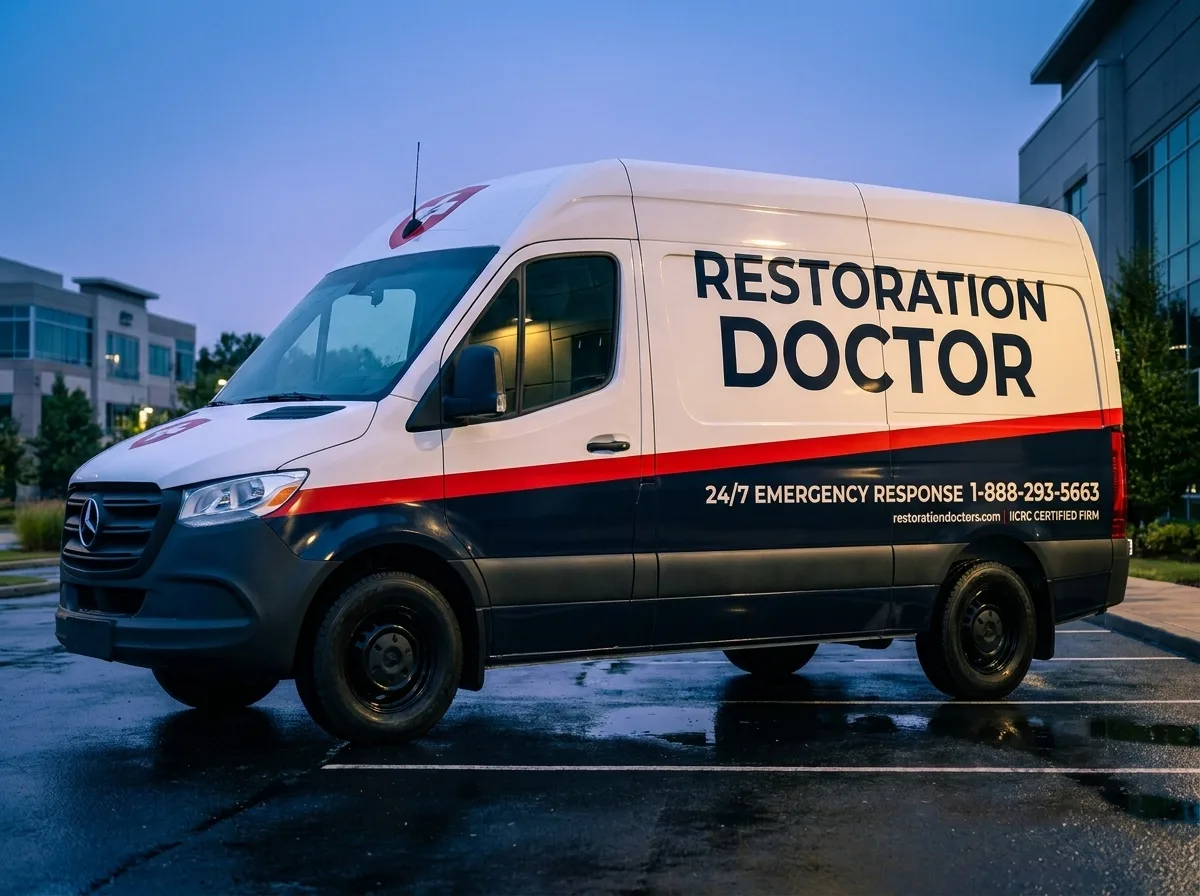
The rapid-response van is the first unit dispatched on every emergency call, and it is built to do real work the moment it arrives — not just scout the loss. Each van is staged with extraction equipment, containment barriers, moisture meters, thermal imaging cameras, and enough air movers to begin stabilizing a room before the second unit arrives.
Vans are pre-loaded and pre-inspected between calls so nothing is scavenged from a warehouse at 2 a.m. — the technician who answers your call is already carrying what the first 60 minutes of a water loss requires: submersible pumps and wet vacs for standing water, moisture meters and thermal cameras to map how far the water traveled behind walls and under flooring, and containment plastic to stop cross-contamination before it starts.
Because these are the units doing the sub-hour sprint, they are staged in clusters across Northern Virginia rather than centralized at one depot — positioning that is the direct reason the median on-site arrival across the region measures 47 minutes.
- Submersible pumps and wet/dry extraction vacuums
- Portable moisture meters and handheld thermal imaging cameras
- Compact air movers for immediate room-level stabilization
- Containment plastic, poly sheeting, and negative-air setup
- First-response documentation kit (CompanyCam-linked, date/time stamped)
Equipment Box Trucks
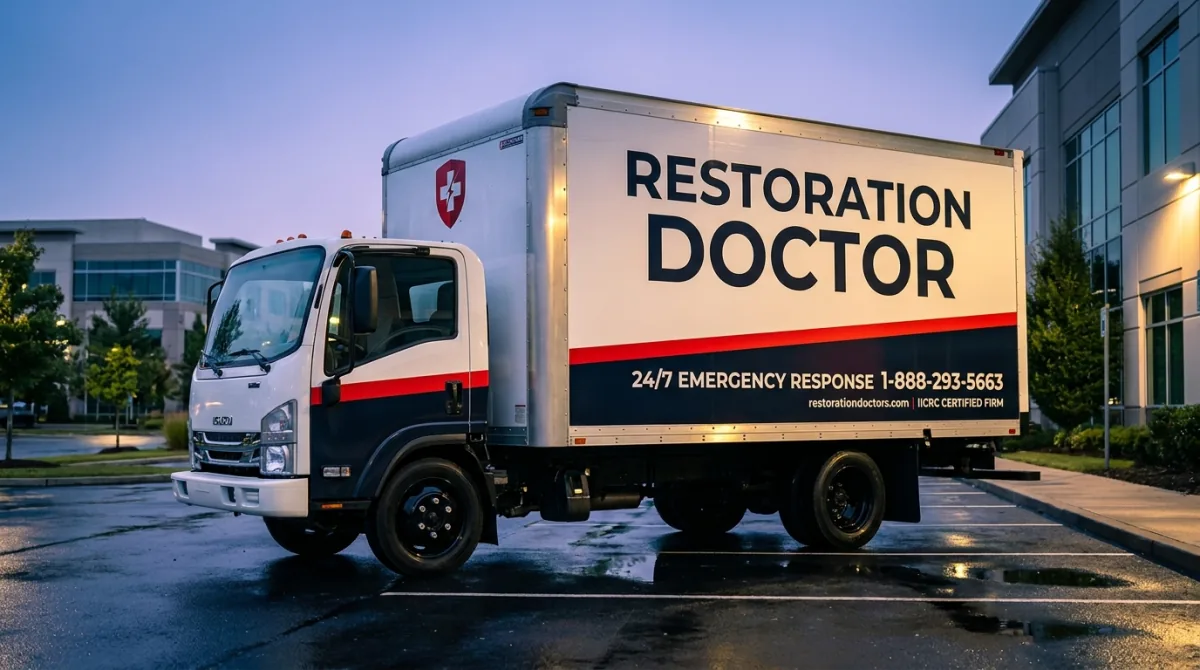
The equipment box truck rolls behind the first-response van once a loss is confirmed to need a full structural dry-out, and it carries the volume of equipment a multi-room project actually requires — not a token unit or two.
Onboard is a bank of LGR (low-grain refrigerant) and desiccant dehumidifiers, sized and paired to the psychrometric conditions our technicians log at intake, plus a run of axial air movers positioned per IICRC S500 drying-chamber principles rather than scattered by guesswork. HEPA air scrubbers travel on the same truck, filtering airborne particulate down to 0.3 microns whenever a loss carries mold risk, soot, or Category 2/3 water contamination.
These trucks are the reason a Restoration Doctor dry-out holds to a documented psychrometric plan instead of drifting: the equipment specified at the walk-through is the equipment on site within the hour, matched to the room count and saturation class of the actual loss, not a fixed kit.
- LGR and desiccant dehumidifiers, sized to psychrometric readings
- Axial and centrifugal air movers, positioned per IICRC S500 drying-chamber principles
- HEPA air scrubbers (0.3-micron filtration) for mold, soot, and Category 2/3 water projects
- Antimicrobial application equipment for containment and post-remediation treatment
- Backup power and extension distribution for structures without usable power
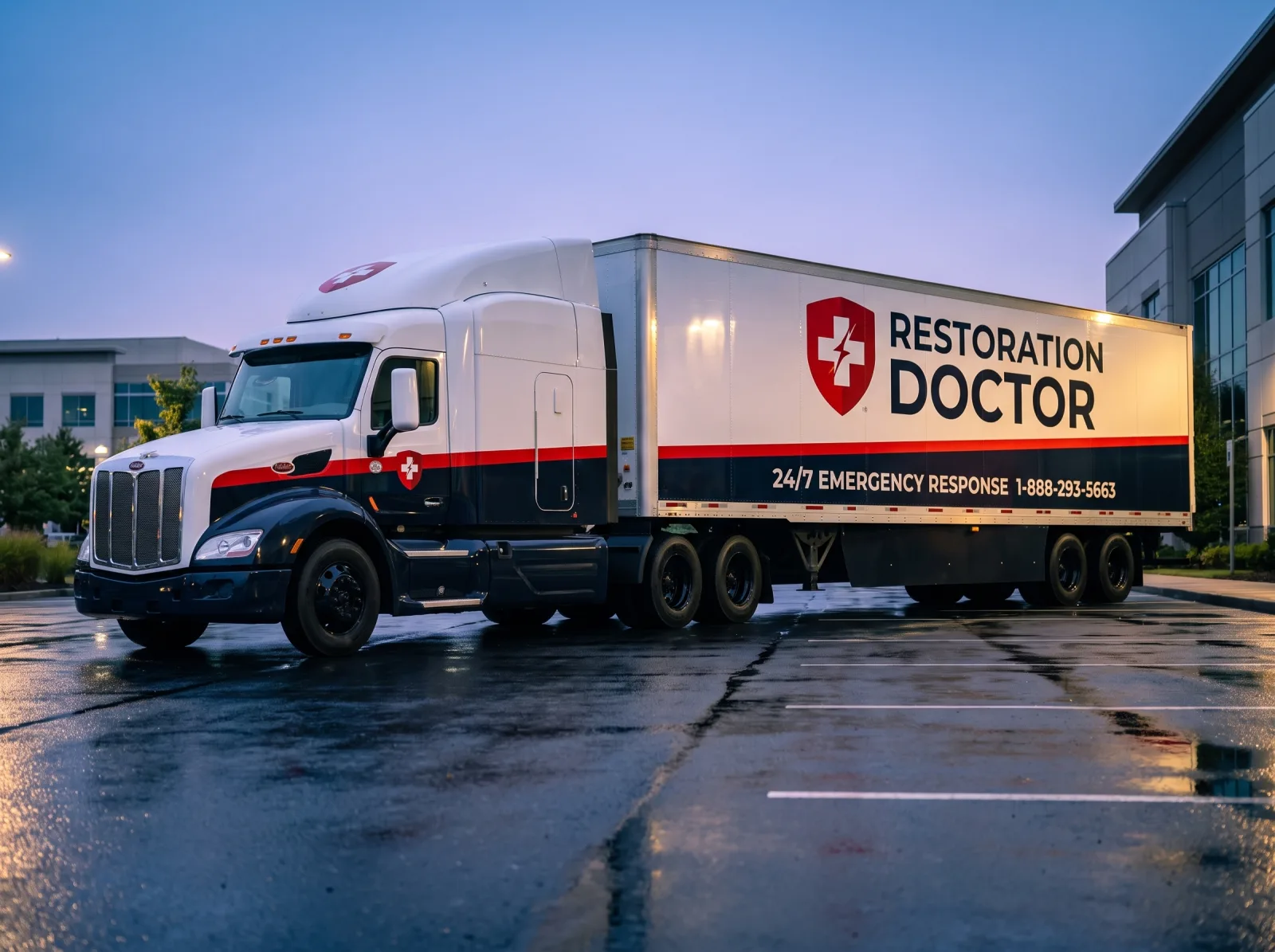
Large-Loss Response
A diesel tractor pulling a 40-ft trailer is the surge asset behind the vans and box trucks — the unit that turns a commercial building, an apartment complex, or a multi-property storm event from an overwhelming loss into a managed one. It carries bulk quantities of the same equipment classes running the daily van and box-truck fleet: dozens of air movers, a bank of high-capacity dehumidifiers, and HEPA filtration sized for open commercial floor plates rather than residential rooms.
Large-loss response is also a staffing and logistics problem, not only an equipment one. The trailer travels with the fuel, power distribution, and consumables to keep a crew self-sufficient on a job site for days, so Restoration Doctor can surge technicians to a single address without stripping equipment away from every other active project across Northern Virginia.
This tier exists because the company capitalizes its own fleet rather than renting equipment ad hoc for large projects. Owning the trailer and the equipment inside it means a large loss gets staffed and equipped on the same response timeline as a single-room project — no waiting on a rental company's availability while a commercial building sits wet.
- High-volume air mover and dehumidifier reserves for open commercial floor plates
- Bulk HEPA filtration for large-footprint air scrubbing
- Self-sufficient power, fuel, and consumables for multi-day deployments
- Surge crew staging without pulling equipment from active residential projects
Why we own the fleet instead of renting it
Every vehicle and every piece of drying, extraction, and air-quality equipment described on this page is owned and capitalized in-house — not rented per project, not subcontracted, and not shared across a franchise network. That distinction shows up directly in response speed and in equipment availability: a company that rents equipment for large losses has to wait on a rental counter's stock; a company that owns its fleet dispatches from its own staging.
It also shows up in maintenance and readiness. Vans and box trucks are inspected and restocked between calls, dehumidifiers are serviced on a rotation rather than run until they fail mid-project, and thermal imaging cameras are calibrated equipment, not a one-time purchase from years ago. When a company invests this deeply in its own fleet, it is a signal about how it plans to operate for the long haul — not just the next call.
That in-house capitalization is also what makes the 10,000+ completed-projects figure possible at the current 47-minute median arrival: the fleet exists to be staged ahead of demand across Northern Virginia, Maryland, and Washington, D.C., not scaled up reactively after a storm.
When a company invests this deeply in its fleet, it’s because it plans to be here for decades. We’re built for the long haul — and for the next 60 minutes.
Restoration Doctor
Frequently asked
Active water, mold, fire, or sewage event?
Connect directly with the Restoration Doctor team for your region. Crews are on standby 24/7 with documented response protocols.