
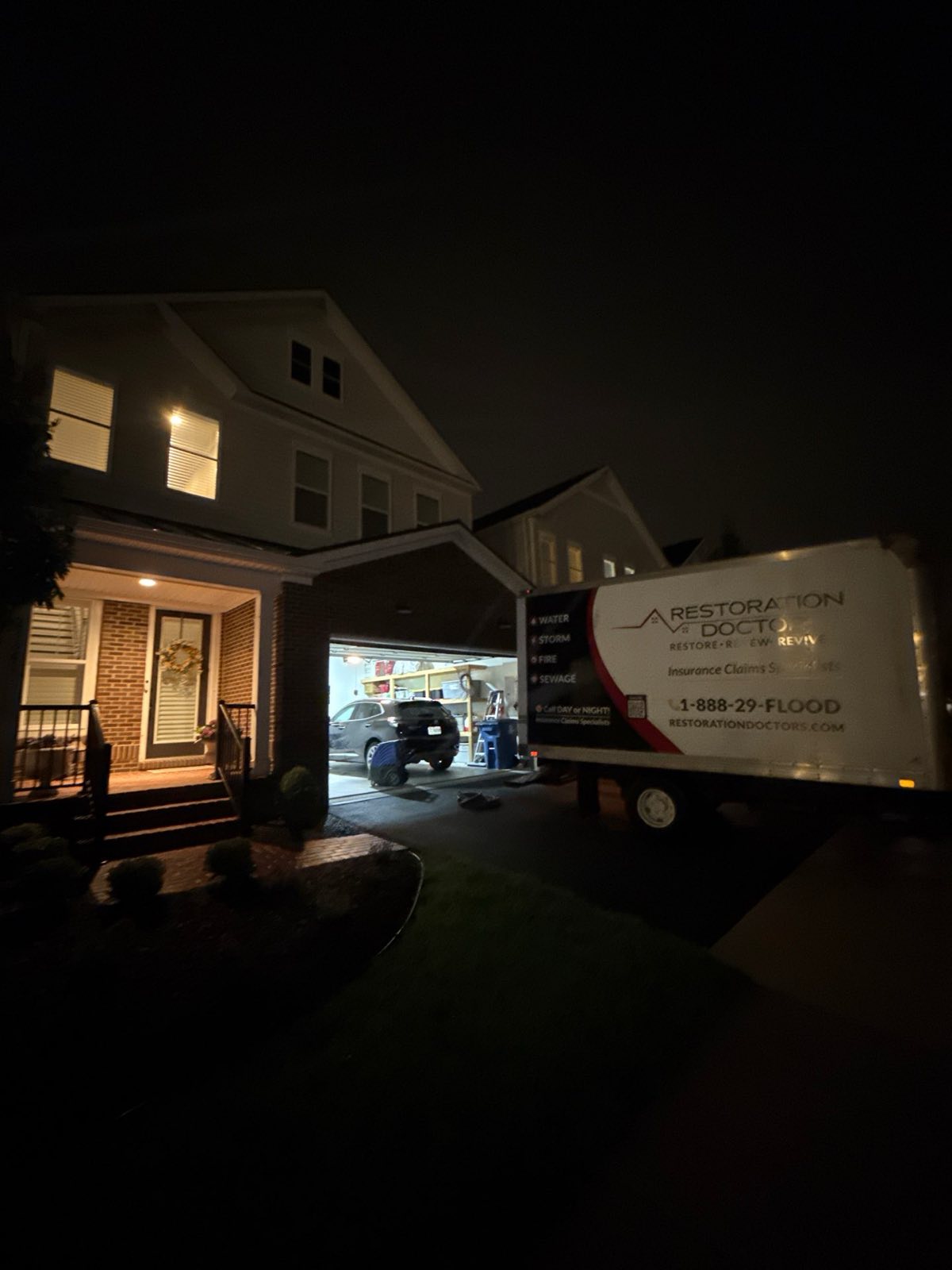
Water Damage Restoration in Ashburn, VA
Water damage restoration in Ashburn, VA is largely a story about newer homes failing in ways their owners never expected. Ashburn grew explosively from the 1990s through the 2010s into one of Loudoun County's signature communities — Ashburn Village, Ashburn Farm, Broadlands, and Brambleton are full of large HOA-governed single-family homes and townhomes, most sitting on expansive finished basements with sump pumps. Homeowners assume a newer house is a low-risk house, but a burst supply line, a failed water heater, or a cracked appliance fitting floods a two-year-old basement just as fast as a fifty-year-old one. Restoration Doctor answers those calls across Ashburn 24/7, dispatching from nearby Vienna with rapid response into Loudoun.
The pattern in Ashburn is specific: sprawling finished basements are the dominant loss driver, and they depend on sump pumps to stay dry against Broad Run, Goose Creek, and the community stormwater ponds that thread through these planned neighborhoods. Add the dense townhome stock, where water migrates between shared walls, and the commercial exposure of 'Data Center Alley,' and Ashburn's risk profile is its own thing entirely. We built this page for Ashburn homeowners and property managers because a generic regional pitch tells you nothing about how water actually moves through a 2005 Brambleton colonial with a 2,000-square-foot finished basement.
Whatever the source — a supply line you just found leaking behind new drywall or storm water rising in a basement at 2 a.m. — the response is the same discipline: stop the source, extract before it soaks deeper into a big finished basement, dry to a verified standard, and document every step for your carrier. Here is how that plays out across Ashburn's newer homes and sprawling basements.
| Metric | Value | Notes |
|---|---|---|
| Median on-site arrival time | 47 minutes | Measured median arrival across dispatched emergency projects — the middle value, not an average. Distinct from the 60-minute response SLA below. |
| Restoration projects completed to date | 10,000+ | Aggregate count of completed restoration projects to date across the VA / MD / D.C. tri-state service area. |
| Customers who file through insurance | 83% | Share of CUSTOMERS who use insurance. Restoration Doctor works for the homeowner — you pay us directly, and we build a carrier-ready claim file documented to IICRC S500 with a line-item Xactimate estimate, which you submit to your insurer when you seek reimbursement. |
| Average structural dry-out time | 4.5 days | Average time to bring a structure to documented dry standards; monitored daily with moisture readings. Individual projects vary by saturation class. |
| Emergency response SLA (NoVA core) | 60 minutes | The PROMISED response commitment across the NoVA core — a broader guarantee than the measured 47-minute median arrival. |
| Google rating (live) | 4.9★ | 4.9★ is the verified average. The review count changes nightly and is served live at /api/reviews-summary — never hardcoded. |
How water damage behaves in Ashburn
Sprawling finished basements on sump pumps
The large finished basement is the defining feature of the Ashburn home and the defining challenge of Ashburn water restoration. These are big spaces — often the size of a small house on their own — and they depend on a sump pump to hold back the groundwater that Loudoun's soil and high water table push against the foundation. That sump is a single point of failure. When the power blips during a storm and the battery backup is dead, or the pump wears out, groundwater seeps in through the foundation across a wide footprint, and water that has moved through soil is Category 2, not clean water. We treat those losses accordingly, with proper extraction, selective removal, and antimicrobial treatment rather than a quick mop-and-fan.
When the loss is a clean-water plumbing failure, the size of the basement works against you: water spreads fast across a large finished level, wicking up into drywall, saturating carpet pad, and soaking the bottom plates of framed walls before anyone catches it. We extract quickly and set a properly sized drying system — enough air movers and high-capacity dehumidification to dry a large footprint on schedule — then monitor daily until the structure hits verified dry standards. Under-equipping a big Ashburn basement is how a manageable claim becomes a mold claim two weeks later.
Broad Run, Goose Creek, and community stormwater ponds
Ashburn's planned communities are laced with stormwater management ponds, and the whole area drains toward Broad Run and Goose Creek. In heavy rain, that engineered drainage can be overwhelmed, and homes downslope of a pond or near the drainage corridors take on storm water from the outside, under pressure, while the rain is still falling. Because so much of Ashburn is newer construction on graded lots, a marginal grade or a clogged area drain can channel surface water straight toward a foundation and into a basement that a plumbing repair will never protect.
When we scope an Ashburn basement, we first determine whether the water is a plumbing failure, a stormwater and groundwater event, or both — because a storm intrusion needs the grade, drainage, and sump system addressed and needs treating for the category of water that entered, not just a dehumidifier in the corner. Getting that diagnosis right early is what keeps a wet Ashburn basement from growing mold behind its finished walls.
Townhome migration and the newer-construction failure pattern
Ashburn's dense townhome communities turn one failure into a shared problem. When a supply line or appliance hose lets go in one unit, water finds the fastest path down through the subfloor and joist bays and frequently migrates through the party wall into the adjoining home, soaking multiple levels and two households at once. We use thermal imaging and moisture meters to trace the water across units rather than guessing from the visible stain, then dry cavities in place wherever we can and open only what genuinely has to come out.
The broader Ashburn lesson is that newer does not mean safe. The failures we respond to most here are fittings, valves, appliance connections, and water-heater tanks in homes barely old enough to have needed a first repair — the kind of losses that catch homeowners off guard precisely because the house is new. We scope each one for what it actually is and document it cleanly for the carrier, including for the HOA-governed common elements a townhome loss often touches.
Ashburn homes and how they fail
Ashburn's housing stock is young by Northern Virginia standards and remarkably uniform in its risk. The large HOA communities — Ashburn Village, Ashburn Farm, Broadlands, Brambleton, Loudoun Valley Estates, and Belmont Country Club — were built out mostly between the mid-1990s and the 2010s as big single-family homes and townhomes with expansive finished basements. Those basements, built out into media rooms, gyms, guest suites, and home offices, are the single most common site of serious water loss in Ashburn, and because they are large, a failure down there can put water across a lot of square footage very quickly. Newer construction does not mean water-proof construction — it means modern PEX and copper plumbing that still fails at fittings, and appliance and supply-line connections that let go without warning.
The townhome is the other defining Ashburn building type, concentrated heavily across these communities and in newer high-density mixed-use at One Loudoun and along the Silver Line. In an attached home, a washing-machine hose, water-heater failure, or upstairs bathroom leak in one unit sends water straight down and often through the shared wall into the neighbor's living space, turning a single failure into a multi-unit loss. And because Ashburn is the heart of 'Data Center Alley,' the area carries significant commercial water-loss exposure alongside its residential stock — a different scale of loss that still comes down to fast extraction and properly sized drying.
Ashburn neighborhoods we serve
Real Loudoun County communities — and the water losses we most often see in each.
1990s–2000s single-family homes and townhomes on large finished basements with sump dependence.
Established HOA community where finished-basement supply-line and sump losses are the dominant driver.
Newer single-family and townhome stock near community stormwater ponds and the Broad Run drainage.
2000s+ colonials and townhomes with large finished lower levels prone to fast-spreading clean-water losses.
Big HOA-governed homes on expansive basements where under-equipped drying risks hidden mold.
Higher-density mixed-use and townhomes near the Silver Line with shared-wall and stacked-unit water migration.
Documented Ashburn projects
Real CompanyCam-documented restoration work in this city — every project photographed with date and time stamps.
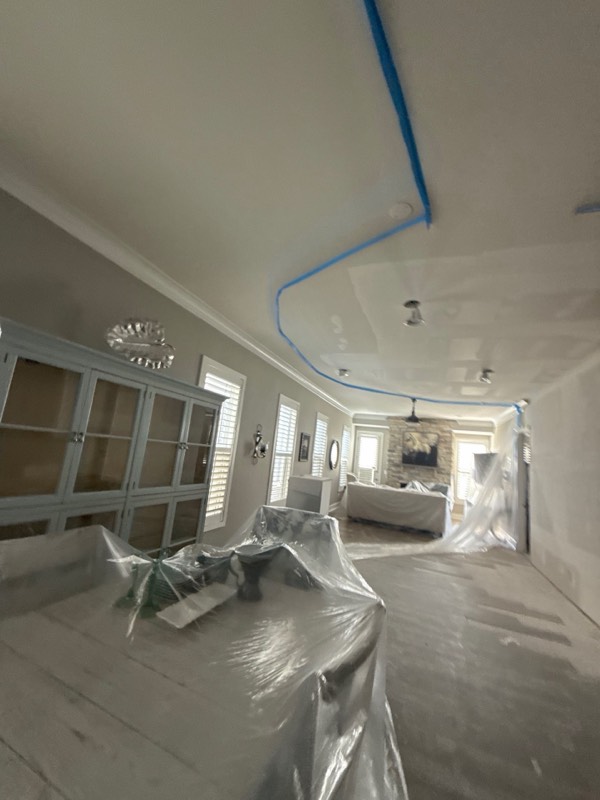
Emergency extraction & dry-out — Ashburn
High-volume truck-mount extraction and a staged drying system on a documented Ashburn water loss, sized to a large finished-basement footprint.
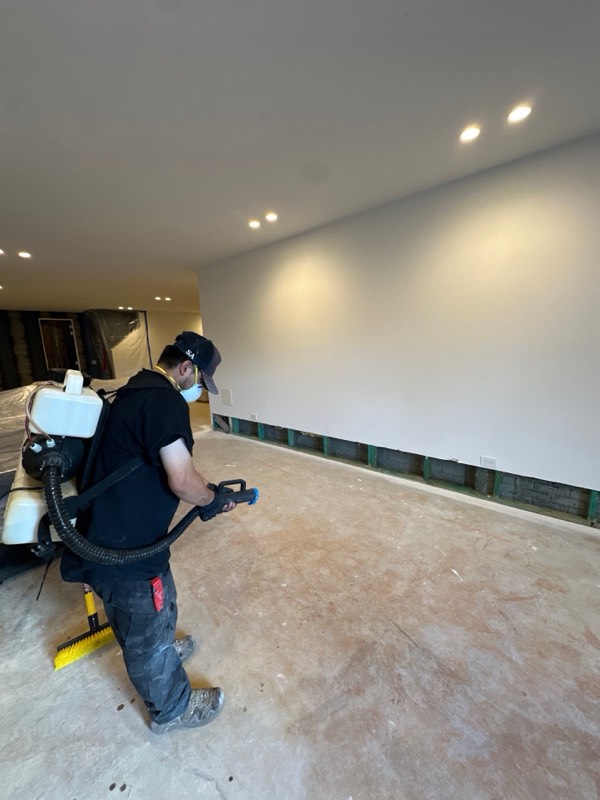
Flood cleanup & dehumidification — Ashburn
A documented Ashburn flood cleanup showing high-capacity dehumidification pulling moisture from a large finished lower level to a verified dry standard.
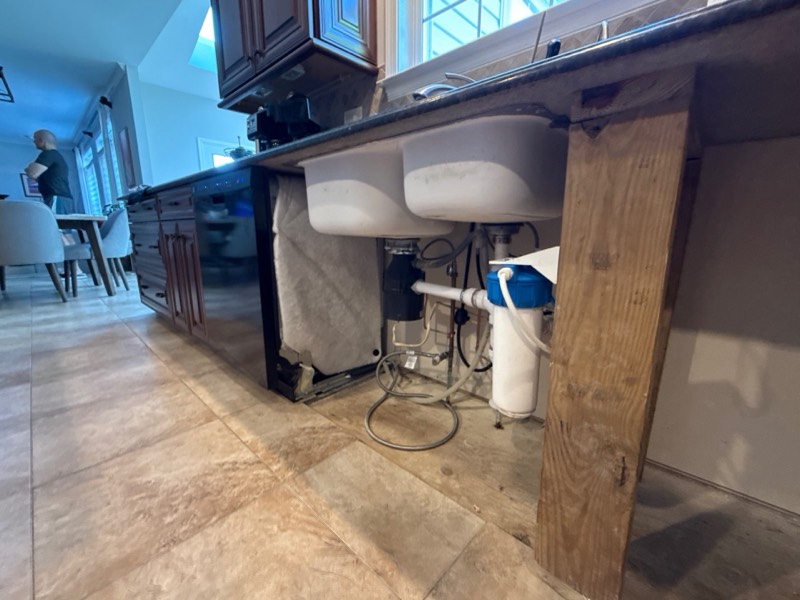
Flood-cut demolition & structural drying — Ashburn
Selective flood-cut demolition and structural drying on a documented Ashburn loss where saturated lower-wall assemblies had to be opened and dried.
Recent Ashburn water damage projects — on video
Real jobsite footage from documented restoration projects in this city — filmed by our crews, not stock.
Whole-Home Water Damage Turnaround in Ashburn
ASHBURN, VA · WHOLE-HOME WATER DAMAGE · DOCUMENTED ON SITE
Burst Pipe Floods an Ashburn Basement — Dried to the Standard, No Guesswork
ASHBURN, VA · WINTER SUPPLY-LINE BURST - FINISHED BASEMENT WATER DAMAGE (MITIGATION SCOPE) · DOCUMENTED ON SITE
Finished Basement Flood in Ashburn VA — Dried, Verified, Ready to Rebuild
ASHBURN, VA · FINISHED BASEMENT WATER DAMAGE · DOCUMENTED ON SITE
Finished Basement Flood in Ashburn VA — Whole Level Underwater, Dried & Verified In Place
ASHBURN, VA · FINISHED-BASEMENT FLOOD / STRUCTURAL WATER DAMAGE · DOCUMENTED ON SITE
Full restoration services in Ashburn
One operation covers every category — from emergency mitigation to full reconstruction.
Water Damage Restoration
Extraction, structural drying, and moisture verification for burst pipes, appliance leaks, and basement flooding.
Fire & Smoke Damage Restoration
Soot and smoke residue removal, odor neutralization, contents pack-out, and reconstruction after a fire.
Storm Damage Restoration
Emergency tarping, water extraction, and reconstruction after wind, hail, and heavy-rain storm events.
Mold Remediation
IICRC S520 containment, HEPA filtration, safe removal, and post-remediation clearance verification.
Sewage & Biohazard Cleanup
Category 3 black-water decontamination with full PPE, safe removal, antimicrobial treatment, and verification.
Odor Removal & Deodorization
Source-based smoke, sewage, mold, pet, and musty-odor removal using thermal fogging, hydroxyl and ozone treatment, and HVAC deodorization.
Reconstruction & Repairs
Drywall, flooring, cabinetry, trim, and paint — the same in-house crew that dried the loss rebuilds it, with no handoff between mitigation and reconstruction.
What Ashburn homeowners look for
Ashburn is a community of informed, connected homeowners who vet contractors through HOA boards, neighborhood groups, and online research before anyone gets a call. The reviews that carry weight here are specific: how fast a crew reached a flooded basement, whether a big finished lower level was dried with enough equipment to actually keep up, whether a shared-wall townhome loss was handled cleanly for both households, and whether the insurance file held together. Those are exactly the experiences we want documented by the homeowners who had them.
We keep our verified reviews and the true aggregate Google rating off this page and on a dedicated reputation hub instead. You can read them at RestorationDoctorsReviews.com and then return here to arrange service for your Ashburn home. Housing the ratings on a separate, source-linked hub is intentional: those are the genuine Google aggregates, not numbers inflated onto a landing page.
Frequently asked
Active water, mold, fire, or sewage event?
Connect directly with the Restoration Doctor team for your region. Crews are on standby 24/7 with documented response protocols.