Sewage Cleanup & Biohazard Decontamination in Northern Virginia, Maryland & Washington, DC
Category 3 black-water decontamination — safe removal, full PPE protocols, antimicrobial treatment, and verified structural drying after backups, overflows, and flooding.
| Metric | Value | Notes |
|---|---|---|
| Median on-site arrival time | 47 minutes | Measured median arrival across dispatched emergency projects — the middle value, not an average. Distinct from the 60-minute response SLA below. |
| Restoration projects completed to date | 10,000+ | Aggregate count of completed restoration projects to date across the VA / MD / D.C. tri-state service area. |
| Customers who file through insurance | 83% | Share of CUSTOMERS who use insurance. Restoration Doctor works for the homeowner — you pay us directly, and we build a carrier-ready claim file documented to IICRC S500 with a line-item Xactimate estimate, which you submit to your insurer when you seek reimbursement. |
| Average structural dry-out time | 4.5 days | Average time to bring a structure to documented dry standards; monitored daily with moisture readings. Individual projects vary by saturation class. |
| Emergency response SLA (NoVA core) | 60 minutes | The PROMISED response commitment across the NoVA core — a broader guarantee than the measured 47-minute median arrival. |
| Google rating (live) | 4.9★ | 4.9★ is the verified average. The review count changes nightly and is served live at /api/reviews-summary — never hardcoded. |
Sewage is a Category 3 health hazard, not a mess to mop
Sewage cleanup is fundamentally different from any other water loss, and treating it like a bad spill is dangerous. Under IICRC S500, sewage is Category 3 water — 'black water' — grossly contaminated and capable of carrying bacteria, viruses, and other pathogens, including E. coli, salmonella, hepatitis, and parasites. A backed-up main, an overflowed toilet reaching the floor, or floodwater that has run through streets and soil all fall into this category, and every one of them turns your home into a contaminated environment that requires trained decontamination, not a mop and a bucket.
The urgency is both biological and structural. Pathogens multiply quickly in warm indoor conditions, and the porous materials sewage touches — carpet, pad, drywall, insulation, particleboard — absorb contamination that cannot be washed back to a safe condition. The right response is fast professional decontamination with proper protective equipment; the wrong response is a homeowner wading in with household cleaner and exposing themselves and their family to a genuine health risk.
Containment, PPE, and safe removal
Our crews arrive in full personal protective equipment appropriate to a Category 3 environment and establish containment so contamination doesn't track through the rest of the home. As with any hazardous work, we isolate the affected area and control the air so aerosolized contaminants aren't spread by foot traffic or the HVAC system.
Removal is aggressive and non-negotiable on the porous materials. Sewage-saturated carpet, pad, drywall, insulation, and similar absorbent materials are removed and disposed of as contaminated waste under documented handling — they cannot be reliably decontaminated in place and are not worth the health risk of trying. Standing sewage and solids are extracted, and the structure is stripped back to cleanable, non-porous surfaces so the decontamination that follows can actually reach every affected area.
Decontamination, drying, and verification
Once contaminated materials are out, the salvageable structure — framing, concrete, subfloor — is cleaned and treated with EPA-registered antimicrobial agents to eliminate the pathogen load, following the IICRC S500 decontamination protocol. HEPA air filtration runs throughout to capture airborne contaminants, and every affected surface is addressed rather than spot-treated.
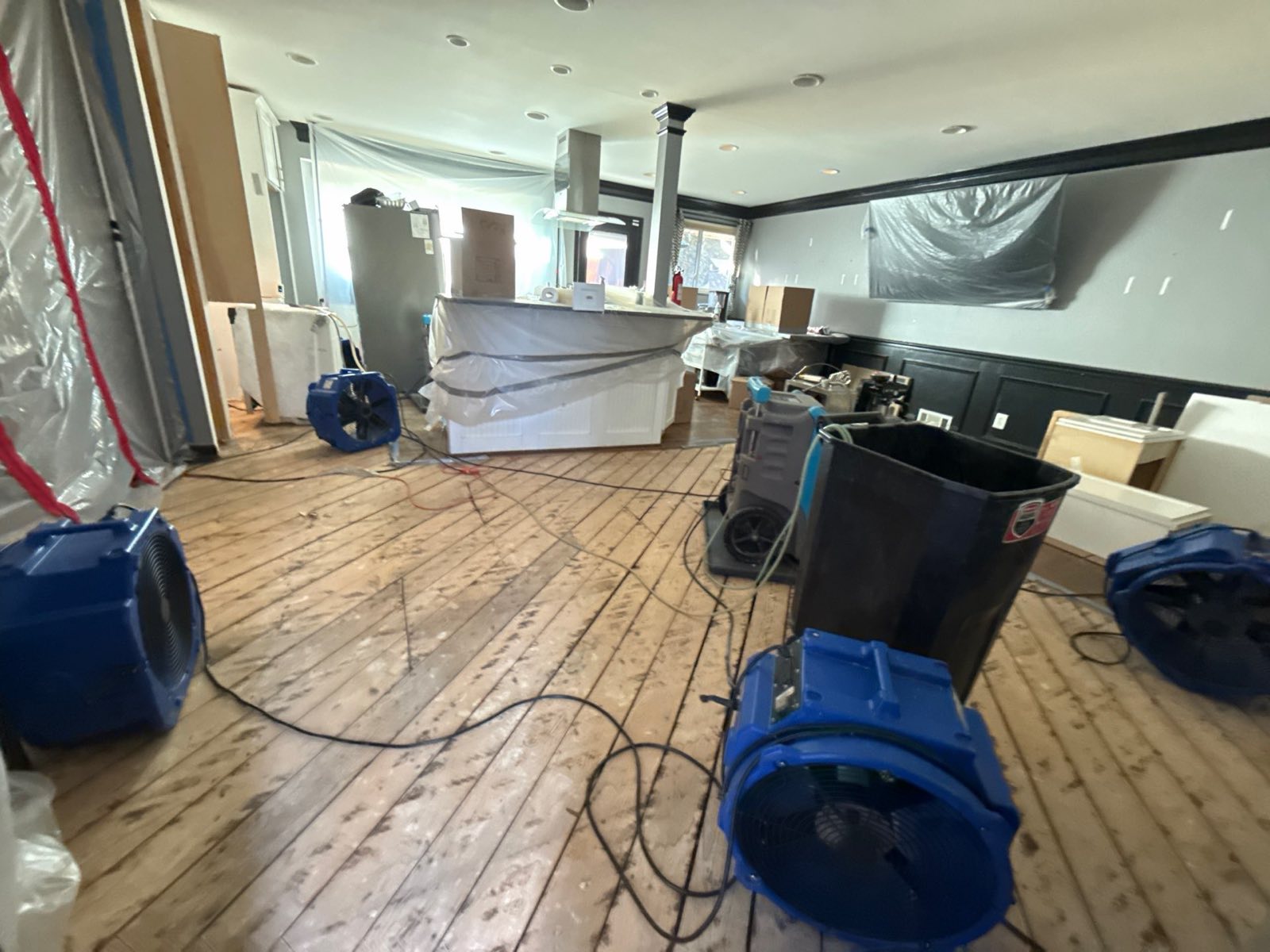
Then, exactly as with a clean-water loss, the structure has to be dried. Decontaminated but damp materials will grow mold and hold odor, so we deploy air movers and dehumidifiers and monitor moisture to documented dry standards. The project is done when the area is decontaminated, structurally dry, and verified safe — with the process, disposal, and antimicrobial treatment documented so there's a clear record that the space was returned to a sanitary condition.
Rebuild and one accountable operation
A sewage loss usually removes real building material — flooring, the bottom courses of drywall, insulation, sometimes cabinetry — which all has to be replaced once the space is clean and dry. Because Restoration Doctor carries licensed plumbing, carpentry, and full reconstruction in-house, we can correct the failure that caused the backup, decontaminate and dry the structure, and rebuild the finishes under one operation and one claim.
Every phase is photographed in CompanyCam and estimated in Xactimate with the notes carriers expect, so the decontamination, disposal, drying, and reconstruction reconcile into a single clean file. Sewage is one of the few losses where doing it right the first time is genuinely a health matter — so it's not a project to hand to the lowest bidder or to tackle yourself.
Backups, overflows, and how they happen in NoVA
Sewage losses in Northern Virginia tend to arrive by a few recognizable routes, and knowing the cause shapes both the cleanup and the coverage conversation. The most common is a main sewer-line backup: a blockage downstream — tree roots invading an older clay or cast-iron lateral, accumulated grease, or a municipal main surcharging during heavy rain — forces waste back up through the lowest drains in the house, usually a basement floor drain, shower, or toilet. Older Fairfax and inner-suburb neighborhoods with mature trees and aging laterals are especially prone to root intrusion, which grows slowly for years and then blocks the line entirely.
Other frequent culprits include a failed ejector or sump pump in a below-grade bathroom, a toilet overflow that reaches the floor and spreads, and combined storm-and-sewer surcharge during the intense downpours our summers deliver. Each of these is a Category 3 event the moment waste reaches living space, regardless of how small the visible mess looks — the contamination, not the volume, defines the hazard.
A word on safety while you wait for our crew: keep people, and especially children and pets, out of the affected area entirely, and do not run water or flush toilets that drain toward the backup, which only adds to the volume. If the backup is near electrical outlets or a panel, and you can safely reach the breaker, cutting power to the affected area is wise. Then call us. Category 3 cleanup is genuinely not a DIY project — the right answer is professional decontamination with the equipment and protective protocols the hazard demands, and the sooner it starts, the smaller the loss stays.
There is also a prevention side worth raising once the immediate crisis is decontaminated. A single main-line backup is often the first visible symptom of a lateral that has been slowly failing — roots that will grow back, a bellied or cracked clay pipe, or a section of old cast iron scaling shut. Clearing the blockage stops today's flood, but a camera inspection of the line is what tells you whether it will happen again next season, and homeowners are frequently glad to learn the underlying condition rather than be surprised by a repeat event. For below-grade bathrooms served by an ejector pump, and for basements relying on a sump, a working battery backup and a maintenance check before storm season are inexpensive insurance against exactly the failures that produce these losses.
Finally, a note on coverage, because it catches many homeowners off guard: standard homeowners policies commonly exclude sewer and drain backup unless you carry a specific water-and-sewer-backup endorsement, and even then there is often a sublimit. We cannot change your policy after the fact, but we can document the cause, category, and full scope thoroughly so that whatever coverage does apply is supported cleanly — and so you have a clear, itemized record of a health-hazard loss that was returned to a verified sanitary condition.
Frequently asked
Active water, mold, fire, or sewage event?
Connect directly with the Restoration Doctor team for your region. Crews are on standby 24/7 with documented response protocols.