Odor Removal & Deodorization in Northern Virginia, Maryland & Washington, DC
Source-based deodorization for smoke, sewage, mold, pet, and water-damage odors — we remove what's causing the smell instead of masking it, then verify the air is genuinely clean.
| Metric | Value | Notes |
|---|---|---|
| Median on-site arrival time | 47 minutes | Measured median arrival across dispatched emergency projects — the middle value, not an average. Distinct from the 60-minute response SLA below. |
| Restoration projects completed to date | 10,000+ | Aggregate count of completed restoration projects to date across the VA / MD / D.C. tri-state service area. |
| Customers who file through insurance | 83% | Share of CUSTOMERS who use insurance. Restoration Doctor works for the homeowner — you pay us directly, and we build a carrier-ready claim file documented to IICRC S500 with a line-item Xactimate estimate, which you submit to your insurer when you seek reimbursement. |
| Average structural dry-out time | 4.5 days | Average time to bring a structure to documented dry standards; monitored daily with moisture readings. Individual projects vary by saturation class. |
| Emergency response SLA (NoVA core) | 60 minutes | The PROMISED response commitment across the NoVA core — a broader guarantee than the measured 47-minute median arrival. |
| Google rating (live) | 4.9★ | 4.9★ is the verified average. The review count changes nightly and is served live at /api/reviews-summary — never hardcoded. |
An odor is a physical thing — you can't perfume it away
Odor removal in Northern Virginia is one of the most misunderstood parts of restoration, because a smell feels like it should be an easy fix — spray something pleasant and the problem is gone. It never works that way, and the reason is simple: an odor is not an atmosphere, it is matter. Every persistent smell in a home is a stream of actual molecules being released from an actual source — soot embedded in drywall, bacteria in a soaked subfloor, mold colonizing the back of a baseboard, urine salts crystallized deep in a pad. As long as that source keeps shedding molecules, your nose keeps detecting them. Cover it with fragrance and you have simply added a second smell on top of the first; the moment the fragrance fades, the original odor is exactly as strong as it ever was.
That is why real deodorization is a removal problem, not a covering problem, and why it belongs to the same discipline as the rest of restoration. The professional standard, rooted in IICRC methodology, follows a fixed logic: identify the source, remove or clean the source material, treat any residue that cannot be removed, and only then address the airborne and absorbed odor that remains. Skipping straight to the 'treat the air' step — the mistake nearly every DIY attempt makes — is why odors come roaring back after a rain, a humid week, or the first time the furnace kicks on. Restoration Doctor treats odor as the measurable, physical condition it is, and we do not consider a space deodorized until the smell is gone at normal humidity with no masking agent running.
The odors we remove and where they come from
Smoke and fire odor is the most stubborn we handle. A fire drives combustion byproducts — soot, char, and volatile compounds — deep into drywall, insulation, framing, soft goods, and the HVAC system, and the smell can persist for months because the source is embedded in porous material rather than sitting on the surface. Protein fires, the low-flame kitchen fires where food scorches, are worse in one respect: they leave little visible residue but produce an acrid, greasy, remarkably penetrating odor that coats everything and resists ordinary cleaning. Both require source cleaning first and then true deodorization, not just wiping down what you can see.
Sewage and biohazard odor is the second family. A Category 3 backup, an unnoticed drain leak, or a decomposition event leaves bacteria and organic residue in porous materials, and the smell is both offensive and a marker that contamination is still present. The odor here is inseparable from the decontamination — you cannot deodorize a surface that is still biologically active, so removal of contaminated material and antimicrobial treatment always come before the air is addressed.
Mold, musty, and VOC odors make up the third family, and they are the ones homeowners most often try to live with. That damp, earthy basement smell is not cosmetic — it is microbial VOCs given off by active mold and mildew, which means the odor itself is evidence of a moisture problem and ongoing growth. Deodorizing without finding the water source and removing the colony is pure theater; the smell returns with the next humid stretch because the mold never left.
The fourth family is pet, biological, and decomposition odor — urine, feces, and organic breakdown. Pet urine is uniquely difficult because it soaks through carpet into the pad and subfloor and crystallizes into salts that reactivate and smell every time humidity rises, which is why surface cleaning a carpet does nothing for a urine problem the way removing and sealing the affected substrate does. The fifth family is the plain mustiness that follows any water-damage event: when materials stay damp even briefly, bacteria and mold begin producing that stale, closed-up smell, and the deodorization is really just the final confirmation that the structure was dried properly. In every one of these cases the smell is a symptom, and our job is to find and eliminate what is producing it.
How professional deodorization actually works
The first and most important step is not a machine — it is source removal and cleaning. Before any deodorizing technology comes out of the truck, we find and eliminate the material producing the odor: extract and dry residual moisture, remove sewage-soaked or mold-colonized porous materials, HEPA-vacuum and wash down soot, and pull up urine-saturated pad and subfloor. A very large share of an odor is gone the moment its source is physically removed, and every technology that follows works dramatically better once the source load is down. Anyone who leads with fogging or ozone before cleaning the source is doing it backwards.
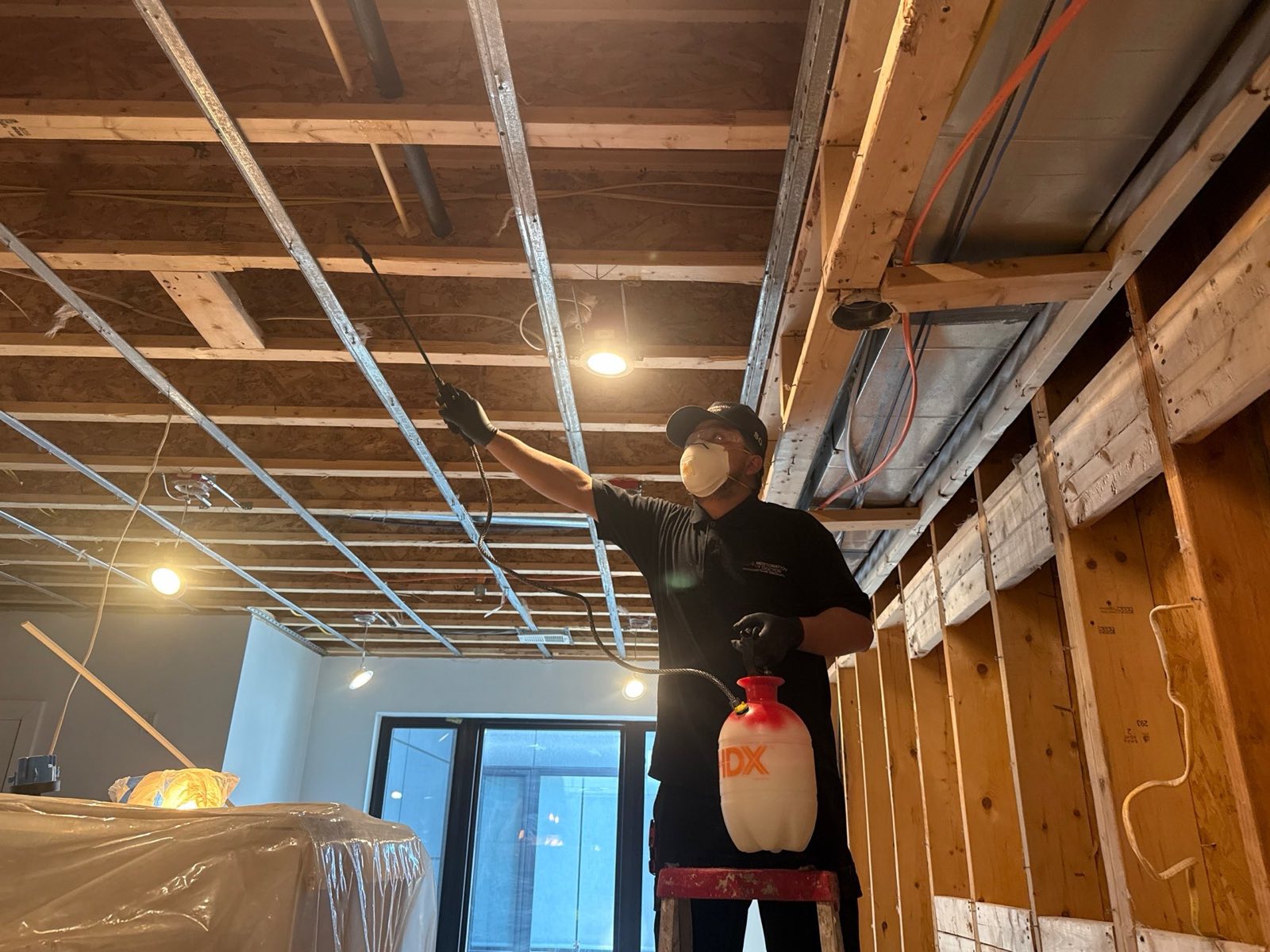
With the source handled, we match the deodorizing method to the odor. Thermal fogging is used on smoke odor in particular: a deodorizer is heated into a dense fog of microscopic particles that follow the same paths the smoke took — into cracks, wall cavities, and porous surfaces — and chemically pair with the odor molecules to neutralize them where a surface spray can never reach. Hydroxyl generators produce hydroxyl radicals that break down odor compounds through oxidation; because they are safe to run in occupied spaces, they are our workhorse for multi-day treatment of smoke, mold, and organic odors while the rest of the work continues around them.
Ozone treatment is the strongest airborne tool we carry, and also the one that demands the most care. Ozone oxidizes odor molecules extremely effectively — but ozone is a respiratory irritant, so it is used only in fully unoccupied, sealed spaces, with people, pets, and plants removed for the duration, followed by a mandatory aeration period before anyone re-enters. Used correctly on the right project it is powerful; used carelessly it is a genuine safety hazard, which is exactly why the consumer 'ozone in a can' and mini-generator approach is both ineffective and risky. Alongside these we run activated-carbon and HEPA air scrubbing to physically pull odor-bearing particulate and gases out of the air, we seal odor-bearing surfaces such as framing and subfloor with specialized encapsulants where the source cannot be fully removed, and we clean and treat the HVAC system and ductwork so the air handler stops recirculating and re-depositing the smell throughout the home. Most real projects combine several of these in sequence rather than relying on any single silver bullet.
Why DIY air fresheners and ozone cans fail
Almost everyone tries the consumer route first, and it is worth understanding precisely why it disappoints. Plug-in fresheners, sprays, scented candles, and 'odor eliminator' aerosols are masking agents: they add a stronger, more pleasant smell that your brain notices instead of the underlying one. They do nothing to the source molecules, so they must run continuously, and the day they run out the original odor is fully intact. Worse, on a smoke or sewage project the fragrance simply layers over the real smell and produces a strange, cloying combination that is arguably harder to live with than the odor alone.
The retail 'ozone' and off-brand generator products fail for a different reason. Genuine ozone deodorization works, but it depends on achieving a sufficient concentration in a sealed, unoccupied space for a controlled period and then aerating fully — a protocol a small plug-in device cannot deliver, and one that is unsafe to attempt in a space where people are living and breathing. So the consumer version is the worst of both worlds: too weak to actually oxidize an embedded odor source, yet still an irritant if overused. The deeper problem with every DIY approach is that it starts at the wrong end of the process. It reaches for the air before touching the source, when the entire professional logic is source-first. Until the soot is cleaned, the wet material is dried and removed, the mold colony is remediated, or the urine-soaked substrate is pulled and sealed, no amount of fogging, fragrance, or ozone will hold — the smell has a supply, and it will keep coming.
A documented process — and the insurance angle
Because deodorization is invisible when it is done right — the proof is the absence of a smell — documentation matters more here than almost anywhere else in restoration. On every odor project we record the source we identified, the materials removed, the cleaning and antimicrobial steps performed, and the specific deodorization methods and equipment used, all photographed in CompanyCam with time stamps. That record does two things: it gives you verifiable evidence that the odor was addressed at its source rather than covered, and it turns an intangible result into a defensible line item.
That last point is the insurance angle. Odor removal is rarely a standalone claim; it is almost always part of a larger covered loss — the deodorization phase of a fire, the final step of a sewage decontamination, or the odor component of a water or mold project. When a fire or water loss is covered, the reasonable cost of returning the property to a pre-loss, odor-free condition is generally part of that same claim, and a scope that documents the deodorization as a distinct, justified activity within the loss is one an adjuster can approve without pushback. We estimate it in Xactimate with the line-item notes carriers expect and hand you a carrier-ready claim file — we work for you, not your carrier — and which you submit to your insurer when you seek reimbursement.
And because Restoration Doctor carries mitigation, cleaning, contents handling, and full reconstruction in-house, the deodorization is never handed to a separate vendor who shows up after the fact with a fogger and no context. The same operation that removed the soot, dried the structure, or decontaminated the backup also owns the odor result — which is the only way to guarantee the smell was solved at the source and not simply perfumed over on the way out the door.
Frequently asked
Active water, mold, fire, or sewage event?
Connect directly with the Restoration Doctor team for your region. Crews are on standby 24/7 with documented response protocols.