
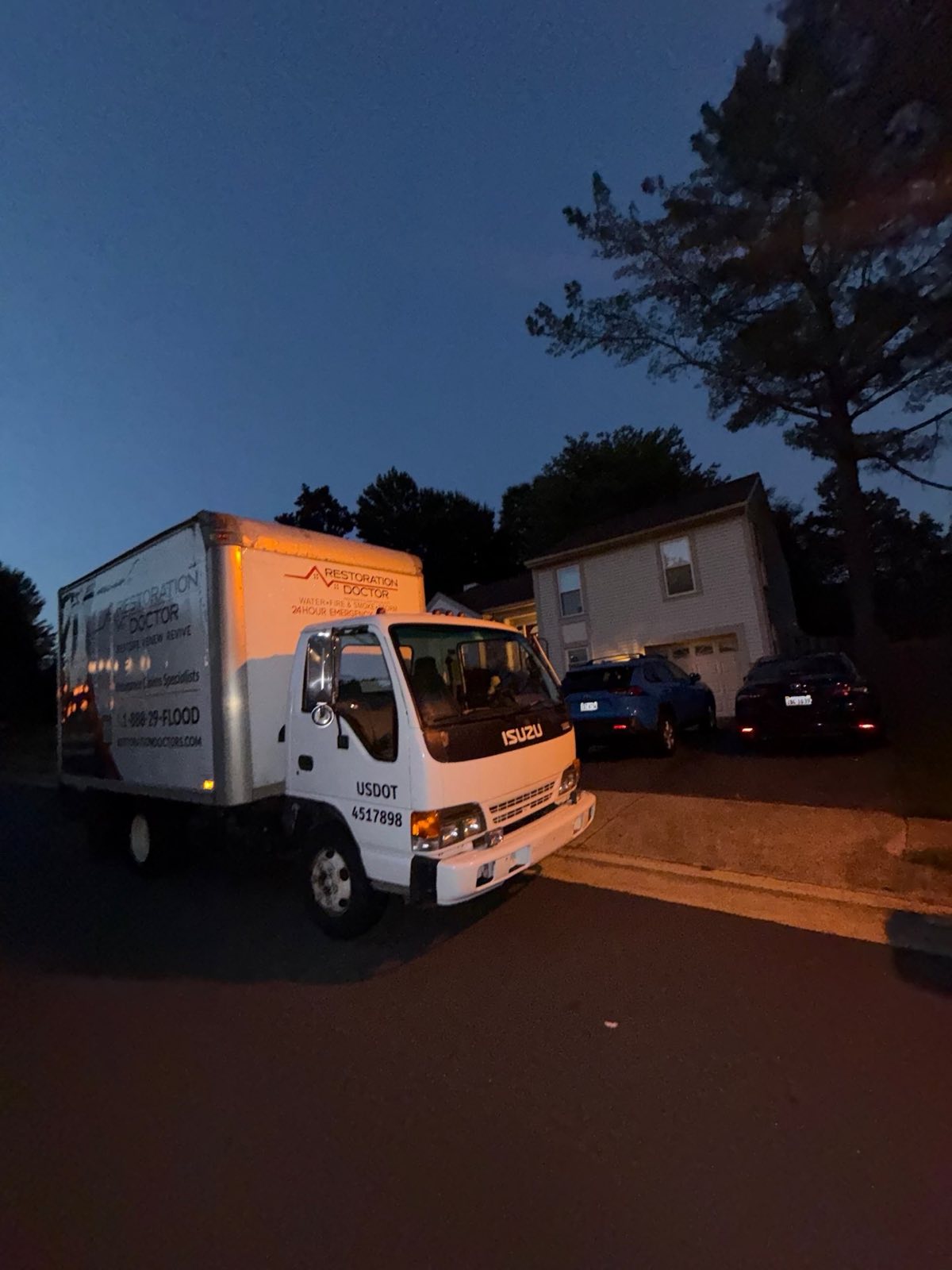
Water Damage Restoration in Centreville, VA
Water damage restoration in Centreville, VA carries a risk most of Northern Virginia doesn't: real flooding, not just plumbing failures. Centreville sits against Bull Run, with Cub Run and Big Rocky Run threading through it, and Bull Run has a serious, documented flood history — a designated FEMA flood zone where storm-driven water comes over the ground and into homes, not just out of a pipe. Layer that on top of the everyday supply-line, water-heater, and sump-pump failures that hit any 1980s–90s subdivision, and Centreville's losses run the full range from a clean second-floor leak to a Category 3 flood full of ground contaminants. Restoration Doctor answers those calls across Centreville 24/7, with crews staged nearby for a fast on-site response.
The community layout shapes the work. Centreville is a dense mix of single-family homes and attached townhomes in large planned HOA communities — Little Rocky Run, Virginia Run, Sully Station, Compton Village, Singleton's Grove — most with finished basements sitting at the lowest point of the house. In the townhome clusters, a loss rarely stays in one unit: water from an upstairs bathroom or a failed appliance travels through shared walls and down into a neighbor's ceiling, so one household's leak becomes two households' claim.
This page is written for Centreville specifically — its Bull Run flood-zone exposure, its townhouse-and-single-family mix, and the distinction between clean plumbing water and contaminated flood water — because a home in the Bull Run flood plain needs a different classification, a different scope, and different documentation than a townhouse that simply sprang an upstairs leak, and treating them the same is how a Category 3 event gets under-scoped.
| Metric | Value | Notes |
|---|---|---|
| Median on-site arrival time | 47 minutes | Measured median arrival across dispatched emergency projects — the middle value, not an average. Distinct from the 60-minute response SLA below. |
| Restoration projects completed to date | 10,000+ | Aggregate count of completed restoration projects to date across the VA / MD / D.C. tri-state service area. |
| Customers who file through insurance | 83% | Share of CUSTOMERS who use insurance. Restoration Doctor works for the homeowner — you pay us directly, and we build a carrier-ready claim file documented to IICRC S500 with a line-item Xactimate estimate, which you submit to your insurer when you seek reimbursement. |
| Average structural dry-out time | 4.5 days | Average time to bring a structure to documented dry standards; monitored daily with moisture readings. Individual projects vary by saturation class. |
| Emergency response SLA (NoVA core) | 60 minutes | The PROMISED response commitment across the NoVA core — a broader guarantee than the measured 47-minute median arrival. |
| Google rating (live) | 4.9★ | 4.9★ is the verified average. The review count changes nightly and is served live at /api/reviews-summary — never hardcoded. |
How water damage behaves in Centreville
Bull Run and the flood plain: when the water comes from outside
Bull Run is the fact that sets Centreville apart. It has a documented history of serious flooding and a designated FEMA flood zone, so when a major storm system stalls over the watershed, water rises over the banks and moves overland into low-lying homes and townhome clusters. Flood water is not clean — it has traveled across ground, roads, and yards, picking up contaminants along the way — so it is classified as Category 3 blackwater from the moment it enters, and it has to be handled that way regardless of how clear it looks.
We scope a flood-plain loss differently from a plumbing leak: containment first, full extraction, removal and disposal of affected porous materials, antimicrobial treatment, and documented decontamination to IICRC S500 Category 3 standards. We also document the flood origin carefully, because whether a loss is covered by a homeowner's policy or an NFIP flood policy turns on that distinction — and getting the classification and paperwork right from day one is what keeps a Centreville flood claim from stalling.
Cub Run, Big Rocky Run, and sump-dependent basements
Away from Bull Run itself, Cub Run and Big Rocky Run flood their own low stretches, and the many finished basements in Centreville's subdivisions rely on sump pumps to hold groundwater back. When heavy rain overwhelms a pump, or a summer storm knocks out power to a home with a dead battery backup, groundwater seeps in through the foundation — a Category 2 event once the water has moved through soil, not a clean spill.
These basement losses reward speed and honest classification. We extract, remove what genuinely can't be saved, and apply antimicrobial treatment appropriate to the water class rather than defaulting to fans and hope. Because a finished Centreville basement combines below-grade exposure with drywall, carpet, and stored belongings, monitored in-place drying is what keeps a cool, slow-drying basement from turning into a mold problem two weeks later.
Townhome clusters and shared-wall losses
Centreville's dense townhome communities create a loss pattern that detached homes don't have: water that crosses between units. An upstairs bathroom overflow, a failed washing-machine hose, or a burst supply line in one townhome sends water through the party wall and down into the finished space of the unit next door or below, so a single failure can involve two or three households and, often, an HOA.
We handle these as the multi-party events they are — mapping the true moisture footprint across the shared assembly, drying each affected unit to a verified standard, and documenting the work cleanly so responsibility and coverage can be sorted out without guesswork. Coordinating the drying across attached units, rather than treating each in isolation, is what prevents moisture from lingering inside a shared wall and resurfacing as mold.
Centreville homes and how they fail
Centreville's residential stock is suburban and planned, built largely from the 1980s through the 1990s. The dominant communities — Little Rocky Run, Virginia Run, Sully Station, Compton Village, and Singleton's Grove — mix detached single-family colonials with large runs of attached townhomes, nearly all with basements and many finished into rec rooms, home offices, and guest space. That single-family-and-townhome blend is the defining feature: the same street network can hold a detached home with its own sump-dependent basement and a cluster of shared-wall townhomes where water crosses between units.
Two risk profiles sit on top of that stock. The first is ordinary aging: water heaters, appliance hoses, and supply lines from the original 1980s–90s build are now failing on schedule across whole subdivisions, and a subset of early-1980s homes carry failure-prone polybutylene supply lines. The second is location: homes and townhome runs near Bull Run, Cub Run, and Big Rocky Run sit in or near mapped flood plains, which means some Centreville properties face overland flooding and stormwater intrusion that has nothing to do with their plumbing and everything to do with the creek behind them.
Centreville neighborhoods we serve
Real Fairfax County communities — and the water losses we most often see in each.
Large planned community of single-family homes and townhomes with sump-dependent finished basements near the Big Rocky Run drainage.
Established 1980s–90s subdivision where aging supply lines and water heaters drive multi-level losses.
Dense mix of detached homes and townhome clusters where shared-wall leaks cross between attached units.
HOA community with finished basements exposed to storm seepage and sump-pump failures.
Townhome and single-family runs where upstairs-bathroom and appliance failures travel down through the structure.
Properties in and near the mapped FEMA flood zone facing overland, Category 3 flood exposure — not just plumbing losses.
Documented Centreville projects
Real CompanyCam-documented restoration work in this city — every project photographed with date and time stamps.
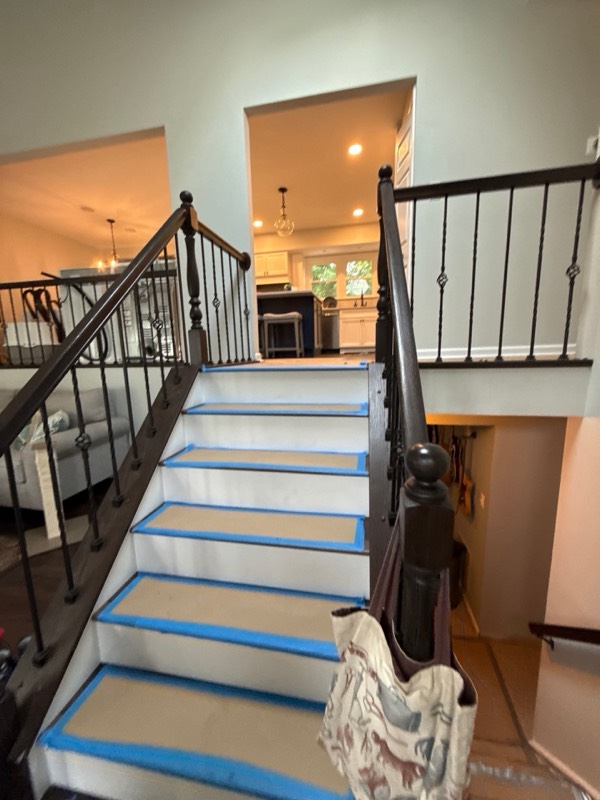
Emergency flood response & structural drying — Centreville
Emergency flood response with staged floor protection and structural drying through the home's stairs and main level on a documented Centreville water loss.
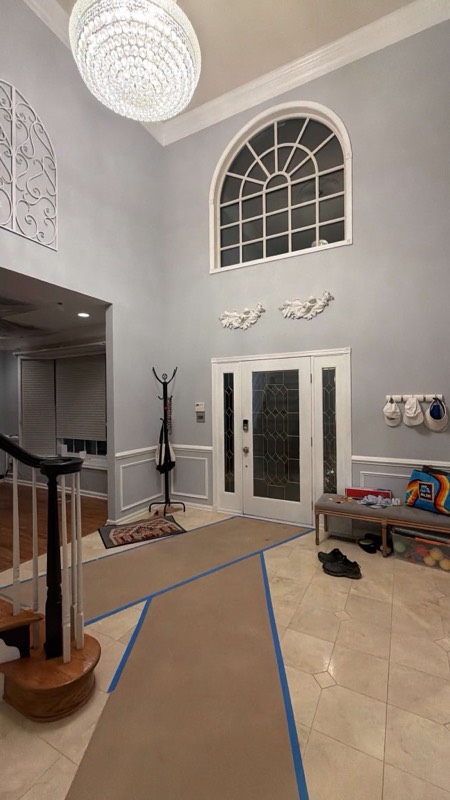
Residential water damage restoration — Centreville
A documented Centreville residential restoration showing floor protection and drying containment set up through a two-story foyer while the structure is dried to standard.
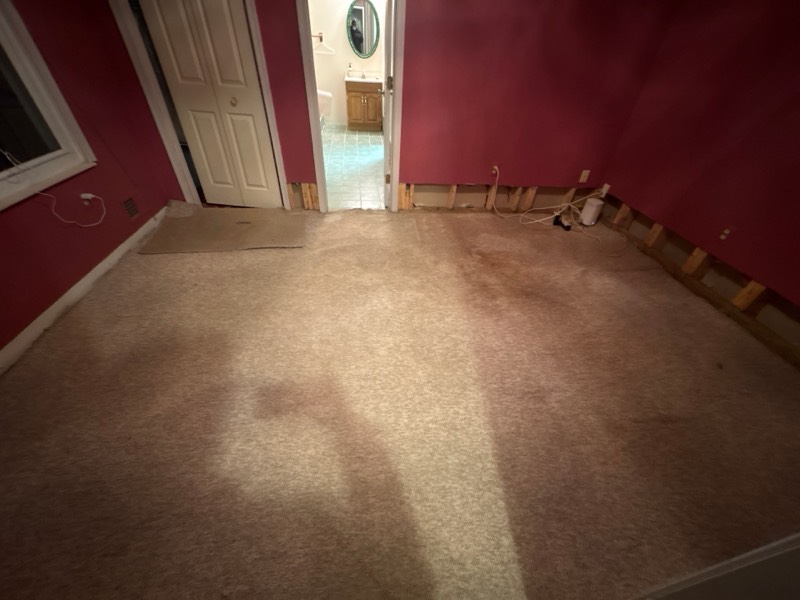
Thermal imaging & moisture inspection — Centreville
Thermal imaging used to map hidden moisture and guide structural drying on a documented Centreville-area water loss, so equipment is placed where the water actually went.
Recent Centreville water damage projects — on video
Real jobsite footage from documented restoration projects in this city — filmed by our crews, not stock.
Hidden Water Damage in Centreville, VA — The Honest Dry-Out
CENTREVILLE, VA · HIDDEN WATER DAMAGE — CATEGORY WATER INTRUSION, MITIGATION · DOCUMENTED ON SITE
Basement Water Heater Leak in Centreville VA — Dried and Verified
CENTREVILLE, VA · BASEMENT WATER HEATER LEAK · DOCUMENTED ON SITE
Ceiling Collapse in Centreville VA — Hardwood Dried In Place, Saved in 6 Days
CENTREVILLE, VA · UPPER-FLOOR WATER LEAK - CEILING COLLAPSE OVER DINING ROOM · DOCUMENTED ON SITE
Full restoration services in Centreville
One operation covers every category — from emergency mitigation to full reconstruction.
Water Damage Restoration
Extraction, structural drying, and moisture verification for burst pipes, appliance leaks, and basement flooding.
Fire & Smoke Damage Restoration
Soot and smoke residue removal, odor neutralization, contents pack-out, and reconstruction after a fire.
Storm Damage Restoration
Emergency tarping, water extraction, and reconstruction after wind, hail, and heavy-rain storm events.
Mold Remediation
IICRC S520 containment, HEPA filtration, safe removal, and post-remediation clearance verification.
Sewage & Biohazard Cleanup
Category 3 black-water decontamination with full PPE, safe removal, antimicrobial treatment, and verification.
Odor Removal & Deodorization
Source-based smoke, sewage, mold, pet, and musty-odor removal using thermal fogging, hydroxyl and ozone treatment, and HVAC deodorization.
Reconstruction & Repairs
Drywall, flooring, cabinetry, trim, and paint — the same in-house crew that dried the loss rebuilds it, with no handoff between mitigation and reconstruction.
What Centreville homeowners look for
In a community with real flood exposure, Centreville homeowners want to know a restorer can tell the difference between a clean leak and a Category 3 flood — and can document it well enough to keep a claim moving. The feedback that matters here speaks to correct water classification, fast response when a storm puts water in the basement, and paperwork that held up with both homeowner and flood carriers. Those are the experiences worth putting on record after a flood.
We keep our reviews off this page on purpose. You can read them on RestorationDoctorsReviews.com, where the aggregate Google rating is published straight from the source, then return here to arrange service for your Centreville home. Housing the ratings on a separate, source-linked hub is a deliberate honesty choice — the rating you see there is the true Google aggregate, not a number selected and reprinted to look good on a marketing page.
Frequently asked
Active water, mold, fire, or sewage event?
Connect directly with the Restoration Doctor team for your region. Crews are on standby 24/7 with documented response protocols.