
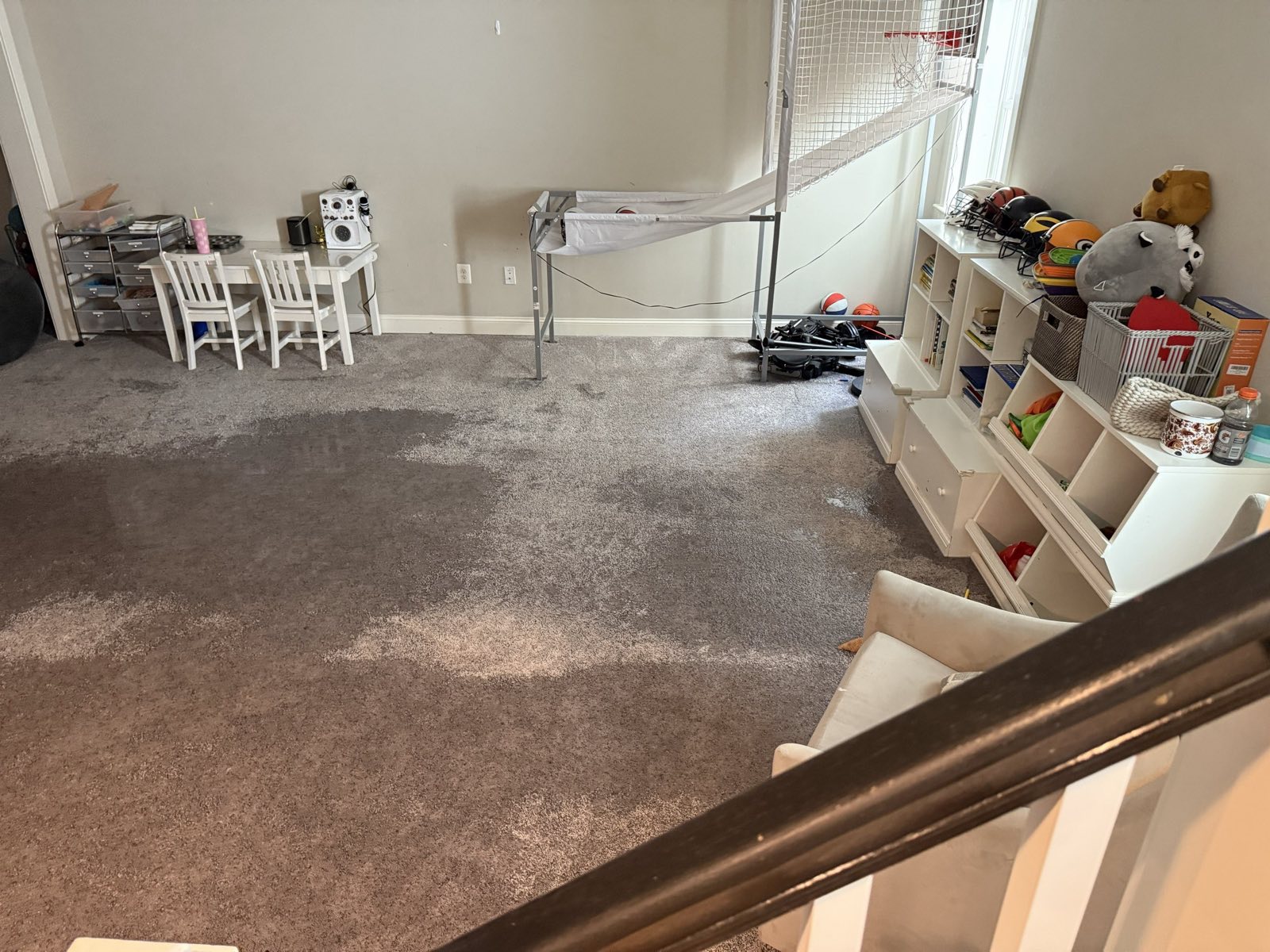
Water Damage Insurance Claims in Northern Virginia, Maryland & Washington, DC
We work for you, not the insurance company. You pay us directly, and we hand you a complete, carrier-ready claim file — documented to IICRC standards and delivered as a line-item Xactimate estimate your adjuster can review line by line — so your claim file is complete, while keeping your legal right to choose your own contractor.
Restoration Doctor handles water damage insurance claims across Northern Virginia, Maryland, and Washington D.C. by working for you — not your insurer. You pay us directly, and we build a complete claim file documented to IICRC S500 standards and delivered as a line-item Xactimate estimate, which you submit to your carrier when you seek reimbursement. About 83% of our customers file through insurance. Under Virginia Code §38.2-2115 (and the MD/DC equivalents) you have the legal right to choose us as your contractor — your insurer cannot require you to use its own vendor.
Who do you work for — me or my insurance company?
We work for you, not your insurance company. You pay Restoration Doctor directly for the work, and in return we hand you a complete, carrier-ready claim file — the IICRC-standard scope, the Xactimate estimate, the photos, and the daily moisture logs — so you have everything your insurer asks for when you seek reimbursement. We never invoice your carrier and we are not beholden to one; our only client is you, the homeowner.
Practically, that means once you file your claim and give us your claim number and adjuster's contact information, we document the loss in the exact format adjusters expect, and we are glad to explain our scope to your adjuster and to you in plain terms. About 83% of our customers go through insurance, so this is the path we run every day — the documentation, and the supplement paperwork when the hidden damage turns out to be larger than the first estimate, all assembled so the file you submit documents the full extent of the loss.
There is an important honesty note here. What your policy reimburses depends on your carrier and your coverage being confirmed. We will always tell you plainly if part of a scope is unlikely to be covered — for example, a pre-existing slow leak versus the sudden pipe burst that triggered the claim — so there are no surprises on the back end. Our job is to document the loss accurately, not to inflate it.
How we build a claim file your adjuster can verify
The single biggest reason water damage claims stall is weak documentation. An adjuster cannot approve what they cannot verify. A restoration company can dry your home perfectly and still leave you fighting your carrier if the scope arrives as a vague, unsupported invoice. We build every file to be approved on first review instead of kicked back for revisions.
Every project opens with an IICRC S500 inspection: we classify the water category (Category 1 clean, Category 2 gray, or Category 3 black water) and the saturation class, then map moisture room by room with pinless meters and thermal imaging. Our crews photograph every phase in CompanyCam with date and time stamps, keep a daily moisture log from a documented pre-drying baseline, and record the psychrometric conditions that justify the drying equipment on site.
We then write the estimate in Xactimate — the same platform your adjuster uses to price the loss — with line-item F9 notes explaining what was done and why. When a scope arrives as a proper Xactimate workfile with photo support, a moisture log, and equipment specifications, it is one an adjuster can approve without a revision cycle. Fewer revision cycles means your claim moves faster and your home gets rebuilt sooner. Across over 10,000 completed projects, this documentation discipline is the core of how we keep claims moving.
- IICRC S500 category and class classification, documented at intake
- Room-by-room moisture mapping with pinless meters and thermal imaging
- Date- and time-stamped CompanyCam photos of every phase
- Daily moisture logs against a documented pre-drying baseline
- Xactimate estimates with line-item F9 justification notes the adjuster can read
Xactimate: our estimating framework, not our standard of care
Xactimate is the industry estimating platform — the same software your carrier's own adjusters use to price property losses. We use it as a framework and a starting point: it is how we organize the loss into a line-item breakdown, room by room and task by task, and build the estimate that ultimately supports the final invoice for the work we perform in your home.
What Xactimate is not is a standard. It is not a standard of care, and it is not a price ceiling on what proper restoration costs. The standard of care — what work must be done, in what sequence, to what verified endpoint — comes from the ANSI/IICRC standards that govern professional restoration. Xactimate is simply the format we use to present that work so your adjuster can review it line by line, with F9 notes, photos, and moisture logs supporting every entry.
The distinction matters on your claim. When a scope is questioned, the answer is never 'because Xactimate says so' — it is the IICRC standard that required the work, documented in a format the carrier already speaks. Framework for the estimate; standards for the work.
The ANSI/IICRC standards we work to
The Institute of Inspection, Cleaning and Restoration Certification (IICRC) publishes the ANSI-accredited standards that define professional restoration in the United States. These — not any estimating platform — are the standards Restoration Doctor works to on every project, and the standards your claim documentation cites:
- ANSI/IICRC S500 — Standard for Professional Water Damage Restoration: water categories and classes, drying goals, and the moisture documentation behind every water loss
- ANSI/IICRC S520 — Standard for Professional Mold Remediation: containment, HEPA filtration, removal protocols, and post-remediation verification
- ANSI/IICRC S700 — Standard for Professional Fire and Smoke Damage Restoration: assessment, cleaning, and deodorization of fire and smoke losses
- ANSI/IICRC S740 — Standard for Professional Restoration of Fire and Smoke Damaged Household Textiles: evaluation and restoration of clothing and soft goods after a fire
How your deductible actually works
Your deductible is the fixed amount your policy makes you carry yourself before your insurance coverage begins, and it is set by your policy — not by us and not by your adjuster. It is not what you owe us. You owe us the whole invoice; the deductible is simply the slice of a covered loss your carrier will never reimburse you for, which is why the deposit we collect at signing is set to match it.
Two things surprise homeowners. First, the deductible applies once per claim, not per contractor or per phase — so paying it does not multiply as your loss moves from emergency mitigation into reconstruction under a single claim. Second, if the total covered loss comes in below your deductible, there is nothing for the carrier to pay, and filing may not make sense; we will tell you honestly when a small loss is likely to land under your deductible so you are not opening a claim for nothing.
Beware of anyone who offers to 'waive,' 'eat,' or 'rebate' your deductible. In Virginia, Maryland, and D.C., a contractor absorbing or paying your insurance deductible for you can constitute insurance fraud and is not something a legitimate, licensed restoration company will do. We collect your actual deductible, we document the real cost of the real work, and we keep your claim clean — which protects you as much as it protects us.
Your right to choose your own contractor
You choose who restores your home. Your insurance carrier may recommend a vendor from its 'preferred' or 'managed repair' program, but a recommendation is a suggestion, not a requirement — and the law protects your choice in every jurisdiction we serve.
In Virginia, Code of Virginia §38.2-2115 gives a policyholder the right to select the licensed contractor or repair firm of their choice to perform covered repairs, and prohibits an insurer from requiring that the work be done by a particular vendor as a condition of payment. Maryland provides the same protection: under Md. Code, Insurance §27-303 and related anti-steering provisions, it is an unfair claim settlement practice for an insurer to require you to use a specific repair vendor. In the District of Columbia, the Unfair Insurance Claims Settlement Practices provisions of the D.C. insurance code (Title 31) likewise bar an insurer from compelling you to use its designated contractor.
What this means in practice: a program vendor works to specifications set by the insurer, whose interest is holding cost down. An independent restoration contractor you hire directly works for you, documents the full extent of the loss, and advocates for a complete and correct scope. You can hire Restoration Doctor even if your adjuster names a different company first, and your carrier cannot penalize the claim for that choice. We are licensed and insured in all three jurisdictions — VA DPOR Class A, Maryland MHIC, and a D.C. Basic Business License — so your choice is always a fully credentialed one.
What to do — and photograph — before we arrive
The minutes right after you discover water shape both the size of the loss and the strength of your claim. If you can act safely, do these things while you wait for our crew — our median on-site arrival across Northern Virginia is 47 minutes, so it is a short window, but it matters.
Above all, document before you disturb. Your own photos of the water at its worst — before mitigation changes the scene — are some of the most persuasive evidence in a claim, because they establish the sudden, accidental nature of the loss that coverage turns on.
- Stop the source if it is safe: shut the fixture's supply valve or the home's main water valve
- Cut power to any wet area at the breaker if outlets, cords, or electronics are involved
- Photograph and video everything wet BEFORE you move or clean anything — wide shots and close-ups
- Capture the source of the water (the burst line, the failed appliance, the overflow) if you can see it
- Save the damaged item and any parts — a failed supply hose or valve is evidence, not trash
- Move small valuables and lift furniture off wet carpet if you can do so safely
- Write down when you found it and what you saw; keep receipts for anything you buy to mitigate
- Do NOT wait to 'see if it dries on its own' — call us and file your claim promptly
Should you even file a claim? An honest framing
About 83% of our customers go through insurance, and for most sudden water losses that is the right call — a burst pipe or a failed water heater in a finished basement routinely runs into five figures once you account for extraction, structural drying, and reconstruction, well above any normal deductible. When the covered cost clearly exceeds your deductible, filing protects you from absorbing a large loss out of pocket.
The remaining share pay out of pocket by choice, and that can be the smart move on a small, contained loss. If a minor leak is likely to land near or below your deductible, a claim may cost you more in the long run than it returns — and you keep your claims history clean. We will give you a straight assessment of the likely scope before you commit either way, because a company that files every loss regardless of size is not acting in your interest.
Whichever path you choose, the work and the documentation are identical. We dry your home to verified standards, we photograph and log every step, and we write a defensible Xactimate scope — so if you self-pay today and your carrier's position changes, or you sell the home and a buyer's inspector asks questions, you have a complete, professional record of exactly what happened and what was done.
We document the real cost of the real work and collect your actual deductible — no inflated scopes, no waived deductibles. That is not just ethics; in VA, MD, and DC it is what keeps your claim clean and legally sound. If any part of a scope is unlikely to be covered, you will hear it from us before the work starts.
Frequently asked
Active water, mold, fire, or sewage event?
Connect directly with the Restoration Doctor team for your region. Crews are on standby 24/7 with documented response protocols.