
Do fans help dry out water damage?
Fans help — but only as half of a system. Airflow speeds evaporation from wet surfaces, moving moisture into the air; without a dehumidifier removing that moisture, it simply redeposits onto cool surfaces and re-absorbs into materials elsewhere. Effective drying pairs directed airflow with active moisture removal in a closed space.
What fans actually do — and don't do
A fan doesn't remove water from a room; it relocates it. Blowing air across a wet surface strips away the boundary layer — the thin blanket of humid air that forms right at the surface and chokes off evaporation — so the material can keep releasing moisture at full rate. That's genuinely valuable: evaporation with strong airflow runs many times faster than evaporation into still air.
But every gram of moisture a fan liberates goes into the room's air, and it has to go somewhere. In a closed room with no dehumidification, humidity climbs until the air approaches saturation — at which point evaporation stalls no matter how hard the fans blow, and the airborne moisture starts condensing on cool surfaces (windows, slab floors, closet walls) and re-absorbing into dry materials like books, fabrics, and the unaffected side of the room. Fans alone can convert one wet floor into a whole damp room.
That's the core principle: airflow accelerates the transfer of moisture from materials to air; something else has to take it from the air out of the building. Drying is the pairing, not either half alone.
Fans plus dehumidifier: the system that works
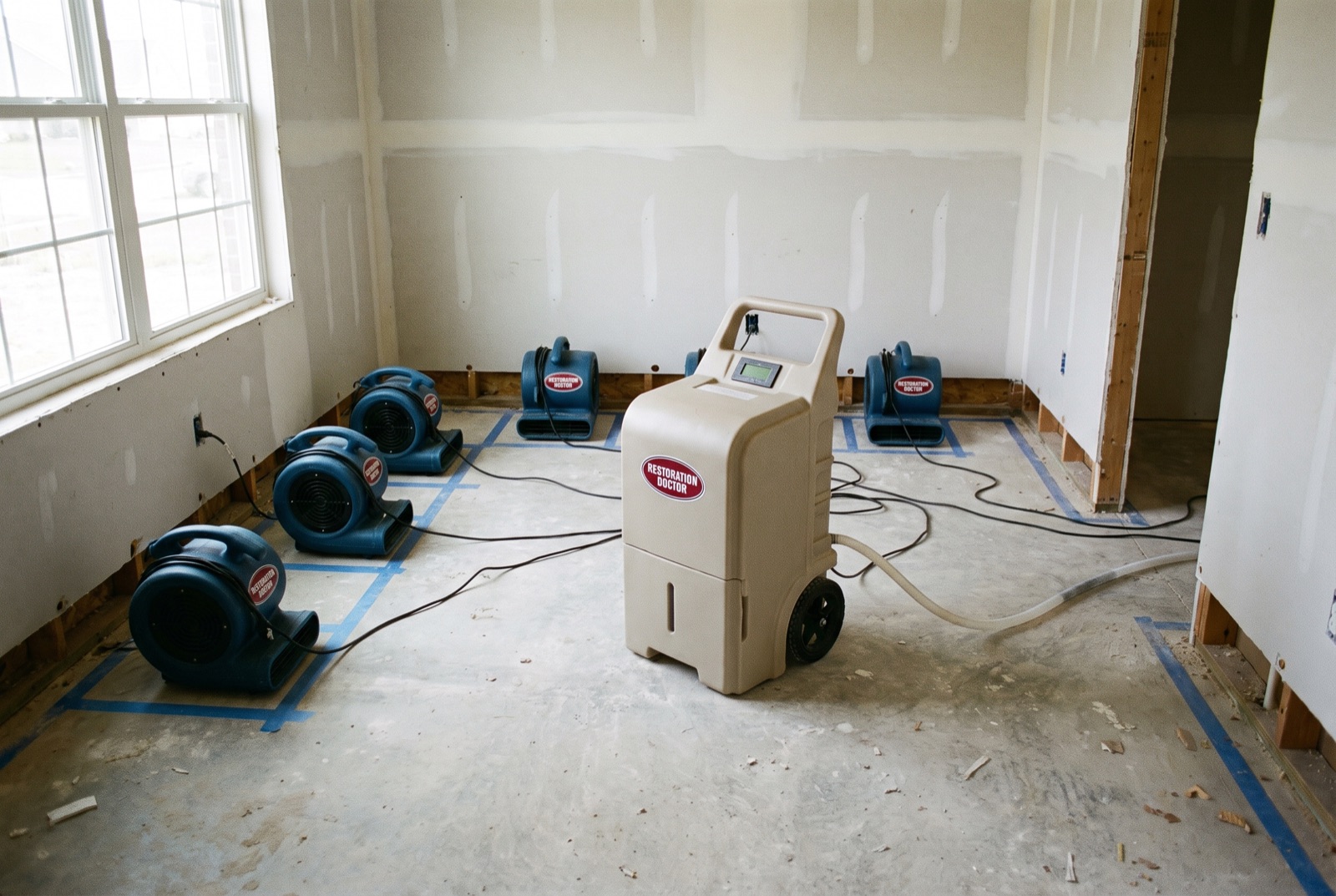
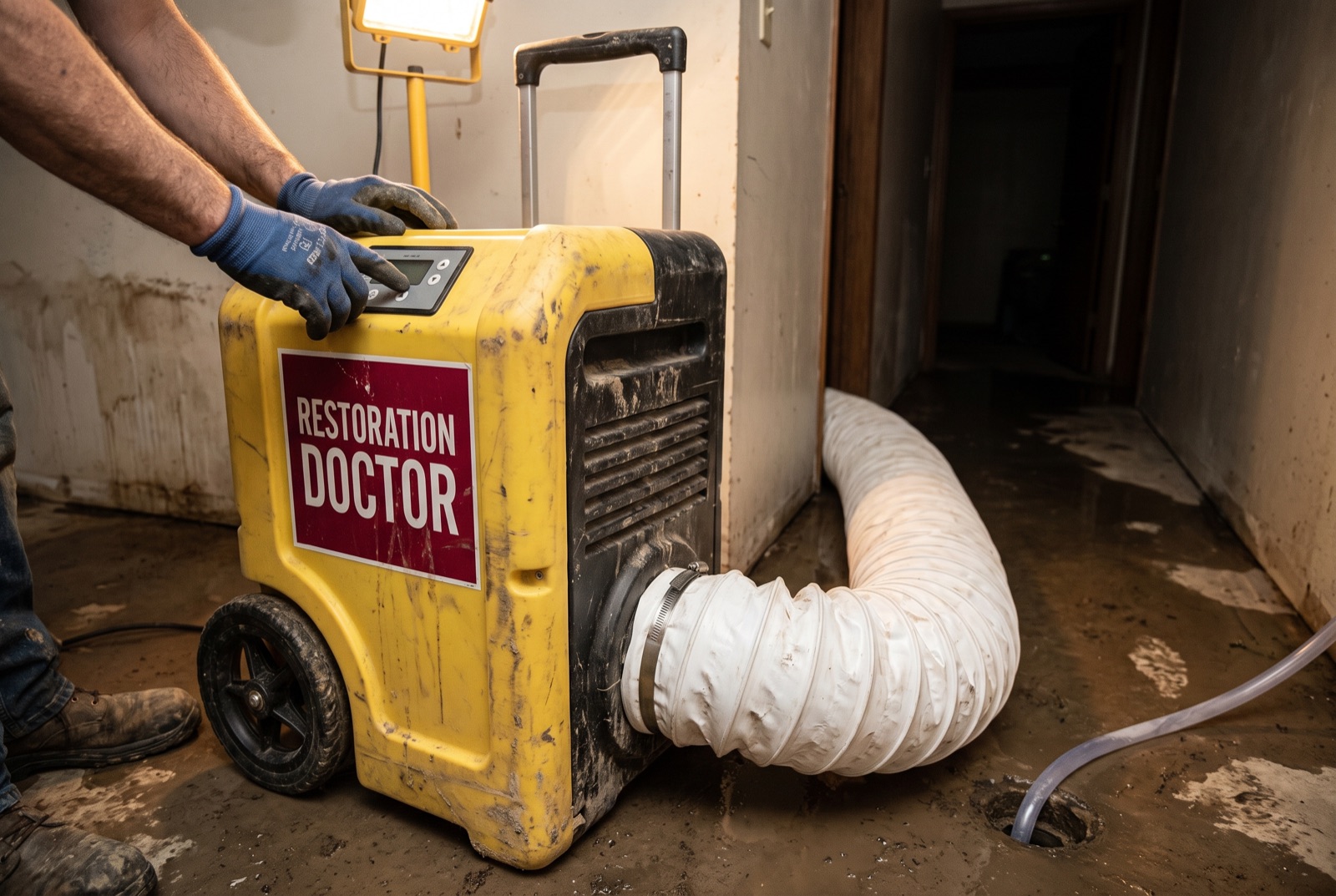
Add a dehumidifier and the picture changes completely. Now the fans keep evaporation running at maximum while the dehumidifier continuously pulls that moisture out of the air and drains it away — a conveyor belt from wet material to drain hose. Keep the room closed so humid outdoor air can't feed the system (a critical detail in the muggy Mid-Atlantic), and humidity drops steadily, the gradient stays steep, and materials genuinely dry.
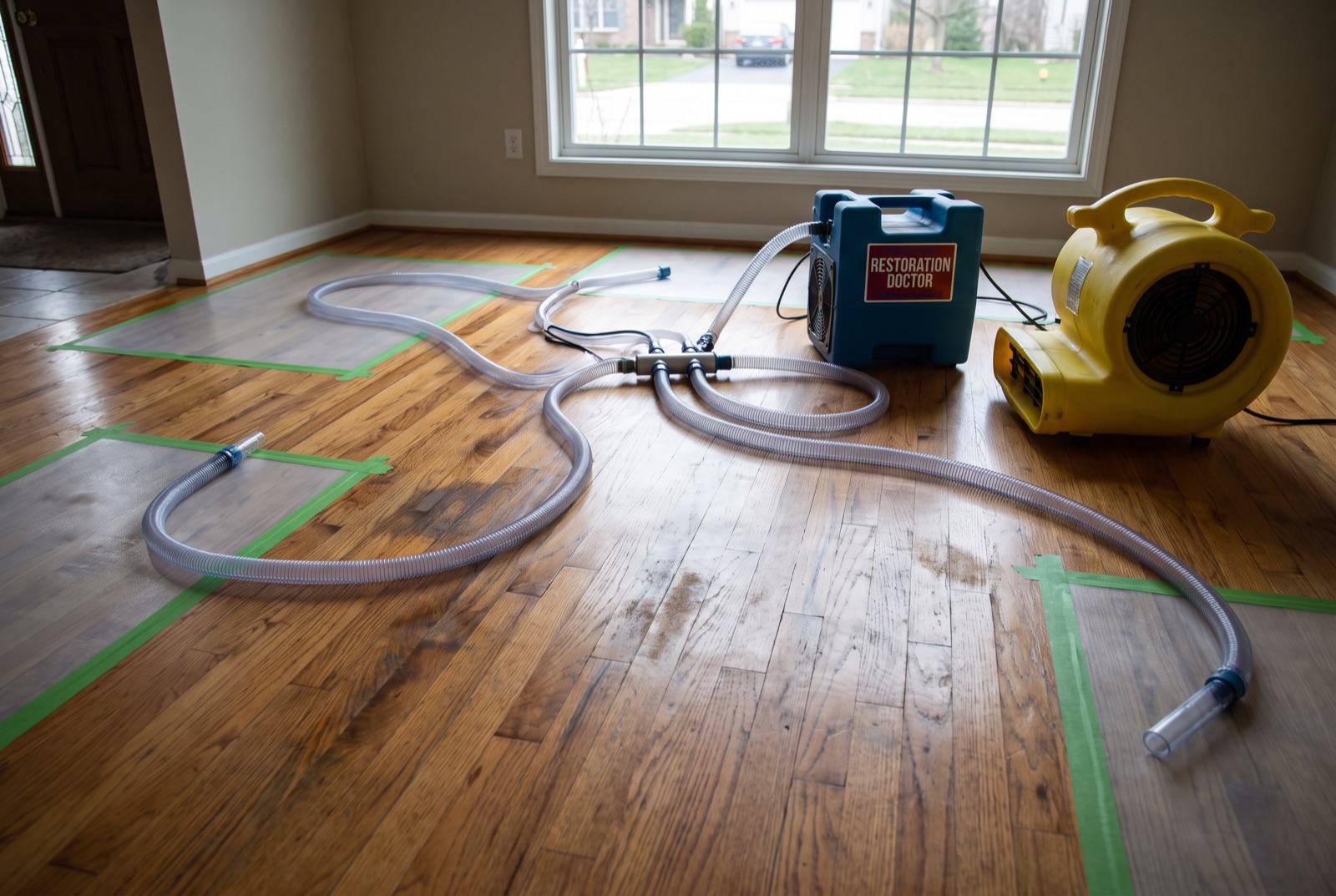
This is exactly the architecture of professional structural drying under the IICRC S500 standard, scaled up: commercial air movers — engineered to throw a focused, high-velocity air stream along floors and walls, several times more effective at boundary-layer stripping than a box fan — paired with low-grain refrigerant (LGR) dehumidifiers that keep extracting moisture even when the air is already quite dry, which is when the last bound water in drywall and framing comes out. Equipment counts are calculated to the affected square footage, and daily moisture readings confirm the system is winning.
Using household fans well while help is en route
Before a crew arrives — or on a genuinely small clean-water spill — household fans deployed thoughtfully do real good. Extract the liquid water first (towels, mop, wet-rated shop vac); fans should work on damp materials, not puddles. Aim the airflow across wet surfaces at a low angle rather than straight at them — sweeping air dries; perpendicular air just splashes back its own humidity. Point one fan along each wet wall, keep air circulating rather than fighting itself, and run your dehumidifier (or at minimum the AC in summer) to give the moisture an exit.
Know the limits: household fans can't reach water inside wall cavities, under installed flooring, or in insulation — no surface airflow dries the inside of a closed assembly. And skip fans entirely on contaminated losses (sewage, outdoor floodwater): high-velocity air over Category 3 water aerosolizes contaminants and spreads them through the home. Those losses need containment and professional handling, not circulation.
The bottom line
Fans are a legitimate and important drying tool — as the airflow half of an airflow-plus-extraction system, in a closed space, on clean water, with the liquid already removed. As a standalone strategy for real water damage, they mostly redistribute the problem while the drying clock runs.
If your loss is bigger than a same-day spill, get the engineered version of the same physics: Restoration Doctor sets calculated air-mover and LGR dehumidifier systems across Northern Virginia, Maryland, and D.C., verified dry with daily meter readings. Call 1-888-29-FLOOD — and keep your fans running until the crew arrives.
Water Damage Restoration
Extraction, structural drying, and moisture verification for burst pipes, appliance leaks, and basement flooding.
Frequently asked
Related questions
How long should a dehumidifier run after a water leak?
Should I open windows to dry out water damage?
How do professionals dry out a house after water damage?
What equipment do water restoration companies use?
Active water, mold, fire, or sewage event?
Connect directly with the Restoration Doctor team for your region. Crews are on standby 24/7 with documented response protocols.