
What is structural drying?
Structural drying is the controlled process of removing moisture from a building's materials — drywall, framing, subfloor, hardwood — in place, using extraction, engineered airflow, and commercial dehumidification guided by psychrometric measurement. Done per the IICRC S500 standard, it returns materials to their normal moisture content, often avoiding the demolition that unmanaged water damage would require.
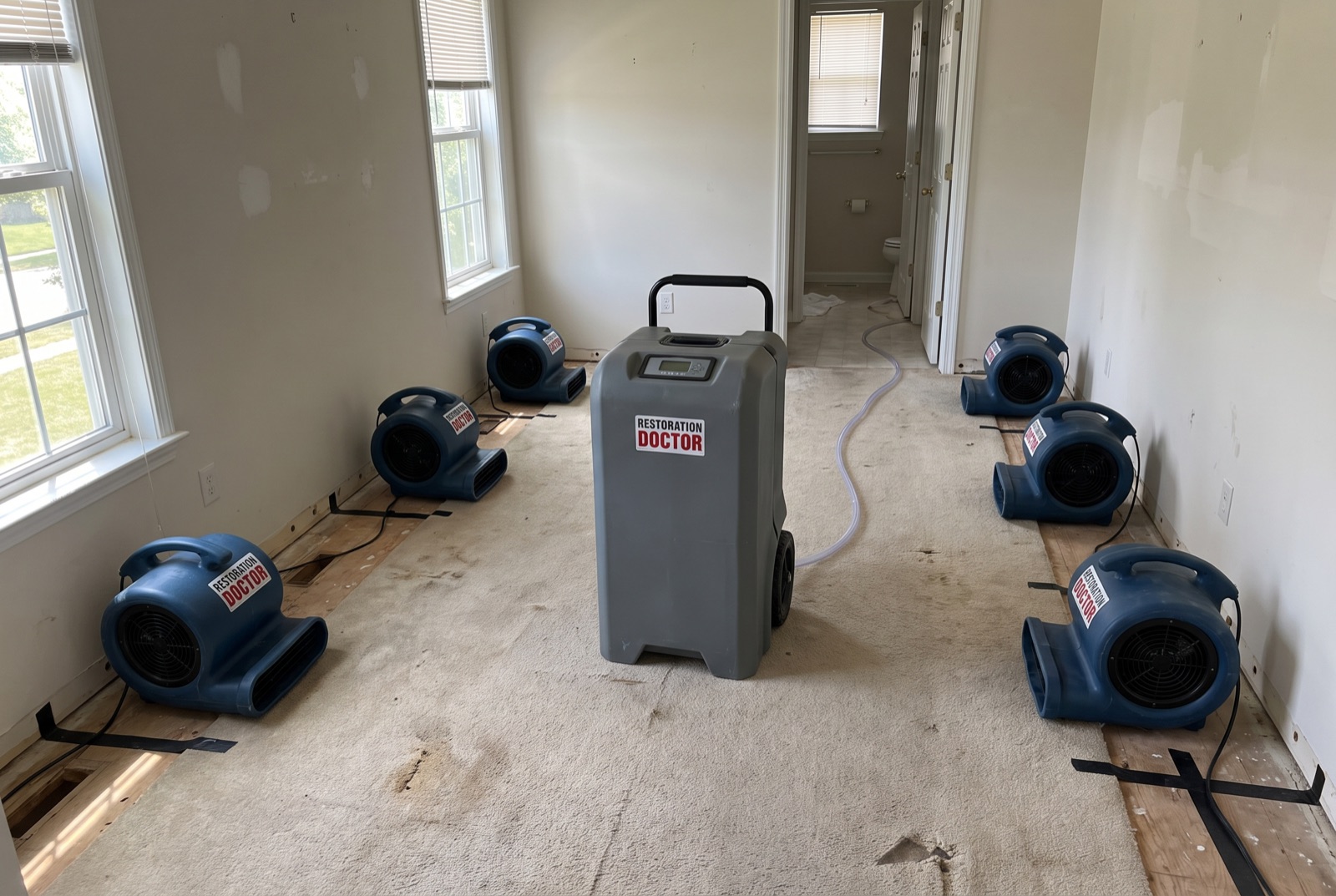
The idea: dry the building instead of demolishing it
When adjusters, contractors, or restoration crews talk about structural drying, they mean something more specific than 'drying things out.' It's the discipline of taking a building whose materials have absorbed water — not just gotten splashed — and scientifically extracting that moisture from the structure itself, in place, until every material returns to its normal dry state.
The alternative it replaces is demolition. Before modern drying science, the answer to saturated drywall and wet framing was largely to tear out and rebuild. Structural drying flips that default: with enough extraction, airflow, dehumidification, and measurement, most structurally sound wet materials — drywall, framing lumber, plywood subfloor, hardwood flooring, even plaster — can be saved. Materials come out only when they're physically ruined (swollen MDF, delaminated subfloor), contaminated beyond cleaning, or colonized by mold. That's better for cost, timeline, insurance claims, and simply keeping your home your home.
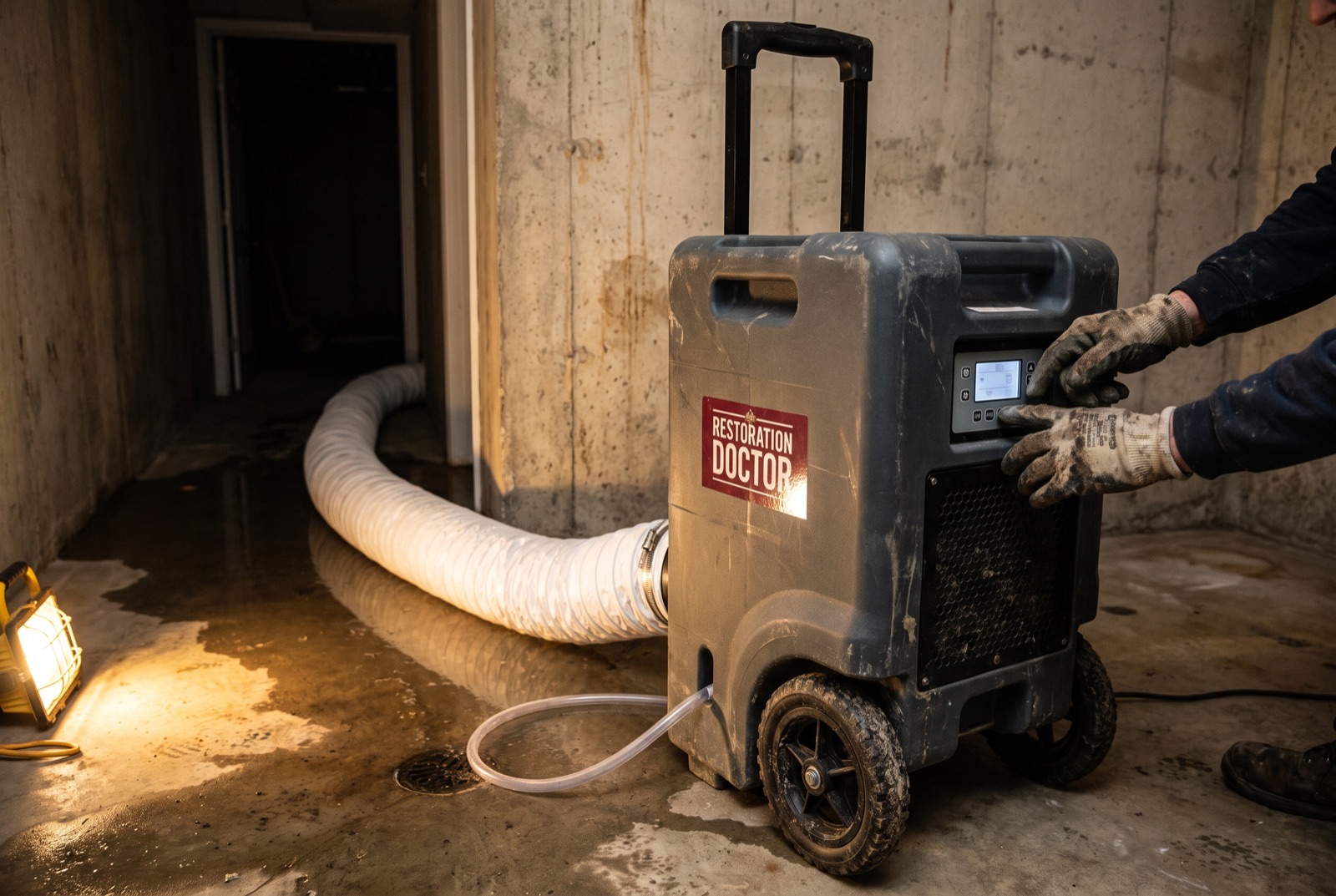
The science underneath: psychrometrics
Structural drying runs on psychrometrics — the physics of air, temperature, and moisture. Two relationships do most of the work. First, moisture always moves from wetter to drier: hold the air surrounding a wet material at low humidity, and the material's bound water migrates out into it. Second, warmer air holds more moisture and speeds the release of water from materials, which is why drying zones are kept warm as well as dry.
A drying system is engineered around those facts. Air movers sweep the humid boundary layer off wet surfaces so evaporation runs at full rate; low-grain refrigerant (LGR) dehumidifiers continuously strip the liberated moisture from the air and drain it away, holding the environment dry enough to keep pulling water even out of dense materials; and the space is closed off so humid outside air can't flatten the gradient. Technicians track it all with daily measurements — temperature, relative humidity, grain depth of the air, and moisture content of each affected material — and adjust the system as the structure dries.
The IICRC S500 standard codifies the practice: how to classify the loss (Categories 1-3 for contamination, Classes 1-4 for how much water the materials absorbed), how to size equipment to the space, and how to verify completion.
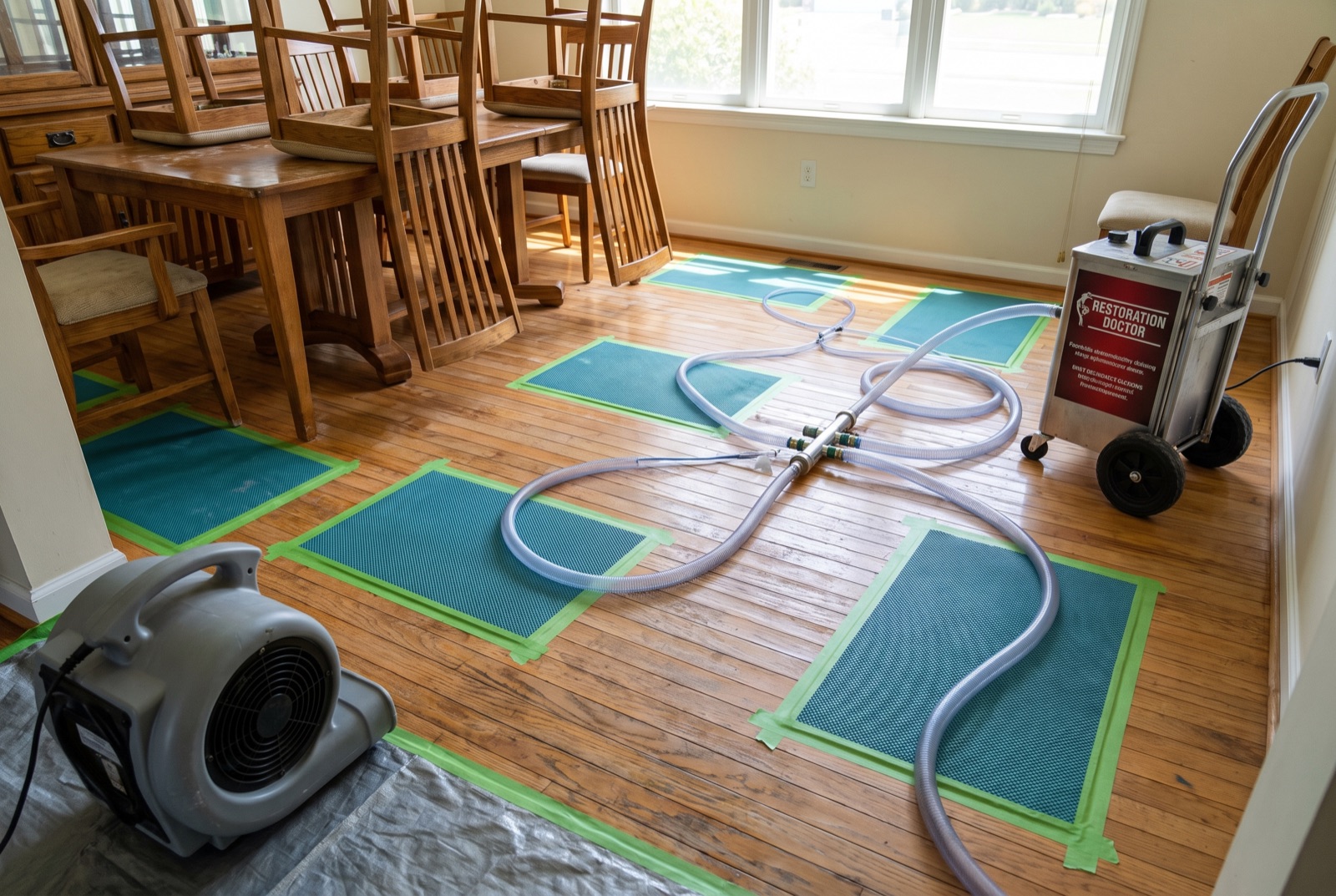
What it looks like on a real project
A structural drying project follows a recognizable arc. Day one: extract liquid water (extraction is hundreds of times faster than evaporation), map the moisture with meters and thermal imaging, establish a dry standard from unaffected materials, remove what can't be saved (wet carpet pad, contaminated porous goods), create drying access — detached baseboards, small vent holes into wall cavities, floated carpet, mat systems on hardwood — and set the calculated equipment.
Days two through completion: daily monitoring visits, with every affected material read against the dry standard and every reading logged. Equipment gets repositioned toward stubborn areas and pulled from finished ones. Specialty tools enter where needed — floor-drying mats for hardwood, injection systems for cavities, controlled heat for Class 4 losses with water bound in plaster, brick, or concrete.
Completion is a measurement, not a vibe: the project is done when every monitored material matches the dry standard. On a typical residential loss that's three to five days; dense-material losses run longer.
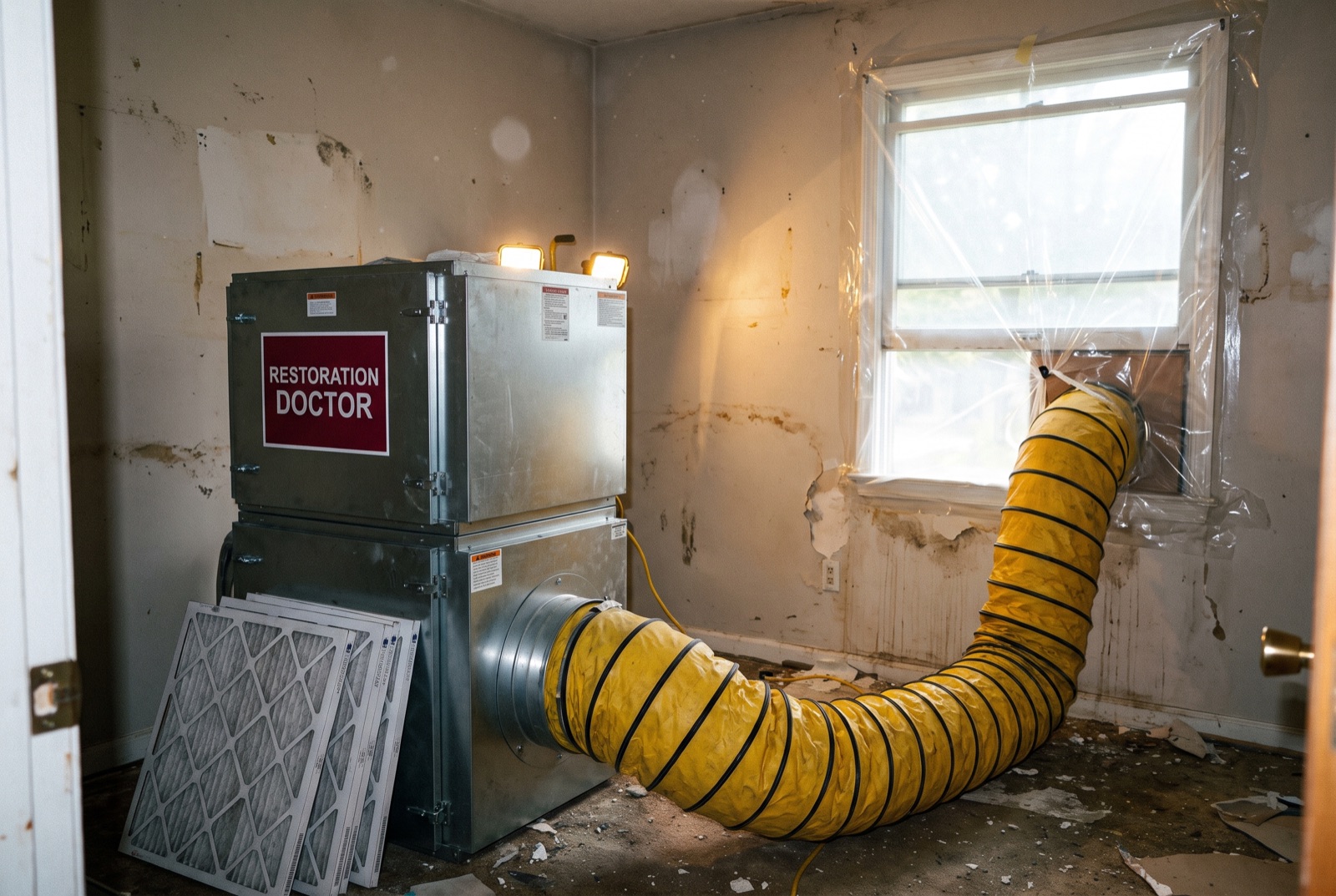
Why it matters to you and your claim
For homeowners, structural drying is usually the difference between a disruption and a renovation — walls dried in place instead of rebuilt, hardwood rescued instead of replaced, a week of equipment instead of a month of contractors. For insurance, the documentation is the point: moisture maps, daily psychrometric logs, and verified dry-standard completion give the carrier objective proof of what was wet, what was done, and that it worked — which is what keeps claims clean.
Restoration Doctor performs IICRC S500-aligned structural drying across Northern Virginia, Maryland, and D.C., from emergency extraction through documented dry verification. If your home has taken on water, call 1-888-29-FLOOD — the more of your house we can dry, the less anyone has to rebuild.
Water Damage Restoration
Extraction, structural drying, and moisture verification for burst pipes, appliance leaks, and basement flooding.
Frequently asked
Related questions
How do professionals dry out a house after water damage?
What is the difference between water mitigation and restoration?
How long does it take to dry out water damage?
Why is water damage restoration so expensive?
Active water, mold, fire, or sewage event?
Connect directly with the Restoration Doctor team for your region. Crews are on standby 24/7 with documented response protocols.