
Restoration Company in Northern Virginia
Water, fire, storm, mold, and sewage damage restoration across every county and independent city in Northern Virginia, dispatched around the clock from our Vienna headquarters by IICRC-standard crews who document the loss the way your carrier expects to see it.
Restoration Doctor is a licensed restoration company in Northern Virginia, headquartered at 8609 Westwood Center Dr, Ste 110-1062, Vienna, VA 22182. Our emergency dispatch runs 24 hours a day, every day of the year on 1-888-293-5663, and our response standard is on-site within 60 minutes across the Northern Virginia core. We handle water, fire and smoke, storm, mold, sewage, odor, contents pack-out, and full reconstruction, and we bill the homeowner and hand you a carrier-ready claim file you submit when you seek reimbursement. Call 1-888-293-5663.
Our 24/7 emergency dispatch across Northern VirginiaA Vienna-headquartered restoration company, not a franchise branch
Restoration Doctor is a restoration company in Northern Virginia headquartered at 8609 Westwood Center Dr, Ste 110-1062, Vienna, VA 22182, a few minutes off Route 7 in Tysons and inside the Beltway loop that most of this region drives every day. Our emergency line, 1-888-29-FLOOD (1-888-293-5663), is answered by a person 24 hours a day, 365 days a year; our response standard is on-site within 60 minutes across the Northern Virginia core, and crews stage from that Vienna address to every county and independent city between the Potomac and the Fauquier line.
Being headquartered here rather than franchised into here changes what a homeowner actually experiences. There is no regional call center triaging your emergency into a queue, no subcontractor introducing himself at your door two days later, and no handoff between the company that dried your house and the company that rebuilds it. The person who scopes the loss works for the same operation that writes the estimate, runs the dehumidifiers, and hangs the replacement drywall.
That matters most in the first hour. Northern Virginia is a region where a fifteen-mile drive can take fifty minutes, so the practical difference between a local crew and a distant one is measured in how far water has traveled into your subfloor before anyone touches it. We plan our staging around that reality instead of around a map that ignores it.
The legal entity behind the brand is VA Water Damage LLC dba Restoration Doctor. Restoration Doctor is the name on the trucks, the uniforms, and the estimates; VA Water Damage LLC is the name on the license and the contract. We publish both, because a homeowner comparing restoration companies should be able to look one up against the other in a state database without guessing which company actually signed the paperwork.
In Virginia we hold DPOR license 2705191604, a Class A contractor registration with Home Improvement and Residential Building specialties. That single number is worth writing down. It is the one you type into the Virginia Department of Professional and Occupational Regulation license lookup to confirm that the company standing in your kitchen is real, current, and permitted to do the reconstruction half of the job rather than only the drying half. We also carry credentials in the two neighboring jurisdictions this metro area spills into, which is what lets us follow a client from a Vienna townhouse to a rental property across the river without handing the file to somebody else.
Our technicians work to the IICRC standards that govern this trade: ANSI/IICRC S500 for water damage restoration, S520 for mold remediation, and full biohazard protocols for Category 3 sewage losses. Those standards are not decoration. They dictate how water categories are classified, what has to be removed instead of dried, what a dry standard actually is, and how the drying has to be verified before equipment comes out of your house. When an adjuster later asks why a wall was flood cut at sixteen inches or why a dehumidifier ran for five days, the standard is the answer, and the daily moisture log is the proof.
Our response standard is on-site within 60 minutes across the Northern Virginia core. Emergency dispatch runs continuously, including holidays and the ice storms and August thunderstorms that generate half the calls in this region. A person answers, not a recording, and the crew is moving while you are still on the phone describing which room is wet.
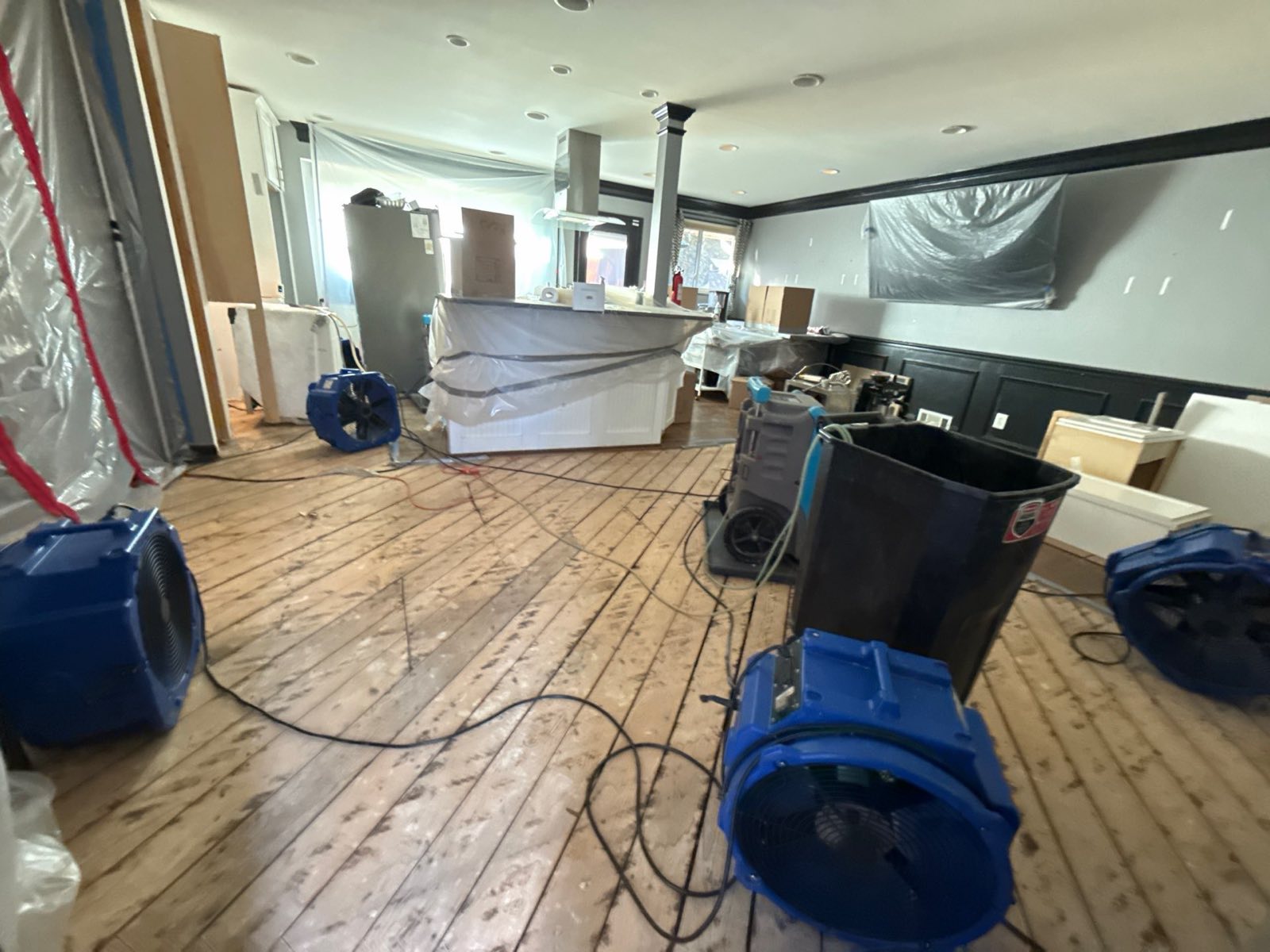
The rest of the operation is deliberately unglamorous. Truck-mount extraction units, low-grain refrigerant and desiccant dehumidification, thermal imaging cameras and penetrating moisture meters, HEPA air scrubbers and negative-air containment for mold and biohazard work, and in-house carpentry, plumbing, and electrical for the rebuild. We own the equipment rather than renting it by the day, which is why we can leave enough of it on a job to dry the structure on the timeline the standard calls for instead of the timeline a rental invoice prefers.
Every number below is issued to VA Water Damage LLC dba Restoration Doctor and can be checked against the issuing authority's public register.
What we restore
Eight lines of work, all carried in-house, from the first extraction to the last coat of paint. Each one has its own detailed page.
Water damage restoration
Burst supply lines, failed water heaters, appliance hoses, ice-maker lines, upstairs bathroom leaks that travel three floors down, and storm water pushing up through a basement slab. We extract, map the real wet footprint with thermal imaging rather than guessing from the stain, and dry to a documented moisture standard with daily readings.
Fire and smoke damage restoration
Structure fires, kitchen fires, furnace puff-backs, and the smoke and soot that travel far past the room that burned. Fire jobs are usually water jobs too, because the fire service leaves thousands of gallons behind, so we stabilize the building, dry it, then deodorize and clean surfaces before any rebuilding starts.
Storm damage restoration
Wind-opened roofs, fallen limbs through a gable, failed windows, and the flash flooding that follows a summer cell parked over Fairfax County. We tarp and board to stop the loss growing, then treat the building envelope and the soaked interior as a single project rather than two separate claims.
Mold remediation
Growth inside wall cavities, under flooring, behind vanities, and in the crawl spaces and finished basements this region is full of. Remediation runs under IICRC S520 with containment, negative air, HEPA filtration, and controlled removal, so spores are not simply relocated to the rest of the house.
Sewage and biohazard cleanup
Drain-line backups, failed ejector pumps, and municipal main surcharges. Sewage is Category 3 water, which means porous materials come out rather than getting dried in place, and the space is cleaned, disinfected, and verified before anyone lives in it again.
Odor removal and deodorization
The smell is usually the last thing to leave and the first thing a family notices. We treat the source rather than masking it, using cleaning, sealing, hydroxyl and ozone equipment as appropriate, and we do not call a job finished while a room still tells you what happened in it.
Contents cleaning and pack-out
Furniture, electronics, clothing, documents, and the things that cannot be replaced at any price. We inventory and photograph contents, pack them out to controlled storage when the structure has to be worked on, clean and deodorize what is salvageable, and pack it back in when the house is ready.
Reconstruction and repairs
Drywall, insulation, trim, cabinetry, flooring, paint, and the plumbing or electrical repair that caused the loss in the first place. Because reconstruction is in-house, the company that opened your wall is the company that closes it, and there is no gap where a homeowner has to go find a second contractor.
Where we work in Northern Virginia
Northern Virginia is not one market, it is five counties and five independent cities stitched together by three highways and a lot of traffic. We cover Fairfax County, Arlington County, Loudoun County, Prince William County, and Fauquier County, plus the independent cities of Alexandria, Falls Church, Fairfax City, Manassas, and Manassas Park. Virginia treats those cities as separate from the counties that surround them, which occasionally matters for permits on a reconstruction job, so we name them explicitly rather than folding them into a county line.
The building stock changes as you move across that footprint, and so does the failure that brings us out. Inside the Beltway, in Arlington, Alexandria, Falls Church, and the older Fairfax County neighborhoods, the calls skew toward aging galvanized supply lines, cast-iron drain stacks, and finished basements in homes built before anyone imagined a media room down there. Along the Route 7 and Tysons corridor it is high-rise and mid-rise condominium losses, where one failed angle stop soaks four units below it and the association, the unit owners, and two insurers all need the same documented scope.
West and south along I-66 and the Route 28 corridor, through Loudoun and Prince William, the housing is newer and larger, which changes the physics rather than removing the risk. A two-story-plus-basement colonial in Ashburn or Gainesville gives water three floors to travel through, and a builder-grade appliance line that lets go at 2 a.m. in a finished lower level can wet four thousand square feet before sunrise. Out in Fauquier, the properties are further apart, more of them are on well and septic, and a saturated drain field turns a plumbing problem into a Category 3 one quickly.
We publish a dedicated page for each city we serve, with the neighborhoods, housing stock, and water-risk detail that are actually true of that place. They are not copies of one another with the town name swapped, because that would be useless to a homeowner and dishonest besides.
Across the river, our Washington DC operation covers the District and close-in Montgomery County, so a loss that sits just outside this map is still answered by the same company.
- Fairfax County
- Arlington County
- Loudoun County
- Prince William County
- Fauquier County
- Alexandria, VA
- Falls Church, VA
- Fairfax City, VA
- Manassas, VA
- Manassas Park, VA
How to choose a restoration company in Northern Virginia
Six checks worth running on us and on anyone else you are considering. They take about ten minutes and they are the difference between a documented restoration and an argument with your carrier six weeks from now.
- 1
Look the license up yourself, before you sign
Ask for the license number and the exact legal entity name, then check it against the Virginia DPOR license lookup while the estimator is standing there. Ours is 2705191604, held by VA Water Damage LLC dba Restoration Doctor. Confirm the license is active, confirm the class covers the work being proposed, and be careful with lookalike names. Several unrelated companies in this region use similar-sounding names, and the number is the only thing that cannot be borrowed.
- 2
Ask which standard the work will follow, and expect a specific answer
The right answer is ANSI/IICRC S500 for water and S520 for mold, and the person saying it should be able to explain what a dry standard is and how they will know when your house has reached it. Vague answers about industry best practices usually mean the equipment comes out when the crew gets busy elsewhere rather than when the material is dry.
- 3
Verify insurance, and verify it covers the whole job
General liability and workers compensation, current, with the certificate available on request. If reconstruction is part of the scope, the coverage has to reach that work too. A mitigation-only contractor who subcontracts the rebuild leaves you managing the seam between two policies and two warranties.
- 4
Require moisture documentation, in writing, every day
A restoration company should be recording moisture content readings from the affected materials and the psychrometric conditions in the drying chamber daily, and should be willing to show you the log. Photographs alone are not documentation. If nobody can tell you what the readings were yesterday, nobody can prove the structure is dry today, and that gap is exactly where claim disputes are born.
- 5
Get a written scope before work starts, not an invoice after
You should know what is being removed, what is being dried in place, how much equipment is going in, and roughly how long it will run, in writing, before anyone cuts drywall. Carriers in this market work in Xactimate line items, so a scope written that way is easier for you to compare and easier for an adjuster to approve.
- 6
Do not sign under pressure at your own front door
Nobody should be pushing a contract at you while your basement is still filling, and you should never feel rushed into an open-ended authorization or an assignment of your insurance benefits. Virginia law protects your right to choose your own contractor. A company that needs your signature before it will answer questions is telling you something useful about how the rest of the job will go.
How the insurance side actually works
This is the part most homeowners get wrong, usually because a different contractor was vague about it on purpose. Our billing relationship is with you, the property owner. You are our client, you receive our invoice, and you pay us. We then hand you a complete, carrier-ready claim file documenting what the loss actually cost, and you submit it to your insurer when you seek reimbursement.
That claim file is the product of the fieldwork, not an afterthought assembled at the end. It contains a line-item Xactimate estimate written in the format adjusters already use, time-stamped photographs from every phase including the conditions behind the walls we opened, the daily moisture and psychrometric logs that prove the structure reached a dry standard, an equipment log showing what ran and for how long, and a plain description of the source and water category that explains why the scope is what it is.
We are deliberate about this arrangement because of who we answer to. A restoration company that takes its payment from your carrier has a commercial relationship with your carrier, and the pressure to trim a scope to keep that relationship comfortable is real even when nobody says it out loud. We work for you, not for the insurance company. Nothing about our scope depends on staying on somebody's preferred vendor list, which means the estimate says what the job required rather than what it was expected to cost.
In practice that also makes the claim move faster. A file that arrives complete, with the readings and photographs an adjuster would otherwise have to request, usually clears without a round of revisions. We will speak with your adjuster, walk them through the documentation, and defend the scope line by line, and we will do it as your contractor rather than as theirs.
You keep the right to choose. Your carrier may recommend a vendor from a managed repair program, and you are free to use one, but you are not required to. That choice belongs to the property owner in Virginia, and any suggestion that your coverage depends on using a particular company deserves a second opinion.
We work for you
You are the client and you receive the invoice, so the scope reflects the job rather than a vendor program's expectations.
Carrier-ready claim file
Line-item Xactimate estimate, time-stamped photos, daily moisture and psychrometric logs, and an equipment log.
Fewer revision rounds
A complete file usually clears without a second pass, which is what gets a homeowner reimbursed sooner.
What happens after you call
Dispatch is from Vienna, minutes from Route 7 and the Beltway, with I-66 and the Fairfax County Parkway covering the western half of the region. Here is the sequence from the phone call to the end of the first day.
- 1
The call and the dispatch
A person answers 1-888-293-5663 at any hour. We ask what happened, where the water is coming from, whether the source is shut off, and whether anyone is at risk, and we talk you through making the space safe while a crew is assigned. Dispatch is from Vienna, so the drive is measured in minutes across the core of the region rather than in hours from another metro.
- 2
Arrival, assessment, and stopping the loss
The first job on site is stopping the loss from getting bigger: shutting off the source if it is still running, tarping or boarding an opened envelope, and making the area safe around electricity and standing water. Then the crew lead walks the structure with a thermal camera and moisture meters to find where the water actually went, which is almost always further than the visible damage suggests.
- 3
Extraction and material decisions
Standing water comes out with truck-mount extraction, and saturated carpet pad and unsalvageable porous materials come out with it. What gets removed and what gets dried in place is a decision driven by the water category and the material, not by convenience, and every removal is photographed before and after so the reason is on the record.
- 4
The drying chamber goes in
Air movers and dehumidification are sized to the affected volume and set to the wet footprint rather than sprayed across the whole house. Containment goes up where it helps, and initial moisture content readings and psychrometric conditions are recorded that day. That first set of readings is the baseline every later reading is measured against.
- 5
Documentation and the estimate
Before the first day ends, the loss is photographed in full and the scope is written up. The estimate is a line-item Xactimate document, and the photo set and moisture log start accumulating immediately, so you are never waiting until the end of the job to find out what is being claimed.
- 6
Daily monitoring until dry, then rebuild
A technician returns daily to record readings, adjust equipment, and confirm the materials are actually losing moisture. Equipment comes out when the readings say the structure has hit the dry standard, not before. From there, reconstruction picks up with the same company: drywall, trim, flooring, paint, and the plumbing or electrical repair that caused the loss.
What Northern Virginia homeowners say
We do not print a star rating into this page as static text. The number below is read live from the same Google aggregate our reviews page uses, so it is whatever it genuinely is today. Read the reviews themselves, look at how the company answered the unhappy ones, and weigh that against every other restoration company you are considering in Northern Virginia.
READ ALL VERIFIED REVIEWSNorthern Virginia homeowners, in their own words
- A.C.AshleyVienna, VA
"helped with water damage"
GoogleJul 2026 - C.C.ChristopherVienna, VA
"Outstanding customer service and craftsmanship. The project was completed on time, within budget, and with great attention to detail."
GoogleJul 2026 - V.R.VickyVienna, VA
"Everyone we worked with was friendly, professional, and committed to doing the job right. They exceeded our expectations in every way."
GoogleJun 2026 - T.C.TiffanyVienna, VA
"I was out of town, came back to my basement being flooded due to my water heater breaking. Luckily I called RD, and they got here as quickly as…"
GoogleJun 2026 - A.C.AlexisVienna, VA
"Last night, my dishwater had leaked for several hours while we were asleep and woke up to my basement ceiling caving in and falling and damaging my…"
GoogleJun 2026 - K.R.KelvinVienna, VA
"Great quality work and exceptional customer service thank you!!!"
GoogleJun 2026 - C.B.CristianVienna, VA
"A trustworthy company that stands behind its work"
GoogleJun 2026 - K.K.KevinVienna, VA
"Professional team that made a difficult situation much easier."
GoogleJun 2026 - E.W.ElizabethVienna, VA
"I had leak in my kitchen due to my sink, restoration doctor sent out Carlos and he brought a crew with him and they fixed the leak and dried out my…"
GoogleJun 2026 - A.P.AdamVienna, VA
"I had a flood in my basement due to a broken pipe. Carlos came out in within the hour of me calling. He got to work & extracted the water and…"
GoogleJun 2026 - E.C.ErikVienna, VA
"Great team loved the buisness"
GoogleJun 2026 - S.M.shopifyVienna, VA
"They cleaned up my place really well!"
GoogleJun 2026 - M.K.MatthewVienna, VA
"my roofing is fixed thanks to this team!"
GoogleJun 2026 - A.C.AllieVienna, VA
"Quality work, quality people. Amazing customer service & amazing work overall, would recommend to anyone needing help with water damages!!"
GoogleJun 2026 - K.R.katherineVienna, VA
"From the moment we contacted Restorations Doctor VA, we felt like we were in good hands. Their response time was impressive, communication was…"
GoogleJun 2026 - A.M.AryaVienna, VA
"Did a amazing job"
GoogleJun 2026 - J.N.joselingVienna, VA
"Everything was handled professionally from beginning to end. We couldn’t be happier with the outcome!"
GoogleJun 2026 - R.D.RasheedVienna, VA
"After we had water damage they helped us throughout the the whole insurance headache when they tried to deny us. Please go with them!"
GoogleJun 2026 - K.H.KellyVienna, VA
"5 star experience- can’t go wrong with using their services! Price and thoroughness can’t be beat!"
GoogleJun 2026 - K.G.KellyVienna, VA
"“The attention to detail was incredible. From cleanup to repairs, every aspect of the restoration was handled professionally. They didn’t cut corners…"
GoogleJun 2026 - S.A.SophiaVienna, VA
"When disaster struck, Restorations Doctor VA was there every step of the way. Their team responded quickly, communicated clearly, and treated our…"
GoogleJun 2026 - S.G.StephanieVienna, VA
"A leaking water heater caused significant flooding, and I honestly believe their fast response prevented thousands of dollars in additional damage.…"
GoogleJun 2026 - C.G.ChristinaVienna, VA
"⭐⭐⭐⭐⭐ When our home suffered storm damage, we were overwhelmed and unsure what to do next. Restorations Doctor VA made the entire process…"
GoogleJun 2026 - A.P.AntioneVienna, VA
"⭐⭐⭐⭐⭐ “The quality of work exceeded our expectations. Our property suffered significant hail damage, but the team restored everything perfectly. We…"
GoogleJun 2026 - L.T.LeslyVienna, VA
"Great service! 10/10"
GoogleJun 2026 - K.D.KVienna, VA
"Restorations Doctor VA did an outstanding job repairing the hail damage to our roof and exterior. The crew was punctual, respectful, and kept the…"
GoogleJun 2026 - S.A.stephanieVienna, VA
"High recommended, excellent service"
GoogleJun 2026 - S.G.StephanieVienna, VA
"10/10"
GoogleJun 2026 - J.G.JuanVienna, VA
"Thank for a fast response and great service. Highly appreicated!!"
GoogleJun 2026 - G.K.GiriVienna, VA
"Loved the way they handled our situation. Amazing services, excellent handling of the situation. They fixed my leak in the roof, so I highly…"
GoogleJun 2026
- B.L.BraydonVienna, VA
"Fast response,great communication and excellent work.couldn’t have asked for a better experience"
GoogleJun 2026 - M.S.matinVienna, VA
"Thank you restoration doctor!! Appreciate all the work you do and I will highly recommend you to my friends and family"
GoogleJun 2026 - C.C.ChrisVienna, VA
"Great service!! Fixed the leak in my ceiling and fast!! Highly recommended!!"
GoogleJun 2026 - A.S.AhmedVienna, VA
"Top notch service, highly recommended!!"
GoogleJun 2026 - A.T.adenVienna, VA
"Great service; they were very professional and detail oriented. Would definitely recommend"
GoogleJun 2026 - G.A.GersonVienna, VA
"A trustworthy company that stands behind its work, highly recommended"
GoogleJun 2026 - K.F.KevinVienna, VA
"restoration work was flawless. The crew was punctual, hardworking, and genuinely cared about the quality of the finished product."
GoogleJun 2026 - E.G.EvelynVienna, VA
"Everyone we worked with was friendly, professional, and committed to doing the job right. They exceeded our expectations in every way."
GoogleJun 2026 - A.M.AlisonVienna, VA
"Outstanding customer service and craftsmanship. The project was completed on time, within budget, and with great attention to detail."
GoogleJun 2026 - M.R.MariaVienna, VA
"Professional, efficient and fast. I was stressing about a leak on my ceiling but now it got fixed before it could get worse, now I’m stress-free.…"
GoogleJun 2026 - A.G.AndreaVienna, VA
"Outstanding service from start to finish! The team was professional, responsive, and worked efficiently to resolve our issues. They kept us informed…"
GoogleJun 2026 - K.C.KatherineVienna, VA
"The smoke odor was completely eliminated, and the repairs blended seamlessly with the rest of the house. We couldn't be happier with the results.…"
GoogleJun 2026 - J.V.JaimeVienna, VA
"Great company! They showed up fast, explained everything, and did an amazing job. I would definitely use them again"
GoogleJun 2026 - R.C.RogerVienna, VA
"I had a wall replacement issue and the crew was able to fix it nice and smooth, thank you!! 5 star service"
GoogleJun 2026 - M.S.MarioVienna, VA
"Amazing staff super professional and efficient. Highly recommend"
GoogleJun 2026 - M.C.MelissaVienna, VA
"The team that came to my house was great, helpful and very attentive. They really are 24hrs!"
GoogleJun 2026 - S.R.SergioVienna, VA
"I had an insulation issue going in my roof, restoration doctor was able to fix my issue, stress-free, easy and clean. Will definitely keep in contact."
GoogleJun 2026 - K.S.KeliVienna, VA
"I got my walls replaced due to mold and restoration doctor was able to fix it!! Highly recommended!"
GoogleJun 2026 - J.B.jouVienna, VA
"You guy did great with the leak problem, I will be recommending you to my friends and family!! Thank you!!"
GoogleJun 2026 - J.!.JaeVienna, VA
"Excellent work was done and the results turned out better than I expected. I will definitely call again!!"
GoogleJun 2026 - J.Y.JheisonVienna, VA
"My water tank was filling water in my basement causing mold to form on my walls, restoration doctor came and made it look as good as new!! highly…"
GoogleJun 2026 - C.S.CoreyVienna, VA
"Good work, highly recommended"
GoogleJun 2026 - W.N.W0LFENVienna, VA
"Amazing service, highly recommend."
GoogleJun 2026 - B.F.BelenVienna, VA
"3 weeks ago i had a big problem in my Basement and they came to fix the mess and I’m happy with the results thanks"
GoogleJun 2026 - W.S.WassimVienna, VA
"had an issue with a flood in my basement and these guys came and helped out very well def recommend"
GoogleJun 2026 - L.S.LoryVienna, VA
"(Translated by Google) I received excellent service. They explained the entire process to me, were very polite, and showed me everything that would…"
GoogleJun 2026 - C.H.carlosVienna, VA
"Great experience from start to finish. Carlos set up an appointment that was perfect for me. Notified me before arrival, arrived on time, and they…"
GoogleJun 2026 - J.M.JosueVienna, VA
"I had a great experience and they are professional and what they are doing , they were responsive and efficient"
GoogleJun 2026 - A.A.AnaiVienna, VA
"Great work from these guys!! There was water leaking from my water tank and had mold on my walls and ceiling. Restoring the damage was so easy for…"
GoogleJun 2026 - M.C.melissaVienna, VA
"I recently had water damage in my home and contacted this restoration company for help. They responded quickly, explained the process clearly, and…"
GoogleJun 2026
Frequently asked
Talk to a restoration company that answers the phone
Call 1-888-293-5663 for an active emergency and a crew is assigned while you are still on the line, anywhere in Northern Virginia, at any hour. If it is not an emergency, send the details and we will get back to you with a plan and an honest read on whether it is worth a claim.
Active water, mold, fire, or sewage event?
Connect directly with the Restoration Doctor team for your region. Crews are on standby 24/7 with documented response protocols.