Humidity Level to Prevent Mold: A Homeowner's Guide
BY RESTORATION DOCTOR · NORTHERN VIRGINIA, MARYLAND & D.C.
The humidity level to prevent mold is below 50% relative humidity, with the sweet spot between 30% and 50%. In the humid Virginia, Maryland, and D.C. summer, an inexpensive hygrometer (typically $10–$25) plus a right-sized dehumidifier draining to a floor drain will stop mold before it starts — and it works far better than any mold spray, which only treats what's already growing.
Call 1-888-29-FLOODWhat humidity level prevents mold?
Keep your indoor relative humidity below 50% and mold cannot establish itself. The proven safe range is 30% to 50% relative humidity, and staying under that 50% ceiling is the single most effective, lowest-cost thing a homeowner can do to prevent mold growth.
Mold needs three things to grow: mold spores (which are always present in the air), an organic food source (drywall paper, wood, dust, carpet), and moisture. You can't remove the spores and you can't remove the drywall, but you absolutely can remove the moisture. When relative humidity climbs above roughly 60%, the moisture content in porous building materials rises to a level that lets dormant spores germinate — often within 24 to 48 hours in warm conditions.
This is why the 50% rule matters so much in the DMV. Our region's summers are hot and swampy, and basements are naturally the coolest, dampest rooms in the house. Holding the basement under 50% relative humidity denies mold the water it needs, no chemicals required. For context, this same moisture-control principle drives the ANSI/IICRC S500 water damage standard and the ANSI/IICRC S520 mold remediation standard that our crews follow on every job.
- Below 30% RH: too dry, uncomfortable, can crack wood and irritate sinuses
- 30%–50% RH: the target zone — mold cannot grow, comfortable for people
- 50%–60% RH: caution zone — condensation risk on cold surfaces
- Above 60% RH: danger zone — mold can germinate in 24–48 hours
Why do DMV basements get so humid in summer?
DMV basements get humid in summer because warm, moisture-heavy outdoor air meets cool below-grade walls and floors, causing condensation. Virginia, Maryland, and D.C. sit in a humid subtropical climate where July and August dew points regularly climb into the 70s, and that moist air finds its way into every basement.
Here's the physics that traps homeowners: cool surfaces pull moisture out of warm air. Your concrete foundation walls and slab floor stay around 60–65°F year-round because they're surrounded by earth. When 80°F air at 70% humidity drifts down the stairs or seeps through vents, it cools against those surfaces and its relative humidity spikes — often past the dew point, leaving actual water droplets on walls, pipes, and the underside of the subfloor.
A common and costly mistake is opening basement windows on a humid summer day to 'air it out.' That does the opposite: you're inviting warm, saturated air into a cool space where it will condense. The other major sources are unvented dryers, damp crawl spaces, foundation seepage, and small plumbing leaks. Many of the humidity calls we take end up revealing a slow leak behind the drywall — which is where a professional moisture inspection pays for itself.
How do I measure the humidity in my basement?
Measure basement humidity with a hygrometer — a small digital meter that reads relative humidity and typically costs $10 to $25 at any hardware store. Place it in the center of the basement, away from vents and exterior walls, and check it at different times of day, because humidity climbs in the afternoon and overnight.
A hygrometer is the cheapest insurance you can buy against mold. For the price of a takeout lunch, you get a real-time number that tells you exactly whether you're in the safe zone or headed for trouble. We recommend a model with a min/max memory feature so you can see how high the humidity spiked while you were away — a reading that briefly touched 68% overnight explains a lot of 'mystery' musty smells.
Put one hygrometer in the basement, one in any finished lower-level bedroom, and one near the HVAC return. If two rooms read wildly differently, you've located a moisture source. A reading consistently above 55% means it's time to act before mold appears; a reading above 60% combined with a musty odor often means growth has already begun somewhere you can't see.
| Hygrometer reading | What it means | Action to take |
|---|---|---|
| Under 45% | Excellent — mold-safe | Maintain; check monthly |
| 45%–50% | Good — top of safe range | Monitor daily in summer |
| 51%–59% | Warning zone | Run a dehumidifier now |
| 60% and above | Mold-risk zone | Dehumidify + inspect for hidden moisture |
What size dehumidifier do I need for a basement?
For most DMV basements, you need a dehumidifier rated for at least 50 pints per day, and a damp or larger basement often needs a 50–70 pint unit sized to the square footage. A right-sized dehumidifier that drains continuously will hold a typical basement under 50% humidity all summer — an undersized one will run nonstop and never catch up.
Match the unit to your space and how damp it is. A dry-feeling basement up to about 1,500 sq ft can do fine with a 50-pint unit, while a damp or musty 1,500–2,500 sq ft basement usually needs a 70-pint model. Set the built-in humidistat to 45% so the unit switches on before you hit the danger zone. Most importantly, run the drain hose to a floor drain, sump pit, or condensate pump so you never have to empty a bucket — a dehumidifier only works when it's actually running.
Keep the unit off the wall for airflow, clean the filter monthly, and don't block the intake. In the deepest summer weeks, expect it to pull several gallons of water out of the air per day. That water is exactly what would otherwise be feeding mold on your walls.
- Small/dry basement (up to 1,500 sq ft): 50-pint unit
- Larger or damp basement (1,500–2,500 sq ft): 70-pint unit
- Set the humidistat to 45% RH
- Drain continuously to a floor drain, sump, or condensate pump
- Clean the filter monthly for full capacity
Why won't a mold spray fix a humidity problem?
Mold spray won't fix a humidity problem because it only kills mold that's already visible — it does nothing about the moisture that's causing the mold, so the growth simply returns. Spraying bleach or a store-bought mold killer on a damp wall is treating the symptom while ignoring the disease.
There are two deeper problems with relying on sprays. First, on porous surfaces like drywall and wood, surface treatments don't reach the mold's root structure (hyphae) growing inside the material, so you get a bleached-looking wall that regrows in weeks. Second, and more dangerous, sprays give a false sense of security: the homeowner thinks the problem is solved while the underlying humidity keeps every surface primed for the next bloom. The ANSI/IICRC S520 standard is clear that effective mold remediation means correcting the moisture problem and physically removing contaminated material — not simply applying a biocide over it.
Controlling humidity is the actual cure. A $10–$25 hygrometer and a properly sized dehumidifier attack the root cause, and together they cost less than repeatedly replacing moldy drywall. When mold has already spread across more than about 10 square feet, or when it's growing behind walls, that's the point to bring in professional mold remediation rather than another can of spray.
What else lowers basement humidity besides a dehumidifier?
Beyond a dehumidifier, you lower basement humidity by fixing water intrusion, improving drainage, sealing air leaks, and keeping the space connected to conditioned air. A dehumidifier is the workhorse, but it works far better when you also cut off the moisture sources feeding it.
Start outside and work in. Make sure gutters are clean and downspouts discharge at least six feet from the foundation, and that the soil grades away from the house — poor drainage is the number-one reason DMV basements stay wet. Inside, vent the clothes dryer directly outdoors, insulate cold water pipes to stop condensation drip, and seal obvious foundation cracks. If you have a crawl space, encapsulation with a vapor barrier can dramatically cut the moisture load that migrates into the basement.
Finally, keep the door to the basement open and let conditioned HVAC air circulate down, and run bathroom or utility exhaust fans when appropriate. What you should NOT do is open windows on humid summer days — that adds moisture instead of removing it. If you've done all this and humidity still won't drop below 55%, you likely have a hidden leak or groundwater intrusion that needs a professional water damage assessment.
- Clean gutters; extend downspouts 6+ feet from the foundation
- Regrade soil so it slopes away from the house
- Vent the dryer directly outside
- Insulate cold water pipes to stop condensation
- Seal foundation cracks and rim-joist air leaks
- Consider crawl space encapsulation
- Keep basement air connected to conditioned HVAC air
When does high humidity mean I already have a mold problem?
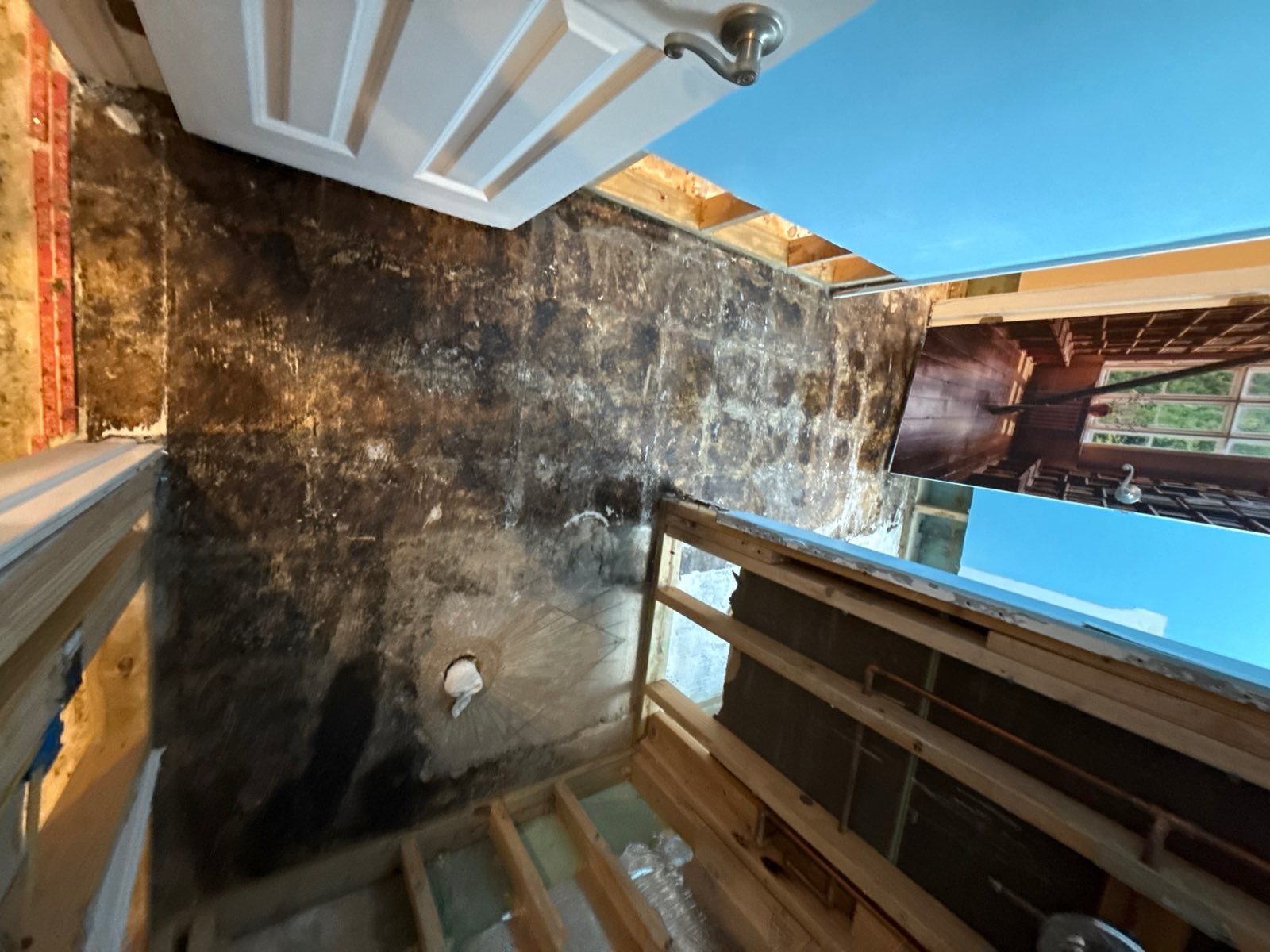
If your basement has held above 60% humidity for days or weeks and you notice a persistent musty, earthy smell, you very likely already have mold growing somewhere you can't see. A musty odor is mold's calling card — it comes from microbial volatile organic compounds released by active growth, and it usually appears before visible staining.
Watch for these confirming signs: discoloration or fuzzy spots on drywall corners, behind furniture, or on stored cardboard; peeling or bubbling paint; a film of growth on the concrete; and worsening allergy or asthma symptoms when family members spend time downstairs. Small surface mold on a hard, non-porous surface under about 10 square feet can often be cleaned by a homeowner. But mold on drywall, insulation, carpet, or ceiling tile — or any patch larger than roughly 10 square feet — calls for professional remediation under IICRC S520 containment protocols so spores aren't spread through the rest of the house.
Restoration Doctor serves the Virginia, Maryland, and Washington, D.C. tri-state area from our Vienna, VA headquarters. If you suspect hidden mold or find standing water, call 1-888-293-5663 and we'll identify the moisture source, document everything with CompanyCam photos and daily moisture logs, and put you back in a dry, safe, sub-50% home. We bill you directly and hand you a carrier-ready claim file — including an Xactimate scope — so you stay in control of the process, because we work for you, not your insurance company.