How to Read a Water Mitigation Invoice: Unit-Days and What to Question
BY RESTORATION DOCTOR · NORTHERN VIRGINIA, MARYLAND & D.C.

A water mitigation invoice is a list of unit-priced line items, and the largest block on it is almost always equipment billed per machine per day rather than per job. This guide explains unit-days, labor hours, antimicrobial and demolition lines, shows how to compare the invoice against the adjuster's own estimate, and gives the questions that get a straight answer.
Call 1-888-29-FLOODWhat is a water mitigation invoice actually pricing?
Learning how to read a water mitigation invoice starts with what the document is pricing: not a job, but a list of separately measured units of work and equipment time. Every line is a quantity multiplied by a unit price, and those quantities come from field measurements, daily readings and a room sketch rather than a lump-sum guess.
That structure is why the total can feel out of proportion to what you watched happen. A crew that spent four hours in your house on day one may have left a full equipment set running for days, and those machines keep billing while nobody is on site. The invoice is measuring the drying, not the visit.
Most residential mitigation in Northern Virginia is priced against a regional unit-price list, the same kind of list the adjuster's software uses. Line codes carry short descriptions like air mover per day, dehumidifier per day, or detach and reset toilet. Once you know which family a line belongs to, you can tell whether the quantity matches what happened in your home.
| Line family | What it pays for | How it is measured | What to check |
|---|---|---|---|
| Emergency service and extraction | The first response, water removal, initial inspection and moisture mapping | Per hour, per room or per square foot of affected floor | That the call-out appears once, not once per technician |
| Equipment | Air movers, dehumidifiers, air scrubbers, heat or drying systems | Per unit, per day (a unit-day) | Machine count and the number of days each one stayed |
| Labor | Technician and supervisor time for monitoring, moving contents, demolition | Per hour, sometimes split by role | Whether hours line up with the daily visit record |
| Materials and consumables | Antimicrobial, plastic sheeting, tape, filters, disposal bags | Per square foot, per roll, per unit | That containment material only appears where containment was built |
| Demolition and disposal | Removing wet drywall, carpet, pad and cabinets, plus hauling it away | Per linear or square foot removed, plus debris haul | Removal quantities against the photographs of what came out |
| Access and protection | Floor protection, moving furniture, detach and reset fixtures | Per item or per square foot | That detach lines have a matching reset line where work is finished |
What is a unit-day, and why is equipment billed that way?
A unit-day is one machine, on site and running, for one day. Ten air movers in place for four days is forty air mover unit-days, and that forty is the quantity you will see on a single air mover line. Drying equipment is priced this way because the cost scales with how much air moving and dehumidification capacity sits in the building and for how long, not with how many times a truck pulls up.
Equipment quantity is not arbitrary. The ANSI/IICRC S500 standard for professional water damage restoration sets out how a drying plan is built from the class of water loss, the affected volume and the amount of moisture the structure holds. Air mover counts are commonly derived from linear feet of affected wall and the affected floor area. Dehumidifier capacity is usually derived from the cubic volume of the drying chamber and the class of loss.
So the question is never why equipment is billed daily. It is whether the machine count and the day count match a documented plan.
- Unit-day = one machine x one day on site, billed whether or not anyone visited
- Air movers are usually scoped from affected wall length and floor area
- Dehumidifiers are usually scoped from room volume and the class of water loss
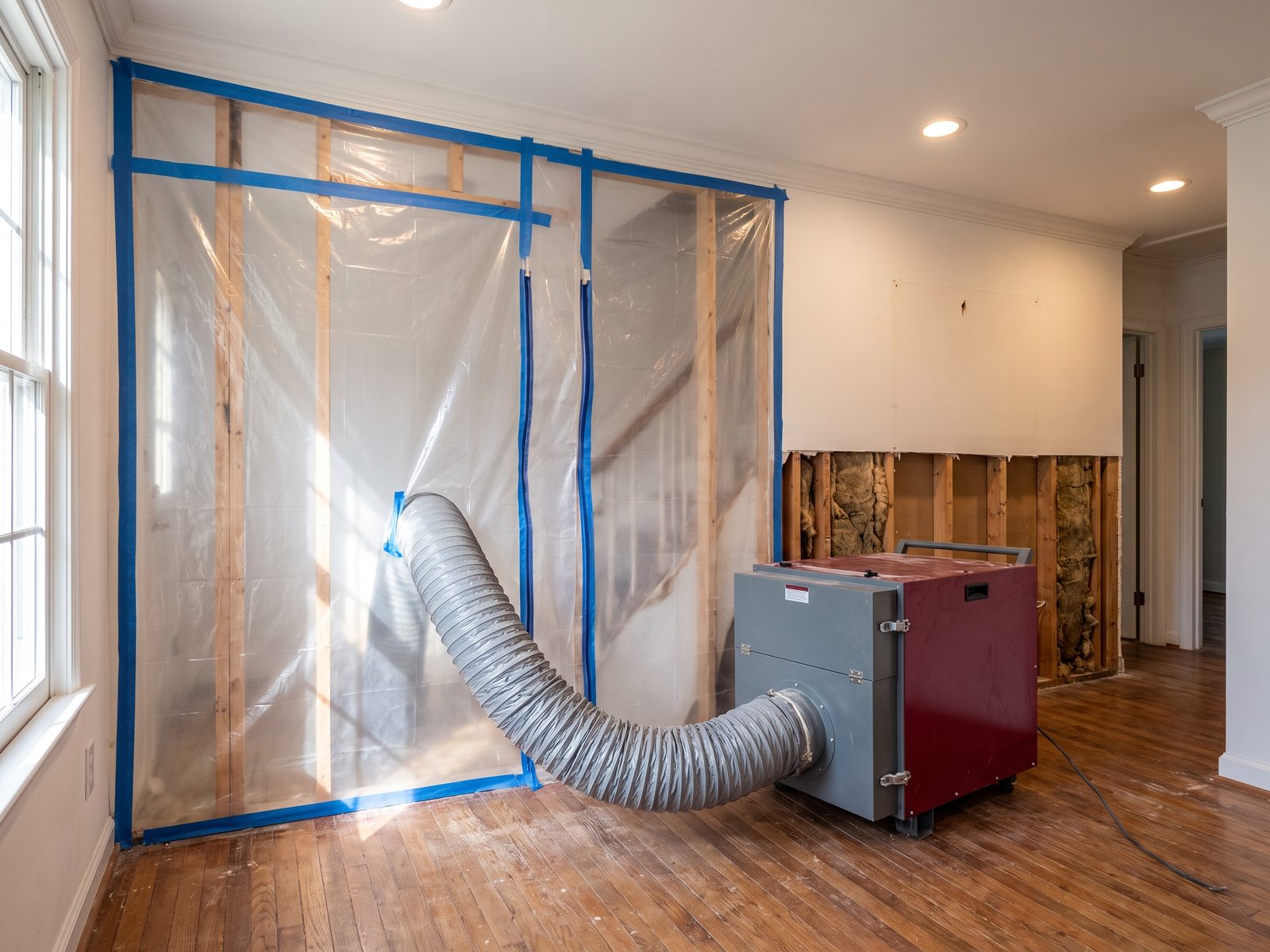
- Air scrubbers appear when containment is built or when contamination is suspected
- Specialty drying systems bill per mat, per panel or per injection point, not per room
Why are there so many dehumidifier and air-mover lines?
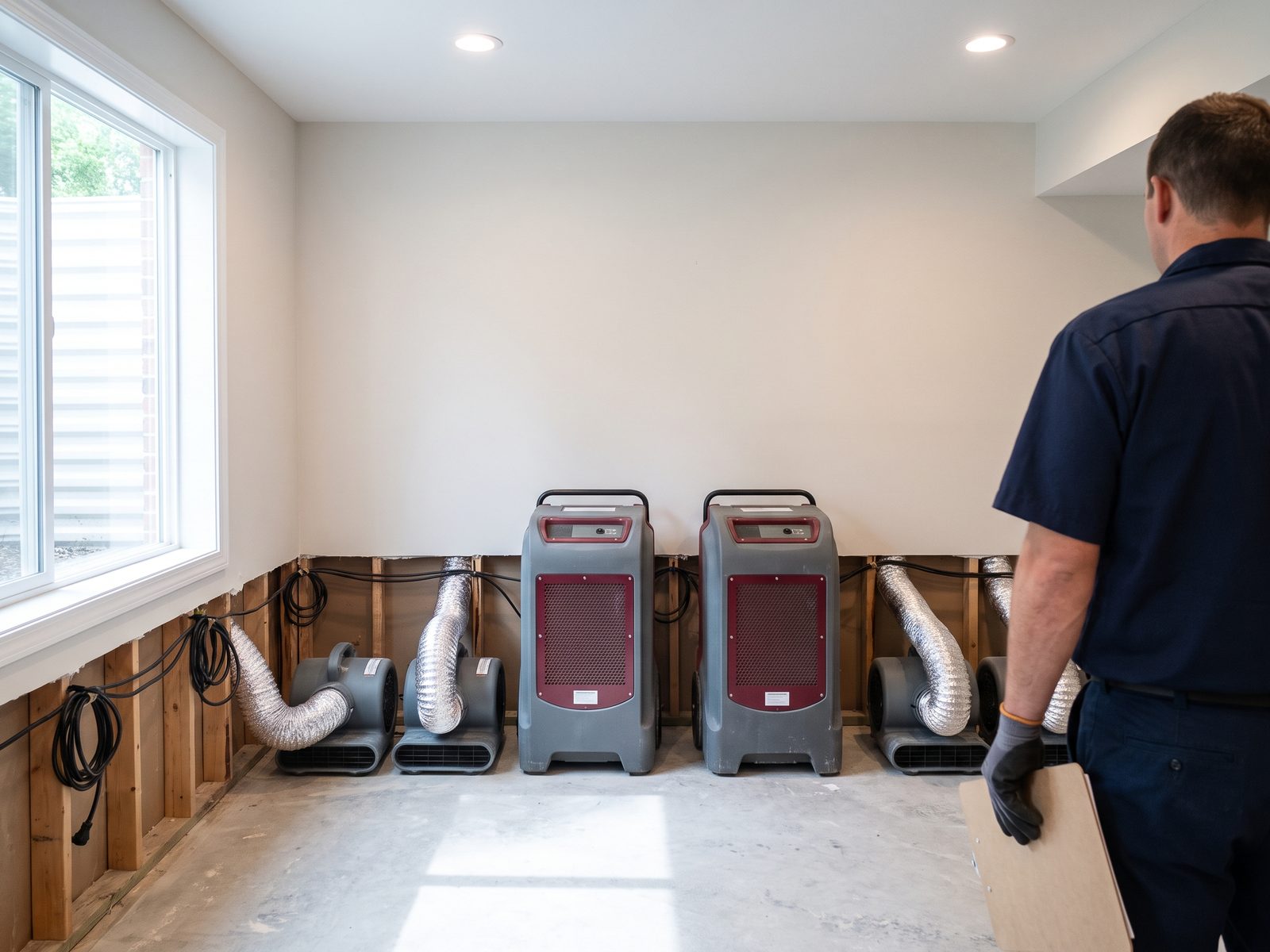
Because a drying chamber is not one machine. Air movers create fast surface airflow that pulls moisture out of materials and into the room air. Dehumidifiers pull that moisture back out of the room air and dump it down a drain. Removing one side of that pair stops the drying, so equipment arrives in sets, and each type of machine gets its own line with the unit-days totaled into the quantity.
Counts climb fast in the kind of housing stock we work in across Fairfax, Arlington, Loudoun and Prince William County. An open-plan basement with a wet stairwell and two adjoining rooms is often one chamber with a long perimeter, and perimeter length drives air mover count. A supply line break upstairs that ran overnight can wet three floors, and each floor becomes its own chamber.
The number that should move over a job is days, not machines. A well run job usually starts with the full equipment set and removes machines room by room as each area hits its dry standard. If your invoice shows the same machine count every day from start to finish, that is a reasonable thing to ask about, and the answer should come from the moisture readings rather than from habit.
What does a supervisor or technician hour cover, and what does it not?
Labor lines pay for people on site doing something measurable. Technician hours cover extraction, moving contents, setting and adjusting equipment, cutting and bagging wet material, cleaning, and taking the daily readings. Supervisor hours cover the work that keeps the job defensible: building the drying plan, reading the meters against yesterday's numbers, deciding what comes out and what stays, and writing the documentation the carrier will later audit.
What a labor hour should not cover is drive time billed as work time, office admin, or a second person standing in a room where one person is working. It also should not cover the same visit twice under two different role names. If a monitoring visit took forty minutes, one technician hour on that day is normal. Four hours of supervisor time on a day with no demolition and no equipment change is the kind of line worth asking about.
Ask how labor is recorded. A crew that logs arrival and departure against photographs can show you where every hour went. A crew that cannot will struggle to defend the line to your adjuster.
- Technician hours: extraction, demolition, content moving, equipment handling, cleaning
- Supervisor hours: drying plan, daily meter interpretation, scope decisions, claim documentation
- Normal on a monitoring day: a short visit logged with readings and photographs
- Worth questioning: hours on a day with no readings, no photographs and no equipment change
Why is there an antimicrobial line, and is it always justified?
Antimicrobial appears on most mitigation invoices and is priced per square foot of treated surface. It is applied to material that stayed in place after contact with water, usually framing and subfloor, plus the cut edge of remaining drywall. The purpose is to reduce the chance that damp organic material starts growing something during the days it takes to dry.
Whether it is justified depends on the category of water. Clean water from a supply line that is dried within a day or two often does not need it. Water that sat, water that ran through insulation, or anything originating from a washing machine, dishwasher or sewer line usually does. The S500 standard classifies water by contamination level for exactly this reason, and the category assigned on day one should be written somewhere in your file.
The honest limit on the line is this: an antimicrobial is not mold remediation and does not substitute for drying. The EPA's Brief Guide to Mold, Moisture and Your Home puts it plainly: the key to mold control is moisture control. Clean up growth without fixing the water problem and, in the EPA's words, the mold problem will come back. Visible growth over a meaningful area is a different scope governed by the ANSI/IICRC S520 mold remediation standard, with different containment and its own line items.
What is the difference between mitigation, demolition and reconstruction on the same bill?
Mitigation is everything done to stop the loss getting worse and to dry the structure. Demolition inside a mitigation invoice is narrow: it is the removal of wet material that cannot be dried in place, such as carpet pad, saturated drywall to a cut line, or wet insulation. Reconstruction puts it all back, and it is a separate scope, usually a separate estimate and often a separate approval.
Confusion comes because mitigation invoices legitimately contain some rebuild-shaped words. Detach and reset toilet is a mitigation line when the toilet had to come out to pull the wet subfloor. Installing a new toilet flange is reconstruction. The test is whether the task was needed to dry the building or to finish it.
The point at which money changes hands also varies by market: our Florida team covers how Florida restoration billing is staged at https://restorationdoctorfl.com/blog/restoration-deposit-progress-billing-florida, where deposits and progress billing split the same document into stages.
- Mitigation: extraction, drying equipment, monitoring, antimicrobial, protection
- Mitigation demolition: removing material that cannot be dried in place, plus disposal
- Reconstruction: drywall replacement, paint, flooring, trim, cabinetry, fixtures
- Red flag on a mitigation invoice: finish materials, paint, or new flooring of any kind
How do you compare the invoice against the adjuster's estimate line by line?
Most carrier estimates handed to a homeowner in Northern Virginia are priced from a regional unit-price list, and most restoration contractors here price from the same kind of list, so the line descriptions usually correspond. Before you start, ask both sides which price list and which version of it their document used. That is what makes a line-by-line read worth the hour it takes.
Put the two documents side by side and work by family rather than page order, because the two sort differently. Start with equipment, which is where almost all disputes live. Compare machine count first, then days, then the rate. In our experience the rate is almost never the disagreement. The disagreement is that the adjuster allowed fewer drying days than the readings supported.
Write the differences down as a short list with a reason beside each one. A list of five specific quantity differences, each tied to a reading or a photograph, gets resolved. A phone call that says the estimate is too low does not.
- Compare family by family: equipment first, then demolition, then labor, then materials, then access lines
- For equipment, check machine count and days before ever looking at the rate
- For demolition, check removal heights and areas against the photographs
- List every line present on one document and absent from the other
- Attach a reason to each difference: a reading, a photograph, or a standard
Which four questions are always fair to ask your contractor?
These four get asked on jobs every week, and a competent restoration company answers all of them without getting defensive. If a question makes the person on the phone uncomfortable, that reaction is information.
Listen for how each answer arrives. A good answer is specific and comes with paper: dates, room names, readings, a log you can keep. A deflection is a total with no breakdown.
- 1. How many machines were in my home, in which rooms, and on which dates? The answer should be a list, not a total.
- 2. What moisture readings supported keeping equipment in place on the last two days of drying? Ask for the readings, not a summary.
- 3. Which lines on this invoice are mitigation and which are reconstruction? You want the two scopes separated on paper.
- 4. What documentation goes to my carrier with this invoice, and can I have the same package? Your file should never be a black box.

What should you do if a line looks wrong?
Start by assuming a documentation gap rather than bad faith, because that is what it usually is. The most common cause is a quantity carried from the initial scope that nobody updated when the job shrank, or a machine pulled on Thursday and logged as removed on Friday. Those get corrected quickly when someone points at them.
Put it in writing, one line at a time. Name the line item, name the quantity you believe is right, and say what you are basing that on. A note that reads, the invoice shows six air movers for seven days and the photographs from day four show two machines in the basement, is specific enough to act on. A note that reads, this seems high, is not.
If the disagreement survives that exchange, involve the adjuster rather than escalating with the contractor. The carrier reviews these documents for a living, has the same price list open, and can settle a quantity dispute in a way neither of you can. Watch the deadlines in your policy while that happens, because a stalled conversation is still a clock running.
What does a carrier need attached before it will pay the invoice?
A carrier pays an invoice it can audit, which means every number on the page traces to something a reviewer can open. The package we send with a mitigation invoice is the same package we would want if we were the ones reviewing it. About 83% of our projects end up inside an insurance claim, so the file is built that way from the first hour on site.
The core attachments are consistent across carriers. A photo record runs from arrival through completion. Daily moisture readings are listed by room, with the meter type noted. An equipment log shows what was placed and removed on which day. A sketch carries room dimensions, and the signed authorization sits with it. Category and class of water should be stated and justified. Anything unusual, a specialty drying system or containment, wants a sentence explaining why it was needed.
One thing this document is not: a coverage decision. Coverage depends on your policy, your deductible and the cause of the water, and no contractor can promise you an outcome there. Flood water in particular sits outside most homeowners policies and belongs to a separate program. Read the declarations page, and ask your adjuster to put coverage positions in writing. The standards and federal guidance behind this guide are listed below.
- ANSI/IICRC S500, the Standard for Professional Water Damage Restoration: https://iicrc.org/s500/
- ANSI/IICRC S520, the Standard for Professional Mold Remediation: https://iicrc.org/s520/
- EPA, A Brief Guide to Mold, Moisture and Your Home: https://www.epa.gov/mold/brief-guide-mold-moisture-and-your-home
- FEMA on flood insurance and what standard homeowners policies exclude: https://www.fema.gov/flood-insurance