Plastic, Negative Air and HEPA: When a Mold Job Needs Containment
BY RESTORATION DOCTOR · NORTHERN VIRGINIA, MARYLAND & D.C.
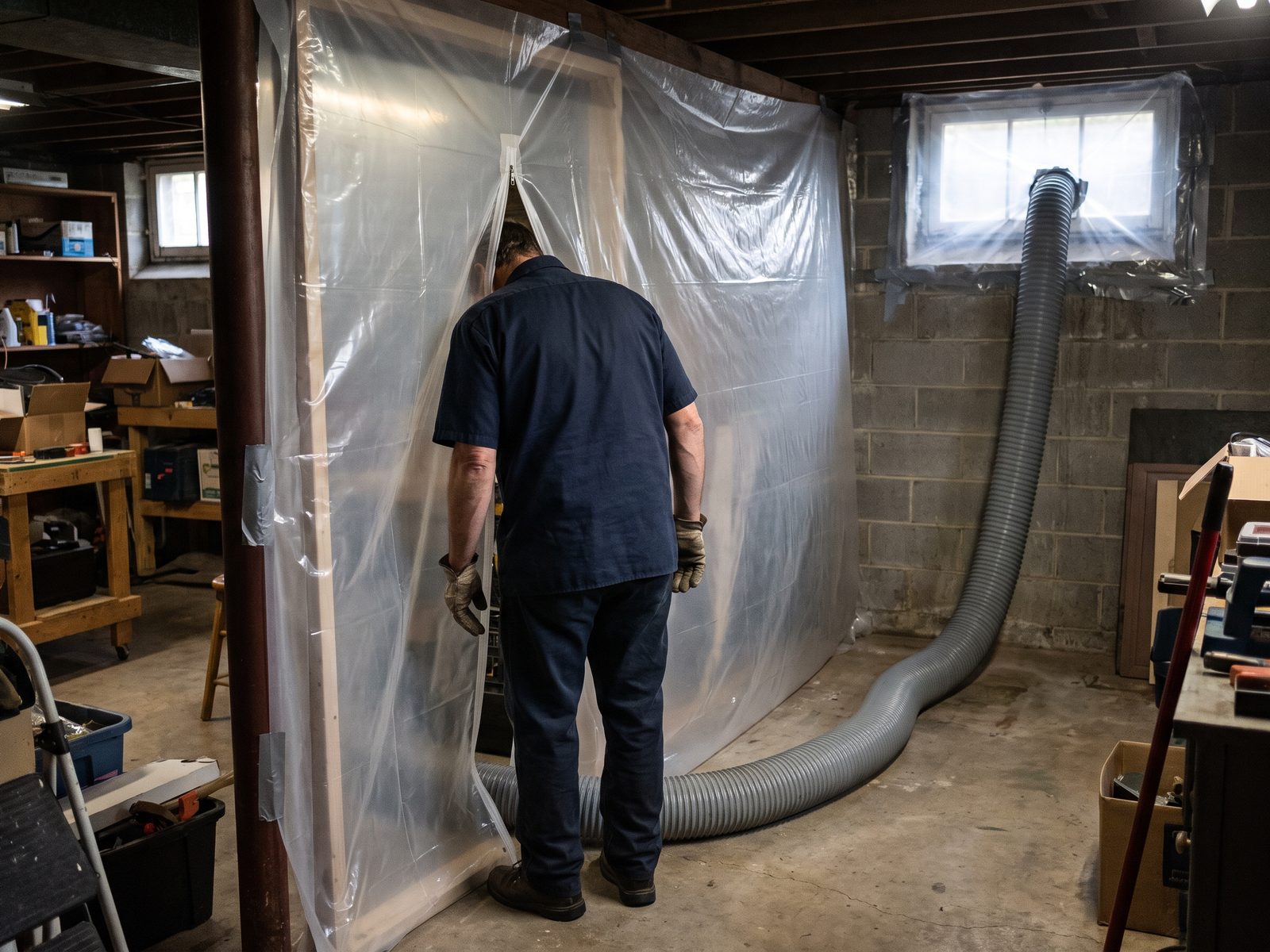
Containment exists to stop a remediation from spreading spores into the rest of the building, and it is built when the affected area, the contamination condition or the occupancy makes uncontrolled disturbance unacceptable. This guide defines Condition 1, 2 and 3, explains negative air and HEPA filtration in plain terms, and describes what a correctly built chamber looks like from outside the plastic.
Call 1-888-29-FLOODWhat is containment actually for, and what is it not for?
Mold containment and negative air exist for one reason: cutting and scraping contaminated material throws spores and fragments into the air, and that dust has to stay in the room it came from. The plastic is a barrier, the machine behind it holds the pressure inside that barrier slightly lower than the rest of the house, and together they send the dust out through a filter instead of up the stairs.
It helps to be blunt about what containment is not. It does not kill anything, and it does not clean the air in the rest of the house. It is not proof that what sits behind the plastic is dangerous, and it is no substitute for fixing the water problem. A chamber built over an unrepaired leak buys a few weeks of clean-looking drywall.
Homeowners tend to read the plastic as a verdict on their health. Read it as a work method instead. What matters is whether the barrier is sealed, the pressure is negative, and the HVAC has been handled.
What do Condition 1, Condition 2 and Condition 3 mean?
Remediators grade an indoor space by condition rather than by how bad a wall looks in a phone photo. Condition 1 is a normal indoor environment, where spore levels look like the outdoors for that season and there is no growth. Condition 2 is a space with settled spores and fragments carried in from elsewhere, so there is contamination without colonies. Condition 3 is a space with growth, visible or hidden, living on the material itself.
The grade matters because it sets the scope. Condition 3 areas get removal and cleaning. Condition 2 areas get cleaning without demolition, because nothing is growing there. Condition 1 is the target state at the end, and the point of a chamber is that the rest of the house stays Condition 1 throughout. The condition language comes from the ANSI/IICRC S520 mold remediation standard, which the IICRC publishes and maintains.
Climate changes how often each grade shows up. Our Florida site, Restoration Doctor Florida, covers how remediators grade the level of growth in a market where the humidity keeps most buildings closer to Condition 2 year-round, at https://restorationdoctorfl.com/blog/mold-condition-1-2-3-explained-florida. In Northern Virginia the pattern is seasonal instead: dew points climb from May through September, a finished basement sits below that dew point, and a house that read Condition 1 in March turns up Condition 2 or 3 in August.
- Condition 1: normal fungal ecology for the season, no growth, no unusual settled spores
- Condition 2: settled spores and fragments carried in from elsewhere, no active colonies
- Condition 3: actual growth on or inside materials, visible or hidden
- The condition, not the square footage alone, decides whether material gets cleaned or removed
When does a mold job need containment at all?
Not every spot needs a chamber. A palm-sized patch of surface growth on tile grout, caused by a shower with no working fan, is a cleaning job. What triggers real containment is a combination: how much material has to be disturbed, what condition the space is in, and who is living in the building meanwhile.
The EPA's mold remediation guide for schools and commercial buildings sets out tiers of response scaled to the size of the affected area, with roughly ten square feet and roughly one hundred square feet as the break points between them. The guide recommends limited containment in the middle tier. Those figures are guidance, not a legal threshold, though plenty of people quote them as law. They are a starting point only, because a small Condition 3 patch beside an open HVAC return carries more cross-contamination risk than a large patch in an empty outbuilding.
The table below is how the decision usually falls on a Northern Virginia residential job. It is a planning tool, not a substitute for an inspection, and the last row is the one people skip: in an older home, painted or textured material that has to be cut may need testing for regulated materials before a mold plan is written.
| Situation | What is typically built | Why |
|---|---|---|
| Small surface spot on a hard, non-porous surface | No chamber; HEPA vacuum, wipe, fix the moisture | Nothing is cut, so little dust is generated |
| Roughly 10 to 100 sq ft, Condition 3, porous material to remove | Limited containment: sheeted opening, HEPA air scrubber running | Demolition dust has to stay in one room |
| Over roughly 100 sq ft, or growth found inside a wall cavity | Full containment: sealed chamber, negative air, decontamination entry | Disturbed material and entry traffic both rise |
| Any size, with an HVAC supply or return inside the work area | Full containment, system shut down, openings sealed | Ductwork takes a local problem house-wide fast |
| Occupied home, work area adjoining bedrooms or a kitchen | Full containment, protected walk path, daily clean-down | Occupants keep using the building |
| Crawl space or basement with a musty smell and no visible growth | Inspection first, then scope; containment decided after | A scope built on a guess gets rebuilt |
| Older home, painted or textured surfaces to be cut | Stop; test for asbestos and lead before a mold plan is written | Cutting regulated material untested is the costly mistake |
What is negative air pressure, and how is it created?
Negative air pressure means the air inside the chamber is held slightly lower than the space around it, so every gap in the barrier leaks inward instead of outward. Air moves from higher pressure to lower pressure, which is the whole trick. A perfect seal is not achievable in a house with baseboards and pipe penetrations, so the crew makes the airflow work in their favor instead.
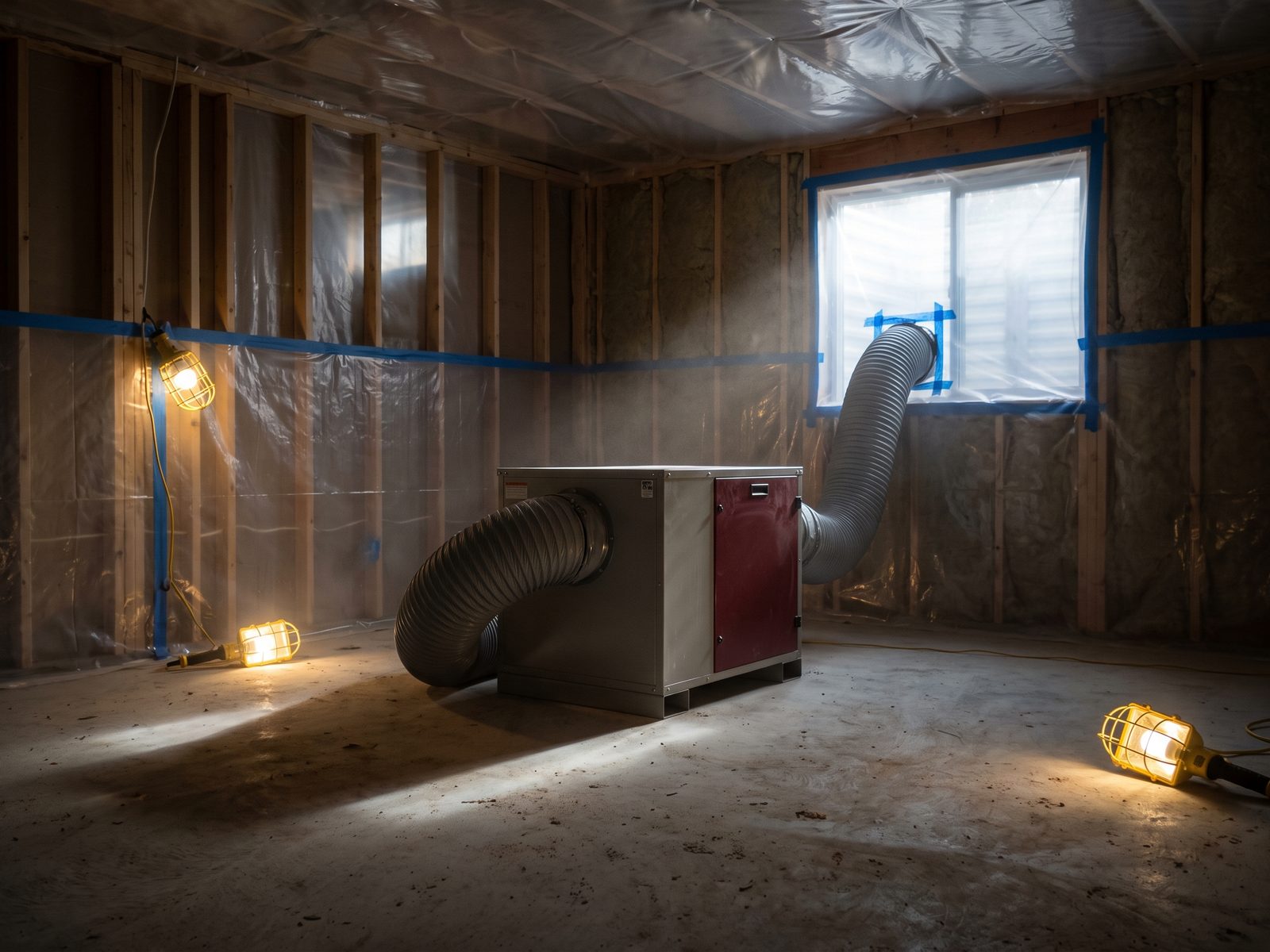
It is created by a HEPA-filtered machine, often called an air scrubber or a negative air machine, that pulls air from the chamber, filters it, and pushes it out through a flexible duct to the exterior. Makeup air enters through the entry flap and the gaps, all of it moving inward. Where exhausting outside is impractical, the same machine runs in recirculation mode, which cleans the chamber air but creates no pressure difference.
You can see it working without any instrument. The plastic sits visibly sucked inward, tight against the door frame, and stays that way. Crews verify it with a manometer across the barrier, and a smoke pencil at the seam shows which way the air travels. If the sheeting billows out into the hallway, the machine is off, the ducting is blocked, or the chamber has a hole big enough to defeat it.
What does a HEPA air scrubber do that a household purifier cannot?
A true HEPA filter is defined by performance, not by marketing: the EPA describes it as capturing at least 99.97 percent of particles at 0.3 microns, the size hardest for a filter to catch. A store-bought room purifier may carry the same filter rating and still be the wrong tool, because the filter is one part of the job.
The differences are mechanical. A remediation scrubber moves far more air, measured in hundreds of cubic feet per minute, and is sized so the chamber air turns over several times every hour. Staged pre-filters catch drywall dust before that grit reaches the final filter. The housing is gasketed so air cannot sneak around the filter under load. The duct collar lets the exhaust go out a window, which is what makes negative pressure possible.
A household purifier has none of that, and running one outside the chamber does not make up for a barrier that leaks. The scrubber filter is treated as contaminated waste at the end of the job, changed with the machine off and bagged on the spot.
- Airflow: sized to turn over the chamber air several times an hour
- Pre-filters: coarse stages protect the HEPA element from grit
- Sealed housing: air is forced through the filter, not around it
- Duct collar: lets the exhaust run to a window, which creates negative pressure
- Filter handling: removed with the unit off, bagged as waste
Why does the HVAC system have to be addressed before work starts?
Because the air handler is built to take air from one room and distribute it to every other room. A return grille inside a work area pulls contaminated air into the ductwork and delivers it upstairs while the crew is still setting up. That is the fastest way for a one-room mold problem to become a whole-house problem, and it happens before anyone notices a smell.
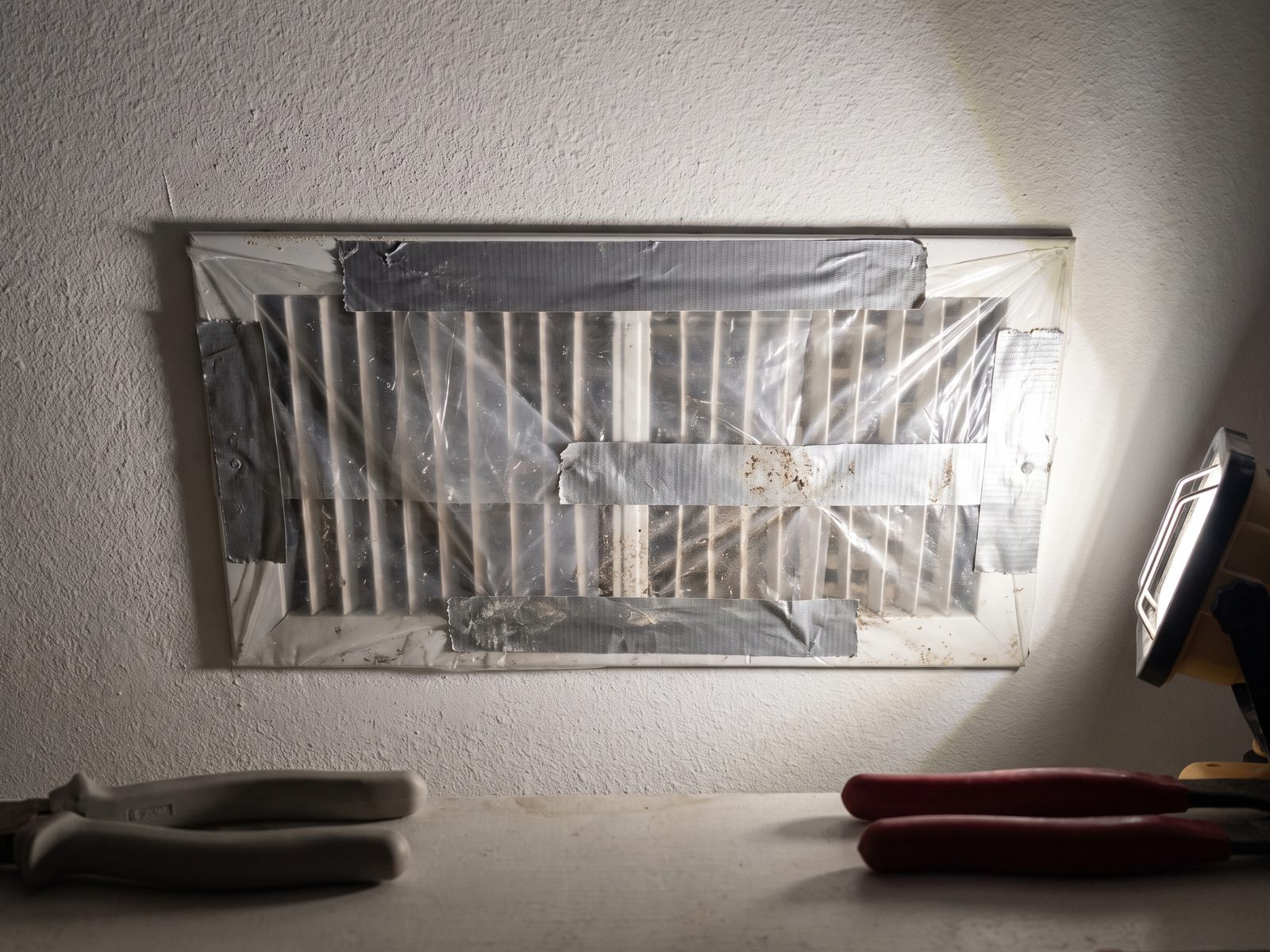
The fix is decided before the first sheet of plastic goes up. Supply and return openings inside the chamber get sealed over with plastic and tape. The system is usually shut down during active demolition, and where a return sits inside the work area it often stays off until the chamber comes down. That has consequences in a humid August week, so temporary conditioning or a schedule change gets discussed at the same time.
This is where Northern Virginia basements cause most of the trouble. In a finished lower level the air handler is often in the same room as the damage, which forces the chamber boundary to be drawn around mechanical equipment rather than a tidy doorway. If the ducts themselves are contaminated, cleaning them is a separate scope with its own verification, and it belongs after the source work.
What does a properly built chamber look like from the outside?
From the hallway it should look boring and tight. Sheeting runs floor to ceiling with no slack, taped continuously along the floor and up both jambs, stuck to a clean surface rather than to dust. The entry is a zippered slit or overlapping flaps, not a gap held shut by a folded corner. On a larger job there is a second small chamber outside the first, where a technician removes protective clothing.
The exhaust duct should run to a window sealed around the duct, not simply propped open. The scrubber should be audible and running continuously, including overnight, because a chamber that goes positive at 2am undoes the day's care. Look for bagged waste wiped down before it left the chamber, protection on the walk path, and no tracked dust outside the plastic.
Small details reveal the standard of the crew. Penetrations for cords and hoses are sleeved and taped. A sign on the barrier says what is happening inside. When a plumber needs to enter, they go through the zip with the machine running rather than slitting a new opening.
- Sheeting taped to floor, jambs and ceiling, pulled visibly inward
- A zip or flap entry, not a gap propped open
- Exhaust ducted outside, with the window sealed around the duct
- The machine running around the clock, not only in working hours
- Waste bagged and wiped before it crosses the barrier
How is the work verified when the plastic comes down?
Verification comes before the chamber comes down, never after. The sequence is: remove the contaminated material, clean every remaining surface by HEPA vacuuming and damp wiping, let the scrubber run on the settled dust, then inspect. Only when the inspection passes does anyone cut the plastic.
The inspection should be visual and physical before it is analytical. No visible growth, no dust or debris, no musty odor, and materials dry to a documented moisture standard, because growth returns if water still feeds it. On larger jobs a post-remediation verification should be done by someone independent of the company that did the removal, against criteria written beforehand.
Air sampling has a place, but it is blunt when used alone. A single sample is a snapshot of one moment in a space where spore counts move hour to hour, and clearance sampling means something only against an outdoor control taken the same day. Ask what the pass criteria are before the work starts, and ask who wrote them.
Can you stay in the house while containment is up?
Often yes. A sealed chamber under negative pressure exists so the rest of the home stays usable, and on a single-room basement job most families carry on upstairs with a clear walk path around the barrier. The answer changes when the work area spans a floor, when the HVAC has to stay off in extreme weather, or when the chamber blocks the only bathroom.
Occupancy also depends on who lives there. The CDC and EPA both note that people with asthma, allergies or weakened immune systems can react more to mold exposure than others, and general guidance is not a diagnosis. If someone in the household falls into one of those groups, that is a question for their physician rather than for a restoration contractor.
Practical points get overlooked. The machine runs day and night and it is not quiet. Doors on the walk path cannot be wedged open. Pets need to stay away from the barrier, because a cat that finds a warm duct will open a hole in the plastic. Expect the work area to be off limits entirely.
What should you ask before a crew starts building?
The useful questions are about method, not about products. A contractor who answers them clearly has thought about your building. One who answers with a brand name for a spray has not. Write the answers down: the scope you agree to at the start is what you will compare the invoice against later.
Ask about the moisture source first. Every question below sits downstream of the leak or the humidity that put water into the material. Containment is how the repair is performed safely. It is not the repair itself.
- What condition is each area in, and what is the scope for each one?
- Where exactly will the containment boundary run, and why there?
- Will the chamber be under negative pressure, and how will that be checked?
- How is the HVAC being handled, and will the system be off?
- Who performs the post-remediation verification, and what are the pass criteria?
- What is the moisture source, who is repairing it, and when?
- Was the building screened for asbestos or lead before any cutting?
Where do these standards and guidance documents come from?
Everything above follows published guidance rather than house opinion. The condition grades and the containment method come from the ANSI/IICRC S520 mold remediation standard. The size tiers, the cleanup advice for homeowners and the HEPA definition come from the EPA. The note about who reacts more strongly to mold comes from the CDC. The sources are listed below so you can read them yourself.
- IICRC standards catalog: https://iicrc.org/standards/
- EPA, Mold Remediation in Schools and Commercial Buildings, Chapter 2 (size tiers and containment): https://www.epa.gov/mold/mold-remediation-schools-and-commercial-buildings-guide-chapter-2
- EPA, Mold Cleanup in Your Home: https://www.epa.gov/mold/mold-cleanup-your-home
- EPA, What is a HEPA filter?: https://www.epa.gov/indoor-air-quality-iaq/what-hepa-filter
- CDC, About Mold and Health: https://www.cdc.gov/mold-health/about/index.html