Mold on Ceiling Causes: A Homeowner's Guide to Leak vs. Condensation

BYSteve Jafari, General ManagerNORTHERN VIRGINIA, MARYLAND & D.C.
Mold on ceiling causes come down to two sources: liquid water from a leak, or condensation forming on a cold spot where warm, humid indoor air meets a poorly insulated surface. The pattern is the tell. A defined stain or ring with a darker center usually means a roof, plumbing, or HVAC leak, while mold concentrated along edges, corners, seams, or in a geometric grid pattern usually means an attic-insulation and ventilation problem. Mold can begin establishing on damp materials within 24 to 48 hours, so identifying the right source first — and fixing it before cleanup — is what keeps the mold from coming back.
Call 1-888-29-FLOODWhat actually causes mold on a ceiling?
Mold on a ceiling is caused by one thing at its root: a moisture supply feeding a surface long enough that spores already present in the air can germinate and grow. In practice that moisture arrives in one of two ways — as liquid water from a leak above the ceiling, or as condensation that forms when warm, humid indoor air touches a cold spot on the ceiling surface.
Mold itself is not the problem you need to solve. Mold spores are present in essentially every building, all the time. What turns dormant spores into a visible, spreading colony is sustained moisture plus an organic food source, and your ceiling offers plenty of food: paper-faced drywall, paint binders, dust, and wood framing. Control the moisture and you starve the mold. Miss the moisture source and you will be repainting that same patch within months.
This is why guessing is expensive. If you clean a ceiling stain but the real driver was a slow roof leak or a cold attic surface, the colony simply regrows. The entire goal of this guide is to help you read the evidence — mainly the shape and placement of the growth — so you know whether you are chasing water or chasing air before anyone touches a scrub brush.
In the ceilings our technicians inspect across Virginia, Maryland, and Washington, D.C., the moisture source almost always sorts into one of those two buckets. Knowing which bucket you are in changes everything about the fix — the repair trade you need, the urgency, and whether hidden materials above the drywall are wet.
How does the mold pattern tell a leak from condensation?
The pattern is the single most reliable clue. A leak produces a defined stain — a roughly circular or teardrop-shaped mark, often with a brown or tan ring and a darker, sometimes black center, because water travels to one low point and drips or wicks outward from there. Condensation produces a diffuse, spread-out pattern that tends to follow the coldest surfaces: edges, corners, the perimeter where ceiling meets exterior wall, and sometimes a repeating grid or stripe pattern.
Think of it as water versus air. Liquid water is driven by gravity and finds a path, so leak mold is localized and has a source point. Condensation is driven by temperature, so condensation mold shows up wherever the ceiling is coldest — which is usually anywhere the attic insulation is thin, missing, compressed, or interrupted by framing.
That grid or stripe pattern deserves special mention. When you see dark lines running in a regular, evenly spaced pattern across the ceiling, you are almost certainly looking at 'ghosting' or thermal-bridging condensation. The ceiling joists or truss chords conduct cold through the insulation, making those lines slightly colder than the insulated bays between them. Moisture and dust collect preferentially on the cold lines, and mold follows. That is never a leak — it is an insulation and air-sealing story.
| Clue | Points to a leak | Points to condensation |
|---|---|---|
| Shape | Defined stain, ring, or teardrop | Diffuse, spread out, or grid/stripe pattern |
| Location | A single spot, often mid-ceiling or under a known fixture | Edges, corners, exterior-wall perimeter, cold lines |
| Color | Brown/tan water ring with darker center | Gray-to-black speckling, often lighter and even |
| Timing | Appears or worsens during/after rain | Worst in winter or in humid rooms (bath, kitchen) |
| Texture | Sometimes soft, sagging, or crumbling drywall | Surface staining, drywall usually still firm |
What does roof-leak or plumbing-leak mold look like?
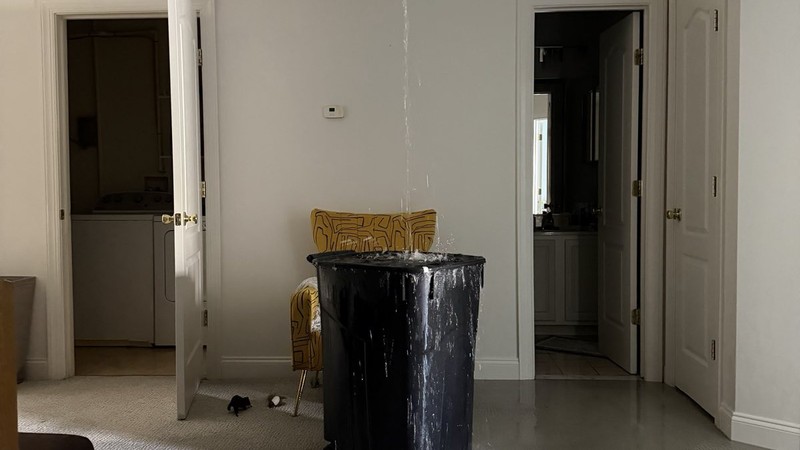
Leak-driven mold looks like a stain first and a mold colony second. You will typically see a discolored ring — the classic 'coffee stain' — with a center that is darker where water sat longest. Over time mold colonizes that wet zone, adding a fuzzy or speckled black, green, or gray growth on top of the water staining. The key feature is that it is concentrated and has an obvious point where water is entering.
Roof leaks tend to show up away from the exterior walls, out in the field of the ceiling, and they get visibly worse during or right after rain or snowmelt. The entry point on the roof is often several feet away from where the stain appears, because water runs along the top of the drywall or down a rafter before it finds a spot to drip. Plumbing leaks — a supply line, a drain, a toilet flange, or an HVAC condensate line in the attic — produce a similar defined stain but may be unrelated to weather, worsening whenever that fixture is used.
Ceilings under a second-floor bathroom, laundry, or water heater are prime plumbing-leak suspects. If the stain sits under a known wet area upstairs, trace the plumbing before you blame the roof.
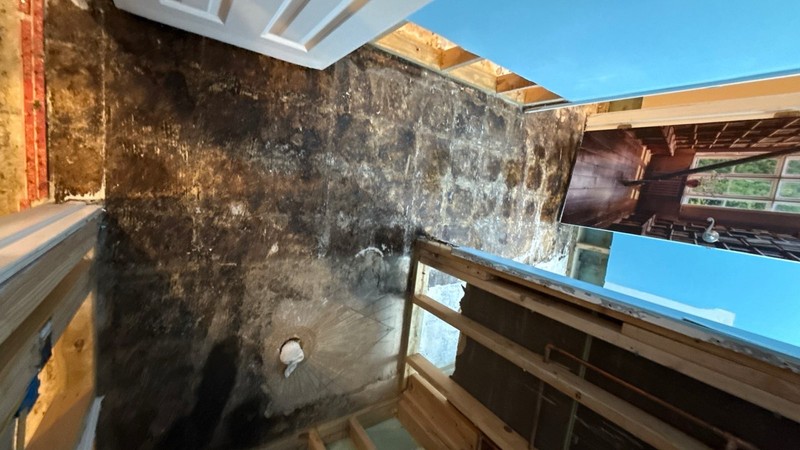
Leak mold is also the type most likely to involve hidden damage. By the time a stain shows on the finished ceiling, the back of the drywall, the insulation above it, and the framing may have been wet for days or weeks. That is a job for professional assessment, because what you can see is usually a fraction of what is wet.
- Defined stain with a ring and a darker center — water has a source point
- Worsens with rain, snowmelt, or use of a specific upstairs fixture
- Drywall may sag, feel soft, or crumble where it stayed saturated
- Often located out in the open ceiling, not just at the edges
- Frequently hides wet insulation and framing above the visible stain
What does attic-condensation and insulation mold look like?
Condensation mold looks like even, diffuse staining that hugs the cold parts of the ceiling. The most common presentation is mold along the perimeter where the ceiling meets an exterior wall, in corners, and in the top corners of closets on exterior walls — all places where insulation coverage is thinnest and air movement is weakest. It is usually a finer speckling than a leak stain, more uniform, and it is not centered on any single drip point.
This is fundamentally an attic problem showing up on your ceiling. In winter, warm moist air from your living space rises and leaks into the attic through gaps around light fixtures, the attic hatch, bath fans, and top plates. Where the ceiling is cold — because insulation is missing, compressed, wind-washed near the eaves, or bridged by framing — that humid air condenses against the drywall. The surface stays damp enough, often enough, for mold to establish. Poor attic ventilation makes it worse by trapping humid air up there instead of flushing it outside.
You will often notice condensation mold is seasonal and room-specific. It is worst in winter, worst on north-facing exterior walls, and worst in the most humid rooms: bathrooms, kitchens, and laundry areas. A bath fan that vents into the attic instead of outdoors is a classic cause — it dumps a plume of shower moisture right onto the cold underside of the roof and ceiling.
Because the water here comes from air rather than a pipe, the fix is different. Cleaning the mold is only step one; the lasting repair is air-sealing the ceiling plane, correcting insulation coverage, and making sure bath and kitchen fans exhaust fully outside. Skip that and the mold returns every cold season.
- Diffuse, even staining along edges, corners, and exterior-wall perimeters
- Grid or stripe 'ghosting' lines that follow ceiling framing
- Worst in winter and in humid rooms like baths and kitchens
- Linked to thin/compressed insulation, air leaks, and weak attic ventilation
- Drywall usually stays firm — it is a surface-moisture problem, not saturation
Can bathroom humidity alone grow mold on the ceiling?
Yes. A bathroom ceiling can grow mold from humidity alone, with no leak and no attic cold spot involved — just repeated bursts of warm, moisture-laden air from showers condensing on a ceiling that cannot dry out fast enough between uses. This is extremely common in windowless or poorly ventilated bathrooms.
The mechanism is the same condensation physics, concentrated into one small room. Each hot shower raises the air's moisture content and dew point; when that humid air contacts the ceiling — especially right over the shower or tub, or in a cold corner — it condenses into a thin film of water. If the room does not clear that humidity quickly, the film lingers, and over weeks of daily showers the paint and drywall paper feed a spreading colony.
The usual culprit is ventilation. Either there is no exhaust fan, the fan is undersized or clogged with dust, the fan runs for too short a time, or — as noted above — the fan discharges into the attic rather than outdoors. Running the fan during the shower and for 20 to 30 minutes afterward, keeping the door open to help the room dry, and wiping down a chronically wet spot all reduce the moisture load.
If bathroom ceiling mold keeps returning despite good habits, the moisture is likely getting reinforced from the attic side, and it is worth having the attic insulation, air-sealing, and fan ducting inspected as a system rather than treating the ceiling over and over.
How do I find the real moisture source before cleaning?
Find the source by matching the pattern to the conditions, then confirming with moisture readings rather than guesses. Start with the pattern from the sections above, then check what is happening upstairs and up in the attic. The goal is to prove where the water comes from before you remove a single piece of drywall.
Walk through this sequence. First, note the shape and location — defined stain versus edge/corner/grid. Second, note the timing — does it track rain, or does it track cold weather and showers? Third, look directly above: is there a bathroom, laundry, water heater, or HVAC unit, or is it open attic? Fourth, if it is safe, inspect the attic with a flashlight, looking for daylight at the roof, dark staining on the underside of the sheathing, wet or matted insulation, a bath fan dumping into the attic, and frost or water on nails in winter.
Moisture meters and thermal imaging remove the doubt. A pinless moisture meter tells you whether the drywall is currently wet and how far the wet zone extends beyond the visible stain. An infrared camera reveals cold spots and suspect wet areas you cannot see with the eye — readings that then get confirmed with a moisture meter, since infrared shows temperature, not moisture itself. This is where professional tools matter: our technicians map the actual extent of moisture so the cleanup matches the problem, not just the stain.
A quick self-check table can keep you organized while you investigate.
| Step | What to check | What it suggests |
|---|---|---|
| 1 | Pattern shape | Stain = leak; edges/grid = condensation |
| 2 | Timing | After rain = roof; winter/showers = condensation |
| 3 | Directly above | Plumbing/HVAC present = possible leak |
| 4 | Attic inspection | Wet sheathing, matted insulation, fan in attic |
| 5 | Moisture meter / IR | Confirms true extent of wet material |
Is ceiling mold dangerous, and when should I call a professional?
Ceiling mold should be treated as a health and structural concern, and you should call a professional when the affected area is larger than roughly a few square feet, when drywall is soft or sagging, when the growth keeps returning, or when anyone in the home has respiratory sensitivity. Mold can trigger allergic reactions, asthma symptoms, and irritation, and some species are more problematic than others — but from a homeowner's standpoint the species matters less than the moisture driving it.
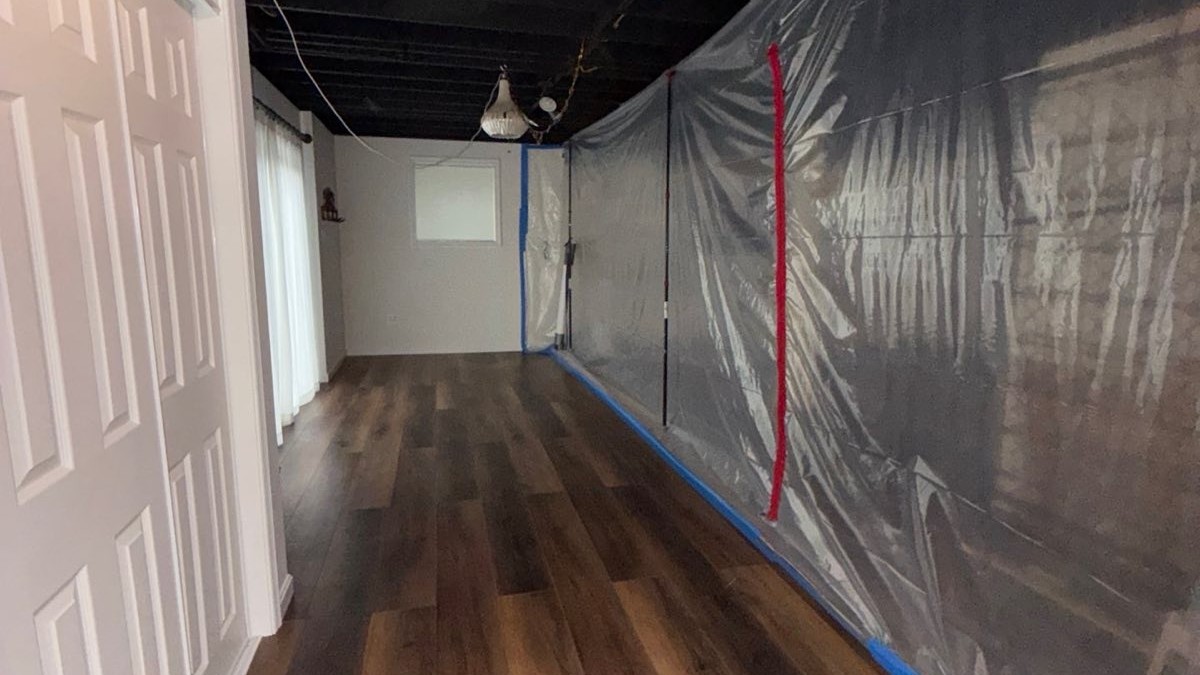
There is also a safety reason not to disturb large areas yourself. Scrubbing a sizeable colony releases spores into the air, and cleaning without fixing the source or without containment can spread the problem to other rooms through your HVAC. The ANSI/IICRC S520 Standard for Professional Mold Remediation that professionals follow exists precisely to contain, remove, and verify remediation so the problem does not simply migrate and regrow.
Any time the mold is tied to an active leak, treat it as more urgent, because you likely have wet insulation and framing above the ceiling that you cannot see. Sustained saturation can weaken drywall and, over time, affect structural wood. If the water involved sewage or another grossly contaminated source, it is Category 3 water under the IICRC S500 standard, which raises the hazard level and calls for stricter removal and protection protocols.
Restoration Doctor provides 24/7 emergency response across the Virginia, Maryland, and Washington, D.C. tri-state area — call 1-888-293-5663. If you are unsure, a professional moisture inspection is the fastest way to find out whether you have a surface problem you can manage or a hidden-water problem that needs remediation. Our mold remediation team handles the containment, removal, and verification; if a leak is involved, our water damage restoration team addresses the source and the structural dry-out. Every job is documented with an Xactimate scope, CompanyCam photos, and daily moisture logs, so if you file a claim you hand your insurer a carrier-ready file — we work for you, not your insurance company.
How do I stop ceiling mold from coming back for good?
You stop ceiling mold from returning by fixing the moisture source, not just the stain — repair the leak or correct the condensation conditions, then remediate the mold, then verify the area is dry. In that order. Cleaning first and fixing later is the most common reason mold reappears.
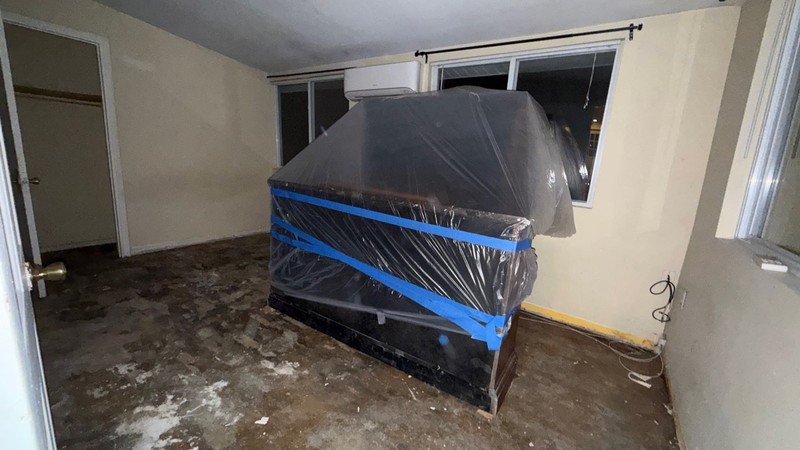
For leak-driven mold, that means repairing the roof, flashing, plumbing, or HVAC condensate line, then drying everything that got wet to verified drying goals before replacing materials. A proper structural dry-out typically takes several days and is monitored daily with moisture logs, so the hidden framing and cavity are genuinely dry, not just dry at the surface. Closing up a wall or ceiling over damp material is how mold comes back inside the assembly where you cannot see it.
For condensation-driven mold, the lasting fix lives in the attic. Air-seal the ceiling plane to stop warm humid indoor air from leaking up, bring insulation to a consistent, correct depth so there are no cold spots, duct every bath and kitchen fan fully to the outdoors, and ensure the attic is ventilated so humid air flushes out. Reduce indoor humidity in winter and run exhaust fans long enough to clear moisture after showers and cooking.
If you are weighing what the work will run, know that significant ceiling mold and water damage repairs typically run in the thousands. The real drivers are how much water got in, how far it spread, how much material has to be removed, and how many days of drying the assembly needs — which is why an honest number only comes after an on-site inspection with moisture readings, not from a phone estimate.
Here is a durable recovery sequence to follow for either cause.
- Identify and repair the moisture source — leak repair or attic air-sealing/insulation/venting
- Remediate the mold with proper containment so spores don't spread
- Dry affected materials to verified drying goals, confirmed with meters
- Replace or refinish only after the cavity is proven dry
- Control indoor humidity and run exhaust fans to prevent recurrence