Is Your Mold Remediation Contractor Licensed in Virginia, DC or Maryland?
BY RESTORATION DOCTOR · NORTHERN VIRGINIA, MARYLAND & D.C.

There is no mold remediation license in Virginia, so what you verify is a Board for Contractors license plus training, while the District licenses mold assessors and remediators through DOEE and Maryland regulates residential work through its Home Improvement Commission. This guide gives the lookup route for each, and explains why the company that tests should not be the company that clears the job.
Call 1-888-29-FLOODDoes Virginia license mold remediation as its own trade?
No. There is no mold remediation license in Virginia, and that answer surprises almost every homeowner who asks. The Virginia Department of Professional and Occupational Regulation, known as DPOR, runs boards for asbestos workers, lead abatement workers, home inspectors, tradesmen and building contractors, and none of those boards issues a mold credential. A company can remediate mold in Fairfax or Arlington tomorrow without holding anything with the word mold printed on it.
What a Virginia company does need is a contractor license from the Board for Contractors. DPOR describes that license as having two parts: the class, A, B or C, which sets the value of the contracts the firm may take on, and the classification or specialty, which sets the type of work allowed. Class A and Class B applicants also clear a financial verification step and an exam, and every new contractor license requires eight hours of pre-license education.
So the license is real and it matters. It proves the business is registered, that someone in charge passed a test, and that a homeowner has a complaint route to a state board. It does not prove the technician cutting into your basement wall has ever been trained to build containment or read a moisture meter. In Virginia the state stops at the business door.
- A Virginia contractor license proves the firm is registered with DPOR, carries the class for the contract value, and answers to a board complaint process.
- It does not prove mold training, containment competence, or that any technician on site holds a certification.
- Virginia has no mold assessor license and no mold remediator license, so those job titles carry no state meaning here.
How do you look up a contractor license before you sign anything?
DPOR publishes a free public License Lookup, and it settles the question faster than any conversation with a salesperson. Search the business name exactly as it appears on the estimate, not the name on the truck, because marketing names and licensed entity names often differ. If the estimate carries a license number, search that instead.
Read four fields on the record. Status should say active or current, not expired, suspended or closed. The expiration date should sit past the end of your project. The class should match the size of the contract you are about to sign. The classification or specialty should cover the work being proposed, because a license issued for one trade does not silently extend to another.
One practical note from the field. If a salesperson cannot produce a license number on request, treat that as the answer, because any legitimate firm carries that number on the estimate, the contract and the vehicle.
- Search the licensed entity name from the estimate, or the license number itself.
- Check status, expiration date, license class and classification or specialty.
- Confirm the name on the license matches the name on the contract you are signing.
- Print or screenshot the record and keep it with your file; records change.

What does the District require, and who issues it?
The District is the strict one. Mold work in Washington, DC is regulated by the Department of Energy and Environment, DOEE, under the District's mold law, and DOEE licenses indoor mold professionals in two separate tracks: mold assessors and mold remediators. To hold either license a professional has to pass a Department-approved examination, and DOEE publishes both the approved exam list and a public list of licensed mold professionals on its mold page.
That two-track structure is the part worth understanding. The District did not create one mold license; it created an assessment license and a remediation license, which tells you the regulator treats finding the problem and fixing it as two different jobs. DOEE also publishes the guidance documents and the rulemaking behind mold licensure.
If your property sits in the District, the verification step is simple: ask for the DOEE license, then confirm the name on DOEE's published list. We keep this short because our District site covers it properly. For the DOEE license rules in the District, see https://restorationdoctordc.com/blog/doee-mold-license-dc.
What does Maryland require, and how is it different again?
Maryland lands between the two. The Maryland Department of Labor's Division of Occupational and Professional Licensing runs boards for dozens of occupations, from electricians to home inspectors to plumbers, and there is no mold board among them. What Maryland regulates tightly is home improvement work, and mold remediation on a house almost always involves altering or replacing part of a residence.
That puts the work under the Maryland Home Improvement Commission, the MHIC. The Commission licenses and regulates home improvement contractors and salespersons, investigates homeowner complaints, awards damages against licensed contractors and prosecutes violations of the home improvement law. It also runs a Guaranty Fund, paid into by licensed contractors, that can compensate a homeowner for actual losses from poor workmanship, up to a cap the Commission publishes.
The consumer lesson is blunt: the Guaranty Fund applies only to work done by a licensed contractor. Hire an unlicensed one and that protection is gone. Maryland also requires home improvement contractors to carry general liability insurance, so an MHIC licensee has cleared a coverage requirement an unlicensed operator has not.
| Jurisdiction | Dedicated mold license? | What is actually required | Where you verify it |
|---|---|---|---|
| Virginia | No | A DPOR Board for Contractors license: class A, B or C plus the classification or specialty for the work. | DPOR License Lookup, by business name or license number |
| Washington, DC | Yes | A DOEE mold license, issued separately for mold assessors and for mold remediators, each requiring a Department-approved exam. | DOEE's published list of licensed mold professionals |
| Maryland | No separate mold board | An MHIC home improvement contractor license for residential work, plus the Commission's insurance requirement. | Maryland Department of Labor license search for MHIC licensees |
| All three | Not regulated anywhere | Technician competence. Training, certification and a written scope are voluntary everywhere. | Certification cards, the written scope, and the insurance certificate |
Why shouldn't the company that tests also do the remediation?
Because the party that defines the problem should not be the party that profits from the size of it. When one company writes the assessment, sets the scope, performs the removal and then declares its own work finished, every check on that work is internal. The District makes the point by licensing assessment and remediation separately, and the same logic holds in Virginia and Maryland even though no regulator enforces it.
The independence question has two halves. First, who writes the protocol: an independent indoor environmental professional or industrial hygienist inspects, finds the moisture source, and produces a written protocol. Second, who verifies the result: post-remediation verification should be performed by someone with no financial stake in the removal. A remediator who clears his own containment is grading his own homework.
This is not a rule against a restoration company inspecting at all. A contractor should meter and document before quoting, and any competent one will. The line sits at the clearance decision. Ask directly: who writes the protocol, who signs off at the end, and are those two parties financially connected?
- Ask who writes the remediation protocol and whether that person is independent of the remediation crew.
- Ask who performs post-remediation verification, and get the answer in writing before work starts.
- Be cautious when free testing is bundled with a same-day remediation quote from the same firm.
- In the District, confirm both the assessor and the remediator hold their own DOEE license.
Which certifications mean something, and which are marketing?
Certifications are not licenses, and no certifying body is a regulator. What a credible certification proves is that a named technician passed an exam written by a standards organization rather than by a marketing department. That is the gap Virginia's licensing structure leaves open, so it is the document worth asking for.
The IICRC, the Institute of Inspection, Cleaning and Restoration Certification, writes the two consensus standards this industry is judged against: ANSI/IICRC S500 for water damage restoration and ANSI/IICRC S520 for mold remediation. Its technician certifications track those standards, notably WRT for water damage restoration and AMRT for applied microbial remediation. DOEE's own list of approved mold examinations includes IICRC exams, which is a useful signal.
Two cautions. Certifications belong to people, not to companies, so a firm advertising one should be able to name the certified technician who will be on your job. And credentials expire, so a card issued years ago proves less than a current one.
- Ask which certified technician will be on your job, not which certifications the company owns.
- IICRC WRT and AMRT are the common technician credentials on mold and water work.
- ANSI/IICRC S520 is the mold remediation standard; ANSI/IICRC S500 covers water damage drying.
- A certification is never a substitute for the license your jurisdiction actually requires.
What should a written mold scope contain before you sign?
A written scope is the second half of checking a contractor, and it is where vague companies reveal themselves. It should name the affected areas by room and by material, state the containment plan, list what gets removed versus cleaned, and say how the job will be verified as complete. If a proposal is a single line reading mold remediation, you have nothing to hold anyone to.
Look specifically for the moisture source. Mold is a water problem wearing a costume, and a scope that never says where the water came from is proposing to remove growth that will return. The document should also state how materials leave the building, because carrying loaded debris through a clean hallway undoes the containment you paid for.
The EPA's homeowner guidance is a fair reference point for scale. Its brief guide points readers toward the schools and commercial buildings guide once the affected area grows past roughly ten square feet. Both documents are free and both are linked at the end of this guide.
- Affected areas listed by room and by material, with approximate quantities.
- The moisture source identified, and the repair that stops it.
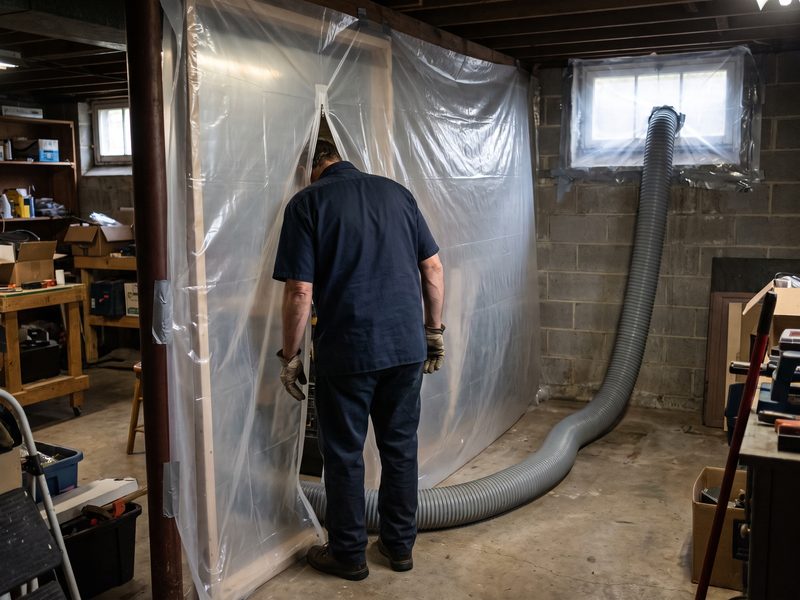
- Containment: barriers, negative air, and how debris leaves the building.
- What is removed, what is cleaned, and what is left in place, stated separately.
- Post-remediation verification: who performs it and what result ends the job.
What do insurance and bonding actually protect you from?
General liability insurance covers damage the contractor causes to your property. Workers compensation covers injuries to that contractor's employees on your site, which matters because an uninsured worker hurt in your basement can become your problem. Maryland requires its home improvement licensees to carry general liability coverage, and Virginia requires Class A and Class B applicants to satisfy a financial verification step, by financial statement or surety bond.
Two traps are worth naming. Many standard general liability policies restrict or exclude fungus and microbial claims, so a mold contractor should carry pollution or contractors environmental coverage on top. And a certificate of insurance is a snapshot, so ask that it come directly from the agent with your project dates on it.
Bonding is often misunderstood. A surety bond does not insure your home; it guarantees a specific obligation, and the amount is usually far smaller than a serious loss. Treat it as a threshold the contractor cleared, not as protection. Your policy, your carrier's decision and the contract you sign govern who pays for what.
What are the three checks to run in ten minutes before hiring?
A service area running from Fairfax into the District and up toward Bethesda crosses three regulatory regimes in about half an hour of driving. The same company can be correctly licensed on one side of a line and unlicensed on the other, and the only person who reliably checks is the homeowner.
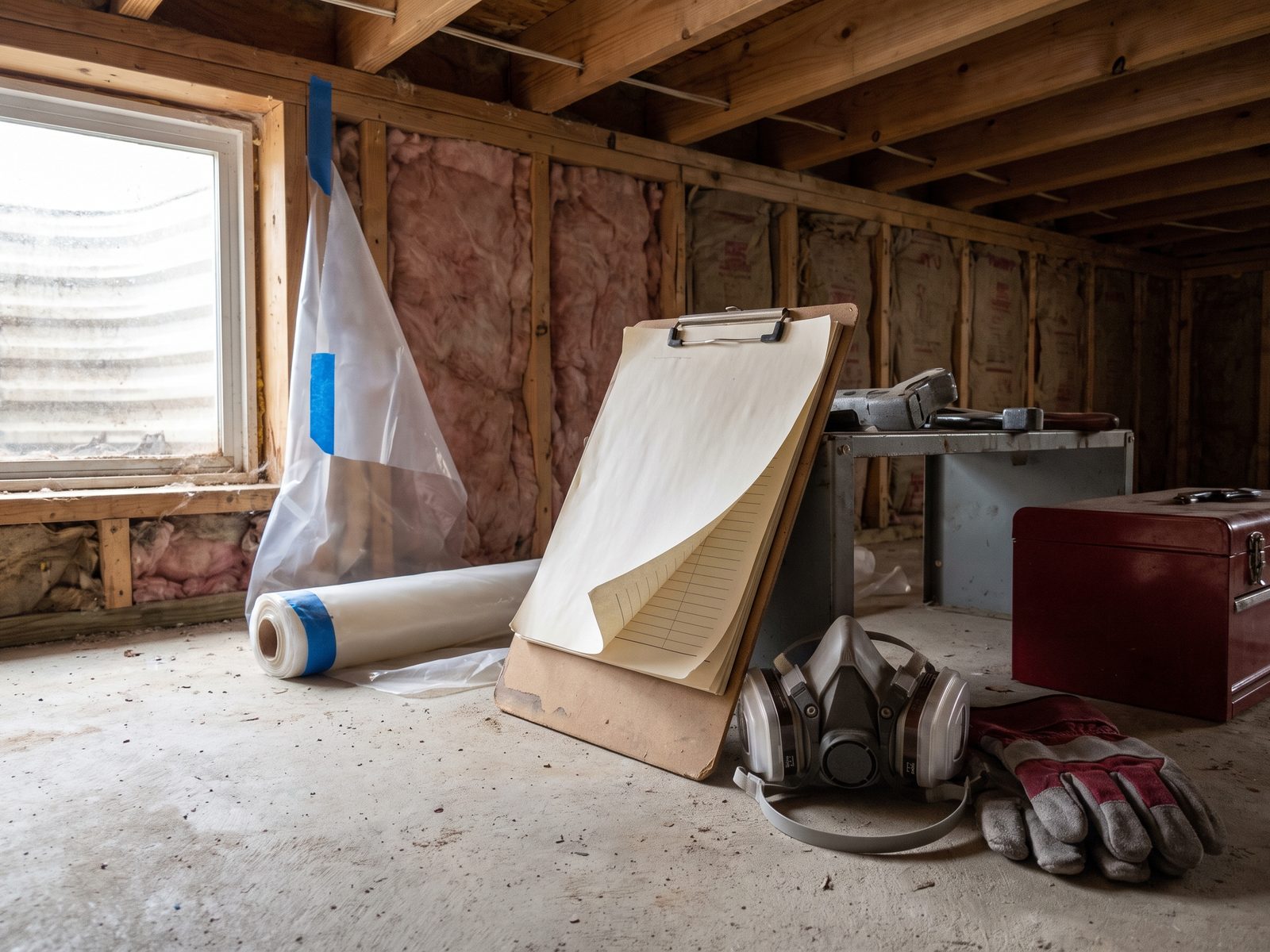
Check one is the license, in the jurisdiction where the property sits, not where the company is headquartered. Check two is the certification, by technician name. Check three is the scope, in writing. Any company that hesitates at all three has answered the question for you.
Our crews work across Virginia, the District and Maryland, and the verification habit is the same in all three. We list our own licenses and certifications on our credentials page, because a homeowner should not have to take that on trust.
- Check one, license: look the firm up in the regulator for the property's jurisdiction and confirm status, expiration, class and specialty.
- Check two, certification: get the certified technician's name and current credential, not a logo on a website.
- Check three, scope: require a written scope naming the moisture source, the containment, and the verification step.
Where can you verify all of this yourself?
Every claim above comes from a regulator or a standards body, and all of it is public. Use the links below rather than any contractor's summary, including ours. Records change weekly, and if a company website conflicts with the regulator, the regulator wins.
- Virginia Board for Contractors, license classes and specialties: https://www.dpor.virginia.gov/Boards/Contractors
- Virginia DPOR License Lookup: https://www.dpor.virginia.gov/LicenseLookup
- DOEE mold information and the list of licensed mold professionals in the District: https://doee.dc.gov/service/mold
- DOEE approved mold assessor and remediator examinations: https://doee.dc.gov/service/mold-training-and-testing
- Maryland Home Improvement Commission: https://www.labor.maryland.gov/license/mhic/
- Maryland Department of Labor, Division of Occupational and Professional Licensing boards: https://www.labor.maryland.gov/license/
- IICRC standards, including S500 and S520: https://www.iicrc.org/standards
- EPA, A Brief Guide to Mold, Moisture and Your Home: https://www.epa.gov/mold/brief-guide-mold-moisture-and-your-home
- EPA, Mold Remediation in Schools and Commercial Buildings: https://www.epa.gov/mold/mold-remediation-schools-and-commercial-buildings-guide