Water Damage Restoration in Purcellville, VA: What Should You Do First?

BYSteve Jafari, General ManagerNORTHERN VIRGINIA, MARYLAND & D.C.

If you need water damage restoration in Purcellville, VA and want to know what to do first: stop the water source, shut off power to affected areas, move valuables up, and call a licensed IICRC-aligned crew right away. Restoration Doctor answers 24/7 at 1-888-293-5663, arrives with a median 47-minute response across Northern Virginia, extracts standing water, and dries your structure to verified moisture standards while documenting everything for your insurance claim.
Call 1-888-29-FLOODWatch a real Purcellville, VA commercial water damage restoration:
Commercial Water Damage in Purcellville VA — A Medical Office Dried Room by Room
PURCELLVILLE, VA · COMMERCIAL WATER DAMAGE · DOCUMENTED ON SITE
What should you do in the first hour after water damage in Purcellville, VA?
In the first hour after water damage in Purcellville, VA, do four things: stop the water source, kill the power to wet areas, lift belongings out of the water, and call a professional restoration crew. Fast action in that first 60 minutes is the single biggest factor in how much of your home you save and how much your repair ultimately costs.
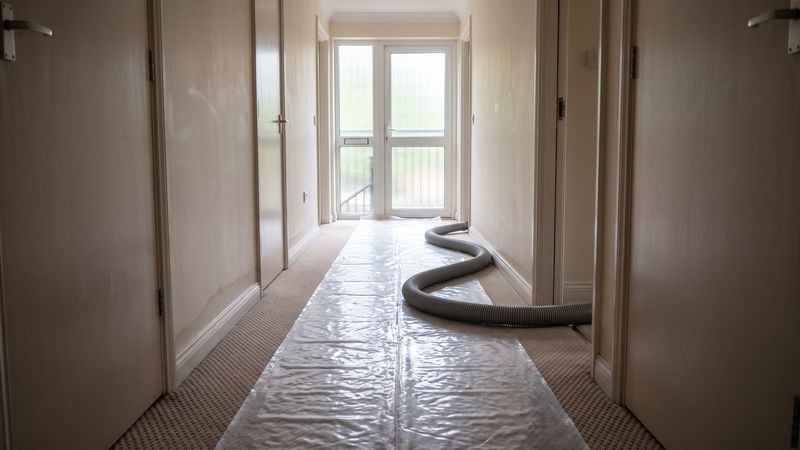
We saw this firsthand on a documented commercial water damage project our crews mitigated in Purcellville. A supply line above a suspended ceiling failed overnight and released clean water across finished offices, drywall partitions, and commercial-grade carpet before anyone arrived in the morning. By the time the property manager called, water had wicked several feet up the drywall and saturated the subfloor. Because the team on site had already shut the water off at the main and cleared a path, our technicians could go straight to extraction on arrival — and that head start is exactly what protected the building from a much larger loss.
The clock matters because water does not sit still. Within minutes it spreads across flat surfaces and wicks upward into porous materials. Within hours, drywall swells, finishes delaminate, and clean water begins degrading toward a contaminated category. Within 24 to 48 hours, the environment becomes ideal for microbial growth. Every action you take in that first hour buys back time on the back end.
If you are standing in water right now, do not wait to finish reading. Call our 24/7 emergency line at 1-888-293-5663 or visit our /emergency-water-damage page, and we will talk you through safe first steps while a crew is dispatched.
- Stop the source — shut off the fixture valve or the main water supply.
- Cut power — switch off breakers to affected rooms before stepping into standing water.
- Protect people first — never enter water near outlets, panels, or submerged cords.
- Move what you can — lift furniture, electronics, and irreplaceable items above the waterline.
- Document early — take wide and close-up photos before anything is moved or removed.
- Call for help — reach a licensed restoration crew so extraction starts fast.

Should you try to clean up water damage yourself or call a professional?
For anything beyond a small, clean spill you can fully dry within minutes, you should call a professional. A shop vac and towels remove the water you can see, but they cannot remove the moisture that has already wicked into drywall, wall cavities, subfloor, and framing — and that hidden moisture is what causes warping, delamination, and mold days later.
The core issue is measurement. Professional restoration is not just water removal; it is drying to a documented, verified standard. Under the ANSI/IICRC S500 standard for water damage restoration, technicians establish a drying goal based on unaffected reference materials, then use moisture meters and thermo-hygrometers to prove each affected material has reached it. Without those tools, a DIY dry-out can look and feel complete while framing behind the wall stays wet enough to rot or grow mold.
Water category also drives the decision. Clean water from a supply line is Category 1, but it degrades over time, and once it contacts contaminated materials or sits too long it can become Category 2 or 3. Category 3 water — sewage, rising flood water, or long-standing contamination — requires biohazard protocols and personal protective equipment that homeowners should not handle alone. When the category is uncertain, treat it as the more serious case and bring in help.
In the Purcellville commercial job, the standing water was clean at the source, but it had traveled through ceiling insulation and pooled against baseboards overnight. That combination is exactly why professional assessment matters: what starts as a simple leak can quietly cross category and material lines while you sleep.
How does professional water extraction and structural drying actually work?
Professional water damage restoration follows a defined sequence: inspect and classify, extract standing water, remove unsalvageable materials, then dry the structure with engineered airflow and dehumidification until it hits a verified drying goal. It is a controlled, measured process — not just fans and hoping.
It begins with inspection and moisture mapping. Technicians use moisture meters, infrared cameras, and thermo-hygrometers to trace exactly how far water has migrated, including inside walls and under flooring where it is invisible. That map defines the drying plan and prevents both under-drying (which leaves mold risk) and over-demolition (which runs up cost needlessly).
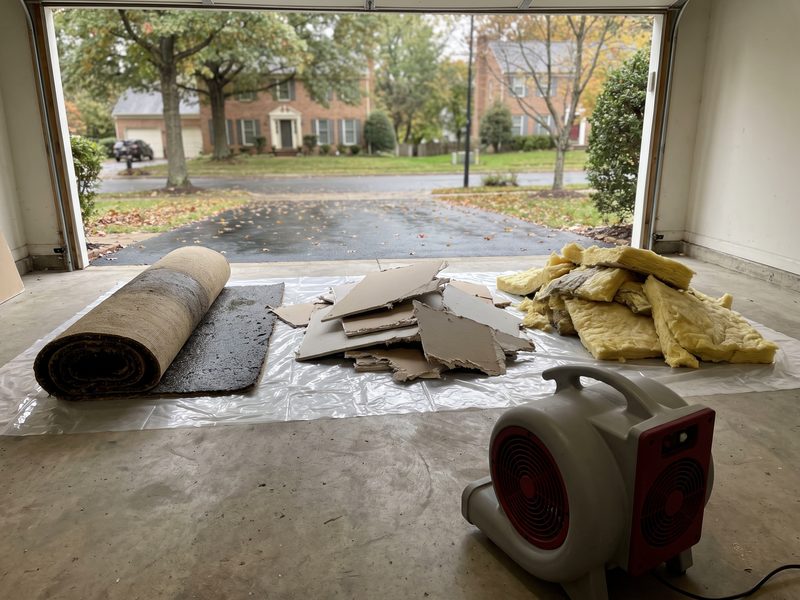
Next comes extraction. Truck-mounted and portable extraction units pull standing water and deeply saturated moisture from carpet and hard surfaces — removing water in liquid form is far faster and cheaper than evaporating it later. Then non-salvageable, saturated porous materials such as soaked drywall, wet insulation, and delaminated carpet pad are removed to open the assembly for drying.
Finally, the structure is dried using psychrometry — the science of the relationship between air temperature, humidity, and moisture. Air movers create high-velocity airflow across wet surfaces to speed evaporation, while commercial dehumidifiers pull that evaporated moisture out of the air so it cannot re-condense onto and re-wet other materials. Technicians return daily to log temperature, relative humidity, and material moisture content, adjusting equipment until every affected material meets its drying goal. You can see the full scope of this work on our /services/water-damage-restoration page.
- Inspect and classify water category and moisture spread with meters and infrared imaging.
- Extract standing and saturated water with truck-mounted and portable units.
- Remove unsalvageable porous materials to open wall and floor assemblies.
- Deploy air movers and dehumidifiers sized to room volume and moisture load.
- Monitor daily with documented moisture logs until verified dry.

How long does water damage restoration take in Purcellville, VA?
A typical structural dry-out takes about 4.5 days, monitored daily to verified dry standards. That is the drying phase specifically — the period during which equipment runs and technicians confirm materials are returning to normal moisture content. Extraction and equipment setup usually happen on day one, often within hours of your call.
The timeline depends on how much water was involved, which materials got wet, how long they stayed wet, and the water category. Dense materials like hardwood, plaster, and thick subfloor hold moisture longer than carpet and drywall. Higher water categories add cleaning and antimicrobial steps. A contained clean-water leak may dry in a few days, while a large or contaminated loss can run longer.
It is important to separate mitigation from reconstruction. Drying stabilizes the structure and stops further damage; that is the roughly 4.5-day window. Rebuilding — reinstalling drywall, flooring, trim, and paint — is a separate phase that follows once the space is verified dry, and its length depends on the finishes involved.
Across Northern Virginia our median on-site arrival is 47 minutes, with a response goal of on-site within 60 minutes across the core service area. That fast start is why Purcellville dry-out timelines stay on the shorter end — the sooner extraction begins, the less material stays saturated long enough to need removal.
| Phase | What happens | Typical timing |
|---|---|---|
| Emergency response | Crew dispatched, safe entry, source confirmed | Median 47 min arrival |
| Inspection & extraction | Moisture mapping, standing water removed | Day 1 |
| Material removal | Unsalvageable porous materials taken out | Day 1–2 |
| Structural drying | Air movers + dehumidifiers, daily monitoring | ~4.5 days |
| Reconstruction | Drywall, flooring, trim, paint restored | Separate phase, varies |
How much does water damage restoration cost in Purcellville, VA?
Water damage restoration costs in Purcellville, VA vary widely because every loss is different — the honest answer is a range, and any single flat price quoted sight unseen should make you skeptical. Cost is driven by the volume of water, the square footage affected, the water category, which materials need removal, and how long equipment must run to reach verified dry.
As general guidance, small and contained clean-water losses tend to fall at the lower end of the range, while larger losses, contaminated Category 2 or 3 water, and jobs requiring extensive material removal and reconstruction land significantly higher. Contributing factors include the number of drying days, the amount of equipment required for the space, any biohazard or antimicrobial treatment, and the scope of rebuild afterward.
Rather than quote a number sight unseen, our technicians assess the loss on site and build a line-item scope in Xactimate — the same estimating platform insurance carriers use. That gives you a transparent, itemized breakdown of exactly what work is proposed and why, so there are no surprises.
A key point for Purcellville homeowners: Restoration Doctor bills you, the homeowner, directly — we never bill your insurance company. What we do is hand you a complete, carrier-ready claim file so the amount you can recover from your policy is documented and defensible. About 83% of our customers file an insurance claim, and that documentation is often what determines how much of the cost they get back. For a deeper breakdown of what drives pricing, see our guide at /blog/water-damage-restoration-cost.

How does Restoration Doctor support your insurance claim?
Restoration Doctor supports your insurance claim by building a complete, carrier-ready claim file and handing it to you — the homeowner — so you can substantiate every dollar. We work for you, not your insurance company. You are always who we invoice, and you stay in control of your claim.
That claim file is built from three documented pillars: an Xactimate line-item scope in the format carriers recognize, timestamped CompanyCam photo documentation captured throughout the job, and daily moisture logs that prove the drying met verified standards. Together, they answer the questions adjusters ask before they pay: what was damaged, what work was done, and how do we know it was necessary and complete.
This matters because undocumented claims get reduced or denied. When you can show an adjuster a professional scope, dated photos of the loss and the mitigation, and daily readings proving the structure was dried to standard, you remove the guesswork that carriers use to justify lower payouts. Roughly 83% of our customers file a claim, and the strength of this documentation is a major reason those claims move faster.
On the Purcellville commercial project, this same documentation package let the property owner present a clear, defensible loss to their carrier without disputes over scope. You can learn more about how we assemble a claim file on our /insurance-claims page, or reach out through /contact to get started.
- Xactimate scope — line-item estimate in the format carriers use.
- CompanyCam photos — timestamped documentation of damage and mitigation.
- Daily moisture logs — proof the structure was dried to verified standards.
- Homeowner-direct billing — we invoice you, never your insurer, so you stay in control.
What are the warning signs of hidden water damage after a leak?
The warning signs of hidden water damage include musty odors, discoloration or staining on walls and ceilings, bubbling or peeling paint, warped or cupping floors, and a persistent damp feeling in a room. These signal that moisture is still present in materials even when surfaces look dry.
Hidden moisture is dangerous precisely because it hides. Water wicks into wall cavities, under flooring, and into subfloor and framing, where it evaporates slowly and invisibly. Left unaddressed, it degrades structural materials and — if it is not dried within 24 to 48 hours — leaves them at real risk of the mold growth that the ANSI/IICRC S520 standard for professional mold remediation exists to address.
If you suspect hidden damage after a leak, get a professional moisture assessment before you assume it dried on its own. Technicians can confirm with meters and infrared cameras whether materials have returned to normal moisture content or whether wet pockets remain behind finishes. Catching it early is far cheaper than treating rot or an established mold colony later.
If you already see or smell these signs, address the moisture first and the mold second — you cannot solve mold without solving the water feeding it. Our /services/mold-remediation team works alongside our water crews so the source and the symptom are handled together. For a fuller list of what to look for, read our guide at /blog/signs-of-hidden-water-damage.
- Musty or earthy odor that lingers after cleanup.
- Staining, discoloration, or water rings on walls and ceilings.
- Bubbling, peeling, or blistering paint and wallpaper.
- Warped, cupped, or springy flooring.
- Visible mold spotting near baseboards, trim, or ceiling corners.

Why choose a local, IICRC-aligned crew for Purcellville water damage?
Choosing a local, IICRC-aligned crew for Purcellville water damage means faster arrival, drying performed to recognized national standards, and documentation your insurer will accept. Speed and standards are the two things that most determine your outcome, and a local licensed team delivers both.
Restoration Doctor (legal entity: VA Water Damage LLC) is a licensed and insured restoration company headquartered nearby at 8609 Westwood Center Dr, Ste 110-1062, Vienna, VA 22182, serving the Virginia, Maryland, and Washington, D.C. tri-state area. Our work follows ANSI/IICRC S500 for water damage restoration, ANSI/IICRC S520 for mold remediation, and Category 3 biohazard protocols for contaminated losses — the same standards professional adjusters expect to see honored.
Experience matters when the water is rising. We have completed over 10,000 restoration projects across Virginia, Maryland, and D.C., and our median on-site arrival across Northern Virginia is 47 minutes with 24/7 emergency response. That local proximity is why Purcellville homeowners and property managers can have a crew extracting water before a small loss becomes a gut renovation.
If you are dealing with water damage right now, call 1-888-293-5663 any hour of the day, or visit our /locations page to confirm coverage in your area. The faster we start, the more of your home we save.