Polybutylene Pipe in Northern Virginia: Build Years and What Fails
BY RESTORATION DOCTOR · NORTHERN VIRGINIA, MARYLAND & D.C.
Polybutylene supply pipe was installed across Northern Virginia between roughly 1978 and 1995 and fails from the inside out, usually at the fittings rather than the pipe wall. This guide shows how to identify it yourself in ten minutes, which local build years carry it, where it lets go first, and how carriers treat a failure in a material with a known defect history.
Call 1-888-29-FLOODWhat is polybutylene, and why was it installed across Northern Virginia?
Polybutylene pipe in Northern Virginia is dull gray plastic supply tubing that carries potable water from the meter to every fixture. It went into new construction and re-plumbs from roughly 1978 through 1995, and it fails from the inside out, almost always at a fitting rather than through the middle of a pipe run.
The material took hold here for practical reasons. It cost less than copper, it coiled off a spool so a plumber could pull one continuous length with no soldered joints, and it was in ordinary use for potable water in new construction at the time. The region was building fast, and Reston, Herndon, Centreville, Sterling and the western edge of Prince William County went up in exactly that window.
What nobody knew was how the material would age in chlorinated municipal water. Polybutylene does not announce itself. A house can run on it for thirty years with nothing worse than a damp spot under a vanity, and then a fitting in a joist bay lets go at two in the morning. One clarification before anything else: Restoration Doctor does not re-pipe houses. We dry and rebuild what the water damaged, working alongside the licensed plumber who does the pipe work.
Which build years and which neighborhoods are most likely to have it?
Houses built or substantially re-plumbed between 1978 and 1995 are the risk window. In Fairfax, Loudoun, Prince William and Arlington you can look up your own year built on the assessor record in about two minutes. Build year is not proof. It is a reason to walk down to the water heater and look.
The correlation is strong here because the build-out and the material overlapped so neatly. Planned communities and townhouse stacks from that era were plumbed by production crews working to one spec, so the material tends to run street by street rather than house by house. Older stock from the 1950s and 1960s usually has copper or galvanized steel. Anything built after about 1996 will normally be copper or early PEX.
Re-plumbs muddy the picture in both directions. A 1965 rambler redone in 1984 can carry polybutylene, and a 1987 townhouse re-piped after a loss will not. The District has the same problem on a different clock, since row houses there run cast iron and galvanized steel. Restoration Doctor DC covers cast-iron failure in older District houses at https://restorationdoctordc.com/blog/cast-iron-pipe-failure-dc.
- Pull the year built from your county or city real estate assessment record first
- Check the permit history for a supply re-pipe after 1996, which usually clears the house
- Treat 1978 to 1995 as the window, with the mid-1980s as the densest part of it
- Look at additions and finished lower levels separately, since branch lines varied
- Ask the neighbors, because production-built streets were plumbed to one spec
How do you identify it in ten minutes without opening a wall?
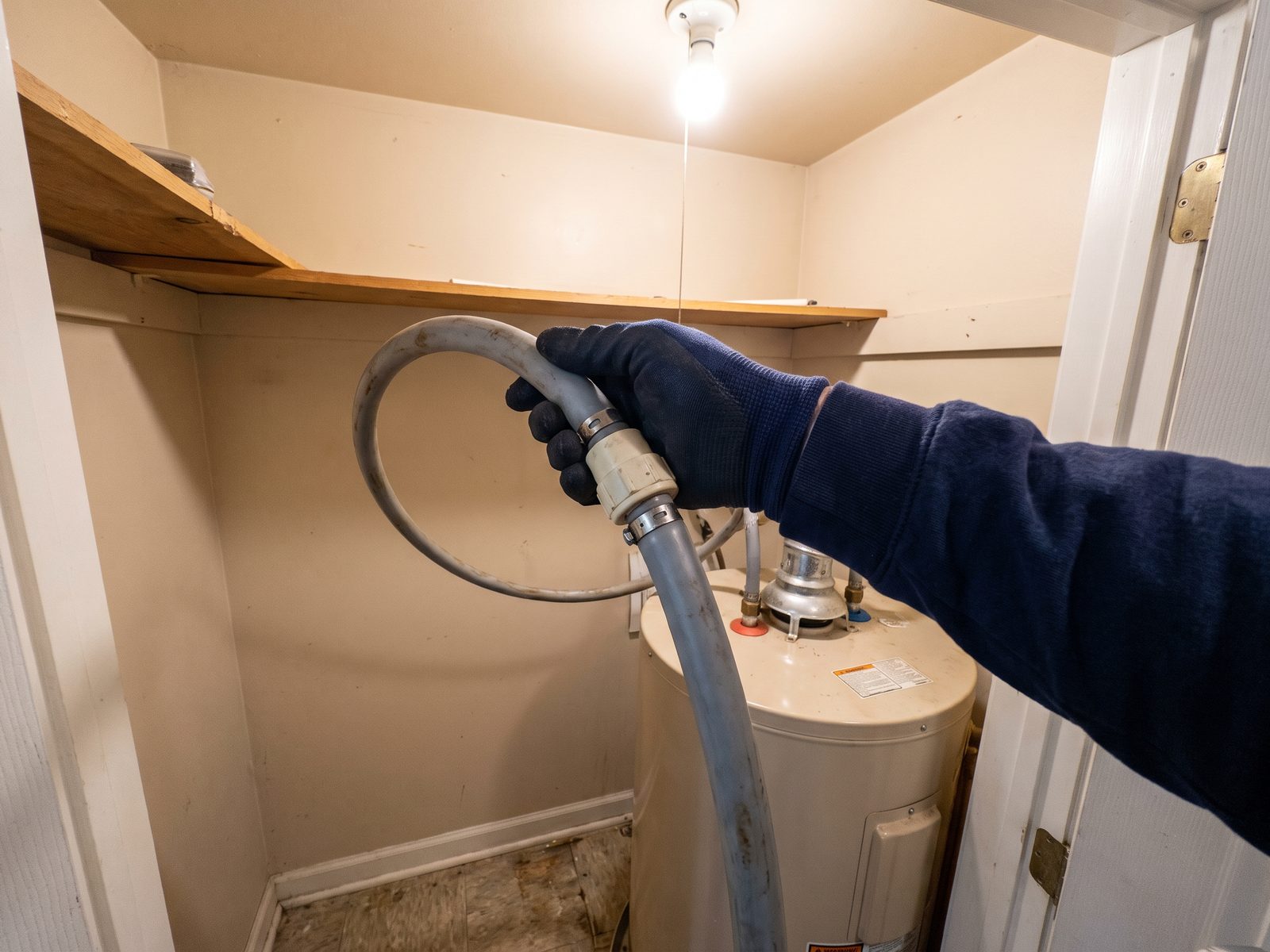
Start at the water heater. In most houses here the supply lines are exposed for a foot or two above the tank. Polybutylene inside the house is almost always dull gray, matte rather than glossy, slightly flexible, and usually half inch or three quarter inch. Blue tubing on the buried service line between the meter and the house can also be polybutylene, so read the printing rather than the color alone. Many runs carry a code including the characters PB2110 printed along the pipe wall.
Then check three more places that are almost always visible. The main shutoff where the line enters the house, usually near the front foundation wall. The shutoff valves under a kitchen sink or bathroom vanity. And the laundry box behind the washing machine. If gray plastic shows up at two of those four spots, you have your answer without cutting anything.
Confusion comes from the other plastics. CPVC is cream or tan, rigid, with solvent-welded joints. PVC is white and belongs on drain lines. PEX is flexible too, and it usually comes in red, blue or white with PEX stamped along it. Because blue can be either material, the printing on the pipe wall settles it, not the color. Photograph whatever you find, including the printing and the fittings, since those photos help the plumber now and the claim later.
| What you see | Likely material | What it means |
|---|---|---|
| Dull gray matte plastic, often printed PB2110 | Polybutylene | Near the end of its service life; have a plumber confirm |
| Red, blue or white flexible tubing stamped PEX | PEX | Modern supply material, usually evidence of a past re-pipe |
| Cream or tan rigid plastic with glued joints | CPVC | A different aging pattern; it grows brittle instead |
| Brown metal with soldered joints and rigid runs | Copper | Long service life; watch for pinholes at elbows |
| Gray metal, threaded joints, rust at the threads | Galvanized steel | Older material that corrodes closed and cuts pressure |
| White rigid plastic running to a floor drain | PVC drain line | Not a supply line and not under pressure |
Why does it fail, and is it the pipe or the fittings?
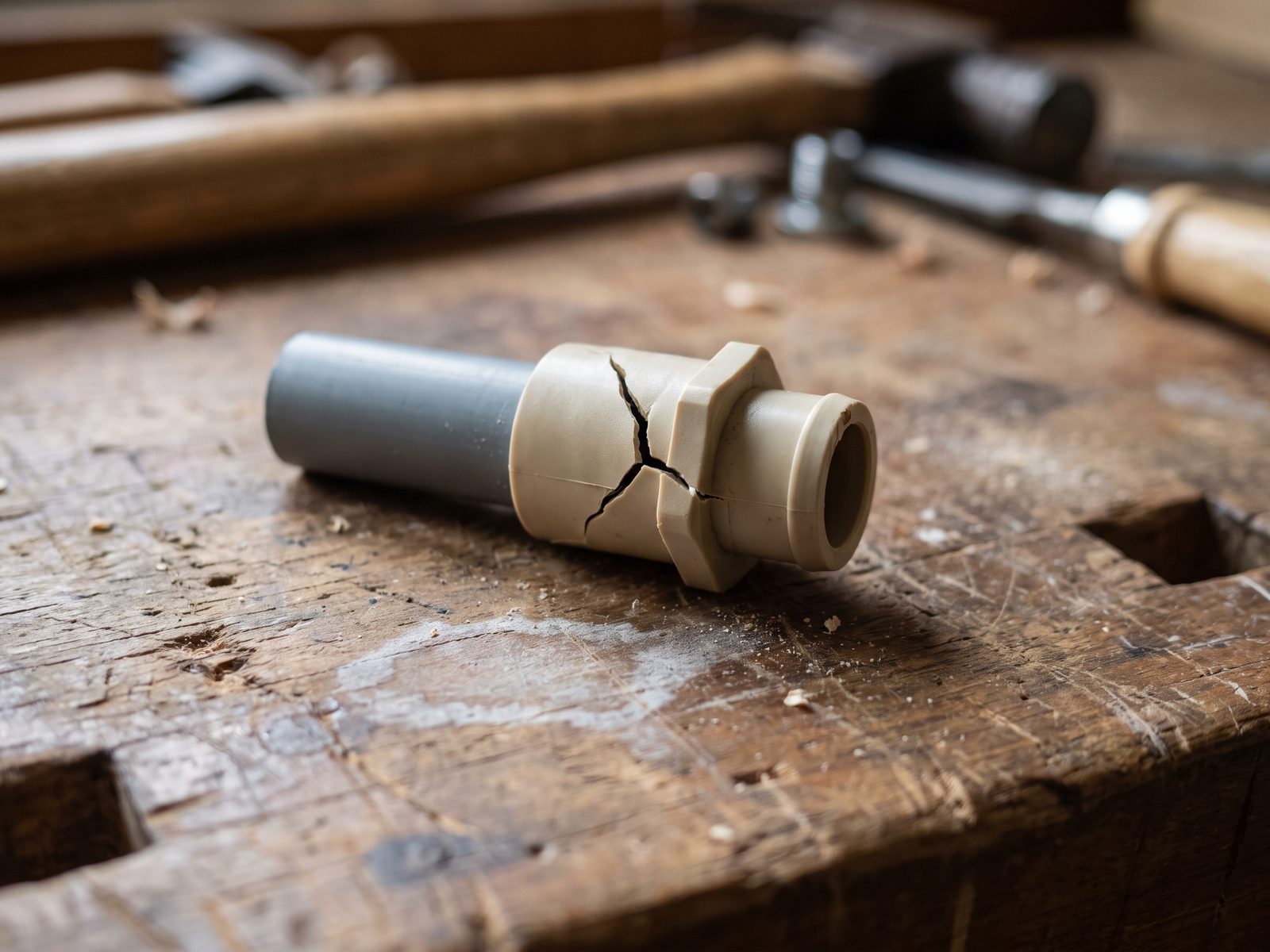
Most failures start at the fitting, not in the middle of a run. The original systems used acetal plastic insert fittings held by a metal crimp ring, and acetal reacts badly to the oxidants in treated municipal water. Chlorine and chloramine attack the plastic, micro-cracks form on the inside surface, and pressure does the rest.
The pipe wall degrades too, just more slowly. Cut open an old run and the inner surface can look chalky where the material has broken down. Once the wall thins in one spot, a pinhole opens or the pipe splits along its length. A half inch line under normal residential pressure does not trickle.
Several conditions speed the clock. High static pressure stresses every joint in the house. Hot water lines age faster than cold ones because heat accelerates the chemistry. The practical result is that age alone does not tell you which fitting goes first. Two identical townhouses on one street can be the same age, and only one loses a fitting behind a tub.
What does a polybutylene failure look like when it happens?
There are two shapes to it. The slow one is a weep at a fitting inside a wall or a joist bay that runs for days or weeks before anything shows. The fast one is a fitting that separates or a pipe that splits, putting pressurized water into the structure until somebody finds the main shutoff.
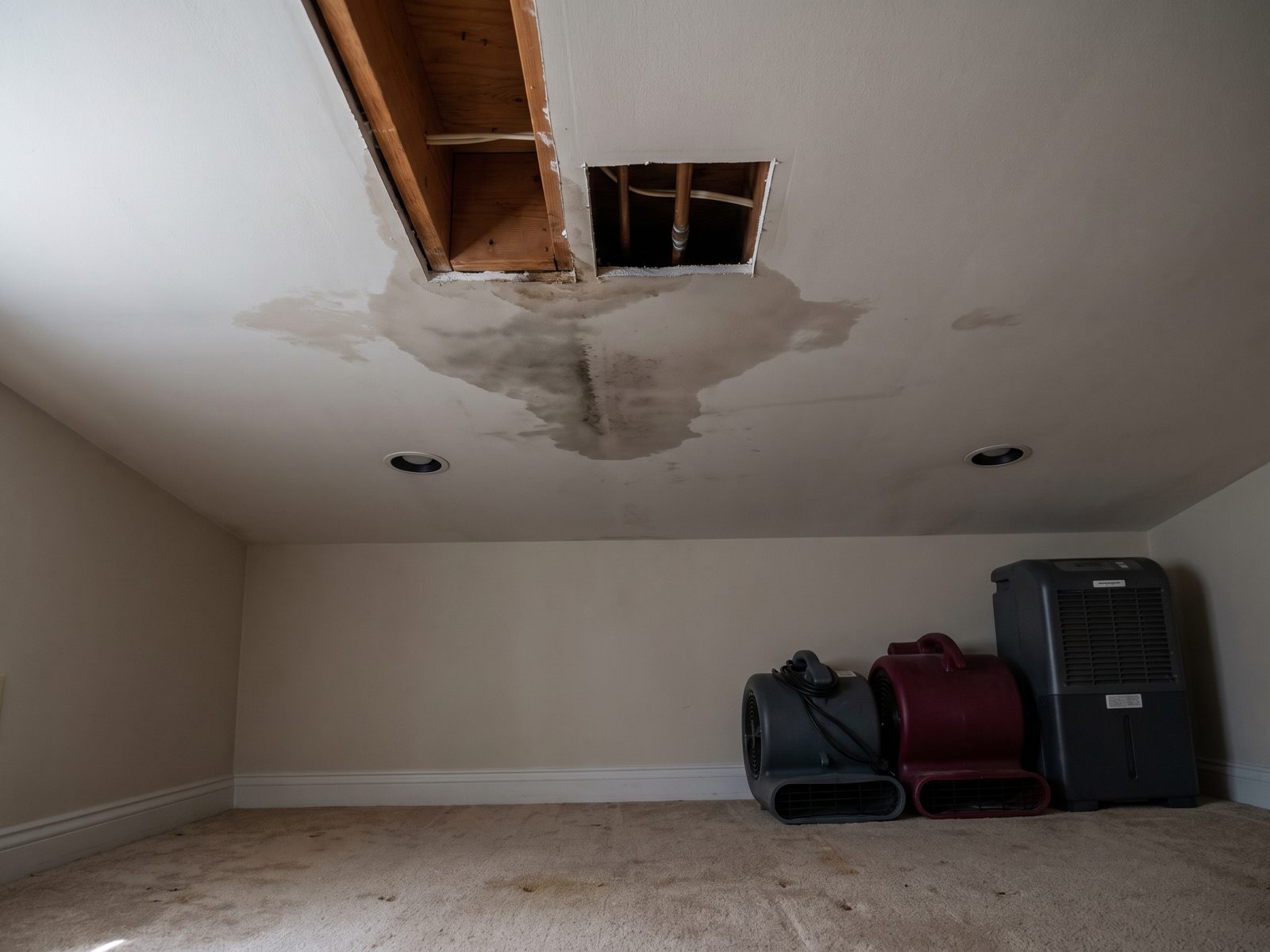
The slow version is often the more expensive, because the water has time to travel. It wicks into bottom plates, soaks insulation, runs along a joist and appears in a room nowhere near the pipe. By the time a ceiling stain shows, the cavity behind it has usually been wet for a while. The EPA puts the general window for mold growth on wet building materials at roughly one to two days.
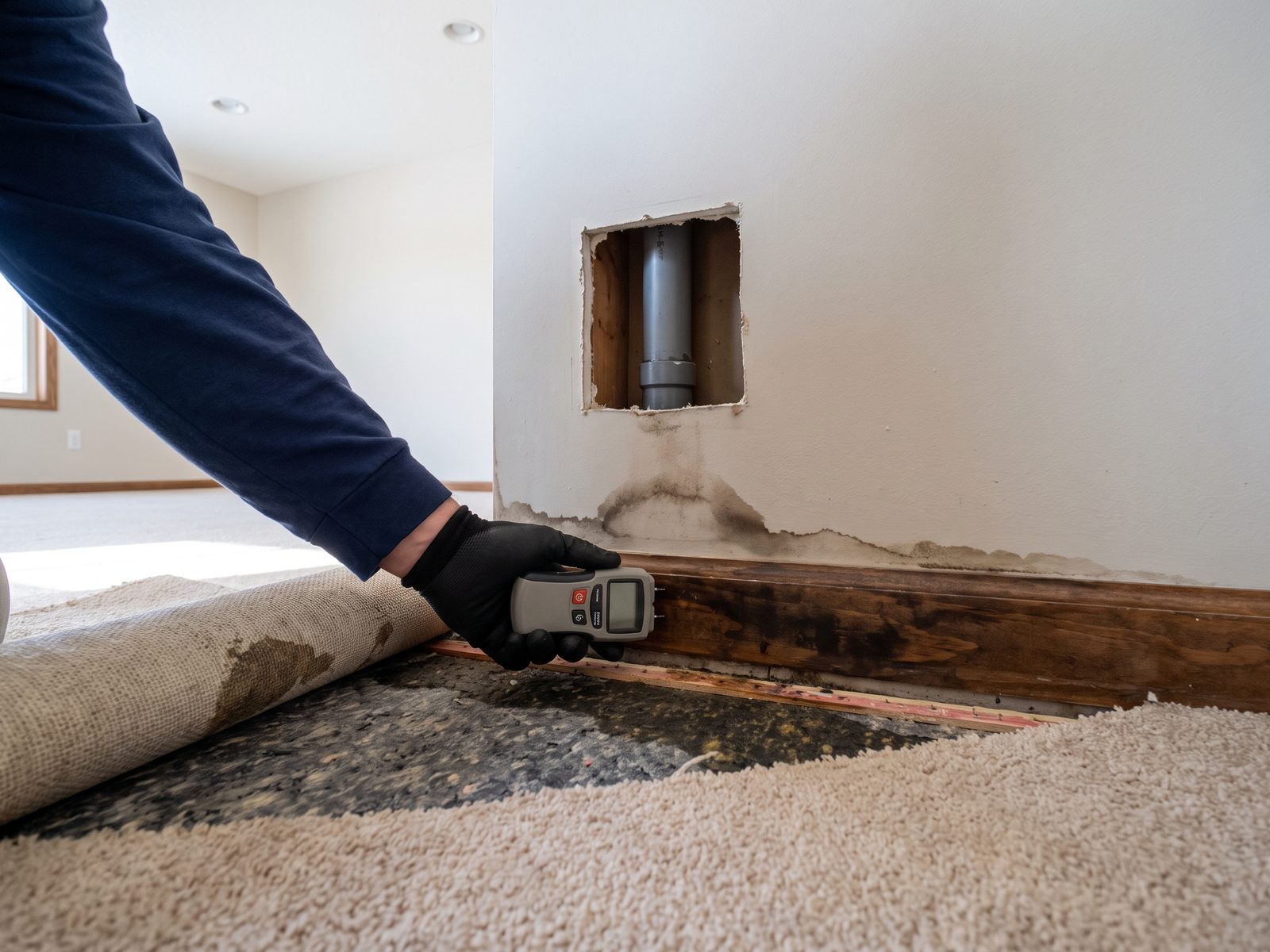
The fast version announces itself. Water comes through a ceiling in sheets, or a finished lower level takes standing water. What matters in the first ten minutes is the main shutoff, not the mop. Either way the wet footprint is larger than the stain, which is why our technicians read walls with a moisture meter and scan with thermal imaging before anything gets opened.
- A stain that reappears after painting, or a soft spot that gives under thumb pressure
- A musty odor in a closet or finished basement that does not clear with ventilation
- Baseboard that cups, swells or pulls away from the wall at one end of a room
- A water bill that climbs with no change in household use
- Buckled flooring or a lifted seam under a bathroom, laundry or water heater
Where does it usually let go first in a local house?
Failures cluster where heat, movement and pressure concentrate. The water heater connections are the most common starting point, because that is where the hottest water meets the oldest fittings. After that come the stub-outs behind toilets and vanities, the manifold, and horizontal runs crossing an unconditioned crawl space or garage ceiling.
Townhouse geometry raises the stakes. Many houses from this era stack a laundry or a hall bath above finished living space. A fitting that lets go upstairs pushes water through two ceilings before it reaches the slab. In a stacked unit the damage can cross a party wall, which turns one plumbing failure into two claims.
If a plumber is inspecting anything, have them start at the water heater and the manifold, then work outward to the stub-outs. That order follows the failure history of the material rather than the convenience of the access panel.
- Supply connections at the water heater, especially on the hot side
- The manifold, where many fittings sit within inches of each other
- Stub-outs at toilets, vanities and the kitchen sink
- The laundry box behind a washing machine, often on an upper floor
- Runs crossing a garage ceiling, a crawl space or unconditioned storage
Does homeowners insurance cover a polybutylene failure?
In most standard homeowners policies the sudden and accidental discharge of water from a plumbing system is a covered peril, and the resulting damage to the structure and your belongings is what the policy is there for. The failed pipe or fitting itself is usually excluded as the thing that broke. Damage covered, broken part not, is the shape of most of these claims.
Where the argument happens is over the words sudden and accidental. Many policies exclude damage from water that leaked repeatedly or seeped over weeks or months, and a slow weep at a polybutylene fitting is exactly the loss an adjuster may frame that way. This is why the discovery date and the moisture documentation matter. Dated photos and meter readings from the day of discovery read very differently from a description written later from memory.
Carriers also apply wear and tear and faulty material language differently from one another. Read your declarations page and the water damage section of the policy, and ask your agent to point at the specific wording rather than summarize it. No restoration contractor can promise you a coverage outcome. What a good one does is document the loss to the ANSI/IICRC S500 standard: daily moisture readings, psychrometric data, equipment logs and photographs tied to the structure.
Will a carrier decline to renew or refuse to write a policy over it?
Underwriting and claims are two separate conversations, and this one belongs to underwriting. Some carriers ask about supply line material on a new application or at renewal. Some do not ask at all. Some ask only after a water claim has been paid on the property. No single answer applies to every company writing business here.
The productive move is to ask your own agent or broker in writing, before a failure forces the conversation. Ask three things. Does this carrier ask about supply line material. Does a documented re-pipe change the rate or the eligibility. And what paperwork they would want, since a plumber's invoice naming the material is easy to get at the time and hard to reconstruct later. If you are buying a house in the build-year window, raise it during the inspection period rather than after closing.
What does replacement involve, and does it have to be done all at once?
A re-pipe replaces the supply lines through the house, normally with PEX or copper, and it is plumbing work performed by a licensed plumber. It is not restoration work and we do not perform it. We handle the part before and after: drying the structure to a verified standard and rebuilding the drywall, trim and finishes the work opened up.
Whether it happens all at once is a real question with real tradeoffs, and it belongs to you and your plumber. A whole-house re-pipe in one visit means one round of wall openings and one disruption. A phased approach spreads the cost, but the house keeps a mix of old and new material, and the remaining original fittings keep aging on their original clock. Ask which runs your plumber considers highest risk, and get the sequence in writing if you are phasing.
The wall repair is usually the surprise, since access openings get cut wherever fittings and runs need reaching. After an actual failure the order is not negotiable. Water off first. Extraction and structural drying next, with readings taken to a documented dry standard. Then the plumbing repair. Then reconstruction. Rebuilding over materials that are still wet is how a water claim turns into a mold claim.
What should you do today if you find gray pipe at the water heater?
If the pipe is dry, nothing about today is an emergency. Photograph the pipe and the fittings, including any printing on the pipe wall. Find the main shutoff, turn it to confirm it actually closes, and make sure everyone in the house knows where it is. Then have a licensed plumber confirm the material and give you a written opinion on condition and sequence. Inexpensive water alarms at the water heater, in the laundry and under the kitchen sink buy you early warning.
If the pipe is already leaking, the order is shorter. Close the main. Cut power to any circuit near standing water if you can reach the panel safely. Photograph everything before you move it, because those first photos carry the claim. Then call for mitigation, since the clock on wet materials starts immediately rather than when the adjuster gets involved. Our crews run around the clock across Fairfax, Arlington, Loudoun, Prince William and Alexandria, with a median arrival time of 47 minutes.
On arrival the work is the same regardless of what broke. We map the moisture footprint with meters and thermal imaging, extract standing water, set drying equipment sized to the affected space, and log readings daily until materials reach a documented dry standard. Then the rebuild puts the house back. The standards and public health guidance cited in this guide are listed below.
- ANSI/IICRC S500, the Standard for Professional Water Damage Restoration: https://iicrc.org/s500/
- EPA, A Brief Guide to Mold, Moisture and Your Home: https://www.epa.gov/mold/brief-guide-mold-moisture-and-your-home
- CDC guidance on mold and damp indoor environments: https://www.cdc.gov/mold-health/about/index.html