Water Leak Damage in Delaplane, VA: What Should You Do First?

BYSteve Jafari, General ManagerNORTHERN VIRGINIA, MARYLAND & D.C.

If you have water leak damage in Delaplane, VA, here's what to do first: stop the water source, cut power to affected areas if it's safe, move valuables clear, and call a licensed restoration crew for professional extraction and structural drying. Fast mitigation under the ANSI/IICRC S500 standard is what prevents a small hidden leak from becoming a mold and structural problem — and our crews document every step so your homeowner-direct claim file is carrier-ready.
Call 1-888-29-FLOODWatch a real Delaplane, VA hidden-water leak with structural saturation — multi-room drying restoration:
Water Damage in Delaplane VA — Hidden Leak Mapped, Dried to Standard, Ready to Rebuild
DELAPLANE, VA · HIDDEN-WATER LEAK WITH STRUCTURAL SATURATION — MULTI-ROOM DRYING · DOCUMENTED ON SITE
What should you do first when you find water leak damage in Delaplane, VA?
The first thing to do with water leak damage in Delaplane, VA is stop the water at its source and make the affected area safe — then call a licensed restoration crew for emergency extraction. Every hour that standing water and saturated materials sit, moisture wicks deeper into walls, subfloors, and cavities where you can't see or reach it. That's how a minor leak becomes a multi-room drying project.
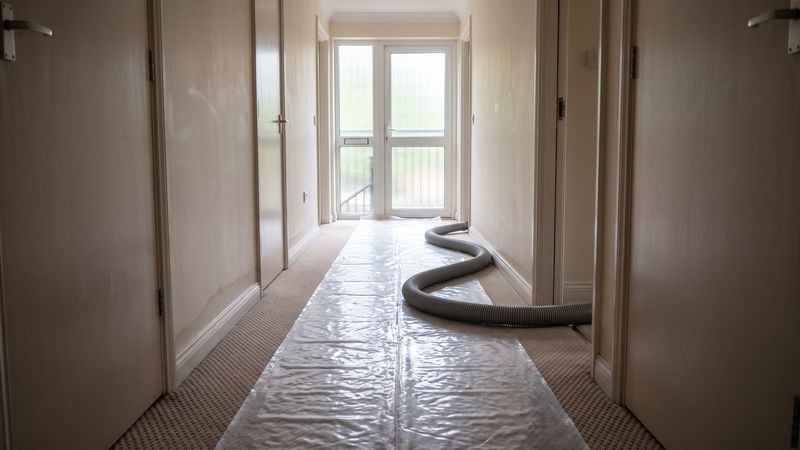
We saw this firsthand on a recent Delaplane job: a slow supply-line leak behind a second-floor bathroom vanity had been running quietly for days. By the time the homeowner noticed a soft spot in the hallway floor and a faint stain on the ceiling below, water had traveled through the subfloor, down the wall cavity, and saturated framing across three rooms. Nothing looked catastrophic on the surface — but a moisture meter told a very different story.
In the first hour, your priorities are safety, containment, and documentation. Do the simple things right and you protect both your home and your insurance claim before a technician even arrives.
- Shut off the water — close the fixture supply valve, or your home's main shutoff if you can't isolate the leak.
- Kill the power to wet areas at the breaker if water is near outlets, fixtures, or electronics, and never wade into standing water near live electricity.
- Move what you can — lift furniture, rugs, electronics, and valuables out of the wet zone or onto blocks.
- Blot and mop only surface water; do not use a household vacuum on standing water.
- Photograph and video everything before you move or clean anything — wide shots and close-ups of the source, the damage, and any wet contents.
- Call a professional for extraction and structural drying — surface drying alone leaves moisture trapped inside the structure.
| Priority | Action | Why it matters |
|---|---|---|
| Stop the source | Close the supply valve or main shutoff | Prevents more water from entering the structure |
| Ensure safety | Cut power to wet areas; avoid standing water near electricity | Reduces shock and slip hazards |
| Protect contents | Move or elevate furniture and valuables | Limits secondary damage and loss |
| Document | Photograph and video before cleanup | Builds the evidence your claim relies on |
| Call for help | Reach a 24/7 restoration crew | Professional extraction stops hidden spread |

How do you know if a hidden water leak has caused structural saturation?
You often can't tell a hidden water leak has caused structural saturation just by looking — the surface can feel nearly dry while framing, insulation, and subfloor stay soaked. Reliable clues include a musty smell, discoloration or staining that spreads, warped or springy flooring, bubbling paint, and a spike in your water bill with no obvious cause.
The only way to confirm the true extent is with professional moisture detection. On the Delaplane project, our technicians used moisture meters, thermal imaging cameras, and hygrometers to map exactly where the water had migrated. Thermal imaging revealed cool, saturated patches inside walls and above the downstairs ceiling that were completely invisible from the surface. This is the difference between guessing and knowing — and it's why trapped moisture behind an intact-looking wall is one of the most commonly missed parts of a water loss.
Under the ANSI/IICRC S500 standard, restorers establish a drying goal by measuring a dry standard — the normal moisture content of unaffected, comparable materials in your home — and then measure affected materials against it. Materials aren't considered dry because they feel dry; they're dry when instruments confirm they've returned to that baseline.
- Musty or earthy odor that lingers even when surfaces look clean
- Staining, discoloration, or watermarks that grow over days
- Warped, cupped, buckling, or spongy flooring
- Peeling paint, bubbling drywall, or sagging ceilings
- Persistent condensation, elevated indoor humidity, or a sudden unexplained jump in your water bill
How does professional water extraction and structural drying work?
Professional water extraction and structural drying removes standing water first, then uses controlled airflow and dehumidification to pull moisture out of the structure itself — the framing, subfloor, and wall cavities — until instruments confirm materials have returned to their dry standard. It's a science-driven process governed by psychrometry, not just fans blowing on a wet floor.
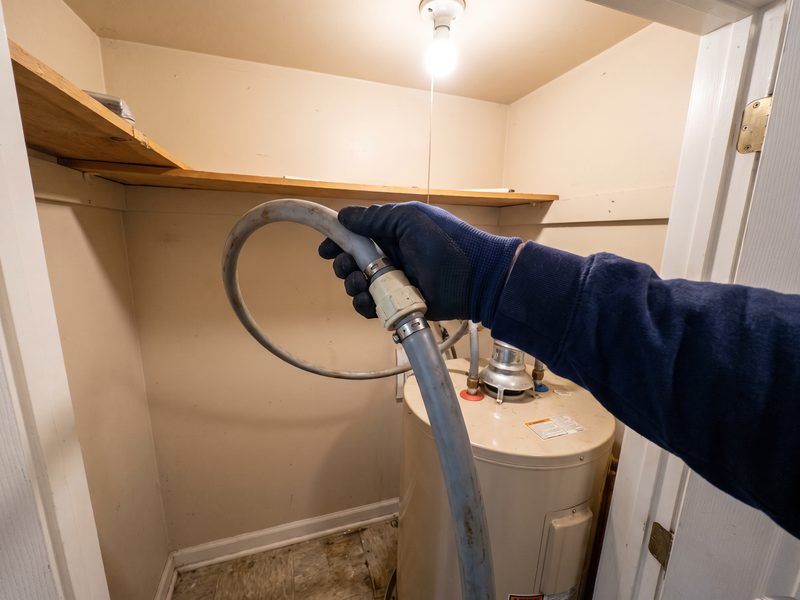
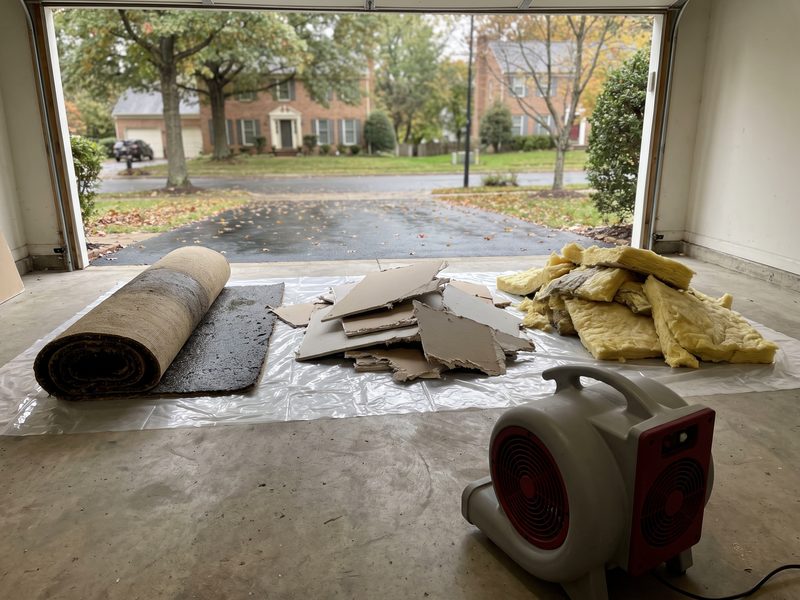
On the Delaplane multi-room job, our crew started with truck-mounted and portable extraction units to remove bulk water, then made controlled cavity access — small, strategic openings and baseboard removal — to reach trapped water inside the walls. We set commercial air movers to drive evaporation and paired them with LGR (low-grain refrigerant) dehumidifiers to capture that moisture and return dry air to the space. Temperature, relative humidity, and material moisture content were measured and logged every day.
The sequence matters. Extraction removes far more water, far faster, than evaporation ever can, so thorough extraction up front shortens the entire dry-out. From there, drying equipment is balanced to the size and saturation of each affected area — too little capacity and moisture lingers; too much without a plan and you waste days. Our technicians adjust the setup daily as the structure dries.
- Inspection and moisture mapping with meters and thermal imaging
- Bulk water extraction with truck-mounted and portable units
- Controlled cavity access to reach water trapped in walls and floors
- Antimicrobial application where Category 2 or Category 3 water is involved
- Air movers plus LGR dehumidifiers sized to the affected area
- Daily moisture readings verified against the dry standard

How long does it take to dry out a multi-room water leak?
A typical structural dry-out takes about 4.5 days, monitored daily to verified dry standards — though a multi-room leak with saturated framing and subfloor can run longer depending on how far the water traveled and what materials it soaked. Hardwood, plaster, and dense insulation hold water longer than drywall and carpet, so they extend the timeline.
On the Delaplane job, three affected rooms and a downstairs ceiling meant we ran equipment continuously and returned daily to check readings. As individual materials reached their drying goals, equipment was pulled and repositioned so the setup stayed efficient. Resist the urge to shut off fans and dehumidifiers overnight to save on noise or electricity — interrupted airflow stretches the process and invites mold.
Be wary of anyone who promises a fixed number of days sight unseen. The honest answer is that drying is complete when instruments confirm it, not when the calendar says so. Daily monitoring is how you know you're actually there rather than just hoping.
Speed of response drives everything. Our median on-site arrival across Northern Virginia is 47 minutes, and we target on-site within 60 minutes across the Northern Virginia core — the sooner extraction begins, the shorter the dry-out and the smaller the repair.
| Factor | Faster drying | Slower drying |
|---|---|---|
| Water category | Clean water (Category 1) | Contaminated water (Category 2/3) |
| Materials affected | Drywall, carpet | Hardwood, plaster, dense insulation |
| Extent | Single room | Multiple rooms and cavities |
| Response time | Extraction within hours | Water sat for days |
What does water leak damage restoration cost in Delaplane, VA?
Water leak damage restoration in Delaplane, VA generally ranges from a few hundred dollars for a small, quickly caught leak to several thousand dollars for a multi-room job with saturated framing, subfloor, and ceilings. The final figure depends on the water category, how many rooms and materials are affected, how long the water sat, and how much reconstruction is needed after drying.
Mitigation (extraction and structural drying) is usually priced separately from any rebuild work (replacing drywall, flooring, or cabinetry). A contained clean-water leak caught early tends to fall at the lower end of the range, while contaminated water, multi-room saturation like the Delaplane job, or extensive rebuild pushes toward the higher end. Because every loss is different, we provide a documented scope rather than a phone quote — no honest restorer can hand you a fixed price without seeing the moisture readings.
Here's the important part for your wallet: about 83% of our customers file an insurance claim, and sudden, accidental water leaks are frequently covered by homeowners policies. We bill you, the homeowner, directly — we work for you, not your insurance company — and we hand you a carrier-ready claim file so you can pursue reimbursement from your carrier with strong documentation behind you.
- Emergency extraction and initial mitigation
- Equipment days — air movers and dehumidifiers running until verified dry
- Water category and any antimicrobial treatment required
- Number of rooms, materials, and cavities affected
- Reconstruction to return your home to pre-loss condition

Will a hidden water leak lead to mold, and how do you prevent it?
Yes — a hidden water leak can lead to mold, and the window is short. Mold needs only moisture, an organic food source (drywall paper, wood, household dust), and time, which is why EPA guidance is to dry water-damaged materials within 24 to 48 hours to prevent growth. That's precisely why trapped, unseen moisture from a slow leak is so risky: the conditions are ideal and nothing on the surface warns you.
The single best mold prevention is fast, thorough structural drying that returns materials to their dry standard before spores can establish. On the Delaplane job, because the water had sat behind walls for days, our crew treated affected framing and cavities with an antimicrobial and verified drying at every measurement point before closing anything up. If mold has already taken hold, remediation follows the ANSI/IICRC S520 standard, which calls for containment, controlled removal of contaminated materials, and post-remediation verification — not simply spraying and painting over growth.
If you suspect a leak has been active for a while, don't wait to see whether mold appears — assume moisture is trapped and get it measured. Our water damage restoration and mold remediation teams work hand in hand so a wet-materials problem doesn't quietly become a health problem.
How does the homeowner-direct claim file support your insurance claim?
Your claim file is the evidence that proves what happened, how bad it was, and what it took to fix — and a strong one is often the difference between a claim that moves and a frustrating fight. Because we work for you, not your insurance company, we build that file to represent your loss accurately and completely, then bill you directly and hand you the documentation to submit to your carrier.
Every Restoration Doctor job includes three core pieces of documentation. First, a detailed Xactimate scope — the same estimating platform insurers use — so your line items speak the carrier's language. Second, CompanyCam photo documentation that timestamps and geotags conditions from arrival through completion. Third, daily moisture logs that show readings dropping toward the verified dry standard, proving the drying was both necessary and correctly executed.
On the Delaplane project, that package documented the hidden saturation across all three rooms, the extraction and drying performed, and daily proof of progress. When a homeowner can hand an adjuster that level of detail, questions get answered before they're even asked. We're also glad to speak with your adjuster to walk through the scope and readings.
Two quick tips: report the loss to your carrier promptly, and keep your own photos and receipts alongside our file. The more complete the record, the stronger your position.
- Xactimate scope — line-item pricing in the format carriers recognize
- CompanyCam photos — timestamped, geotagged documentation start to finish
- Daily moisture logs — proof of saturation and verified dry-down
- Direct billing to you, the homeowner — we advocate for your loss, not the carrier's bottom line

Why call Restoration Doctor for water leak damage in Delaplane?
Call Restoration Doctor for water leak damage in Delaplane, VA because fast, standards-based mitigation plus airtight documentation is exactly what protects your home and your claim — and it's what we do around the clock. We're a licensed, insured restoration company headquartered nearby in Vienna, VA, with 24/7 emergency response across Virginia, Maryland, and Washington, D.C.
Our crews have completed over 10,000 restoration projects across the region, follow the ANSI/IICRC S500 standard for water damage restoration and S520 for mold remediation, and apply appropriate biohazard protocols when Category 3 contamination is involved. With a median on-site arrival of 47 minutes across Northern Virginia and a target of on-site within 60 minutes in the core service area, we're built to start extraction while it still makes a difference.
If you're dealing with a leak right now, don't wait for the damage to reveal itself. Call 1-888-293-5663 or reach us through our contact page, and we'll get a crew moving, measure exactly how far the water traveled, and start the dry-out — with every step documented for your claim.