Crawl Space Water Standing Water Removal: A Homeowner's Guide

BYSteve Jafari, General ManagerNORTHERN VIRGINIA, MARYLAND & D.C.

Crawl space water standing water removal means pumping out the visible water, extracting residual moisture from soil and low spots, drying the space to a verified dry standard, and installing a vapor barrier plus a sump pump so it stays dry. Standing water under your house constantly evaporates upward and rides the stack effect into the living space above, driving indoor humidity, mold growth, and musty odors — which is why fixing it protects the whole home, not just the crawl space. Mold can begin colonizing wet framing within 24 to 48 hours, so speed matters: Restoration Doctor provides 24/7 emergency response across the Virginia, Maryland, and Washington, D.C. tri-state area at 1-888-293-5663.
Call 1-888-29-FLOODHow do you remove standing water from a crawl space?
To remove standing water from a crawl space, you pump the visible water out with a submersible or trash pump, extract residual moisture from the soil and any remaining puddles, then dry the space with air movers and commercial dehumidifiers until the wood framing reaches a verified dry standard. Finally, you install or repair a vapor barrier and, in most Northern Virginia homes with recurring intrusion, a sump pump to keep the water from returning.
The order matters. Removing the pooled water is only the first stage of the job — the moisture that has soaked into soil, wood joists, subflooring, and insulation is what keeps a crawl space wet for weeks afterward and pushes humidity up into your living space. That is why professional crawl space drying follows the same ANSI/IICRC S500 water-damage principles used anywhere else in a home: stop the source, classify the water, extract, dry with controlled airflow and dehumidification, and verify dryness with instruments rather than by sight or feel.
At Restoration Doctor, our technicians begin every crawl space job by identifying whether the water is clean groundwater, gray water, or Category 3 contaminated water — because that classification changes everything about how the space is handled, what protective equipment is required, and which materials can be dried in place versus removed. A crawl space full of clean supply-line water is a very different project from one holding floodwater or sewage, even if the two look identical from the access hatch.
- Pump out visible standing water with a submersible or trash pump
- Extract residual moisture from soil, puddles, and low spots
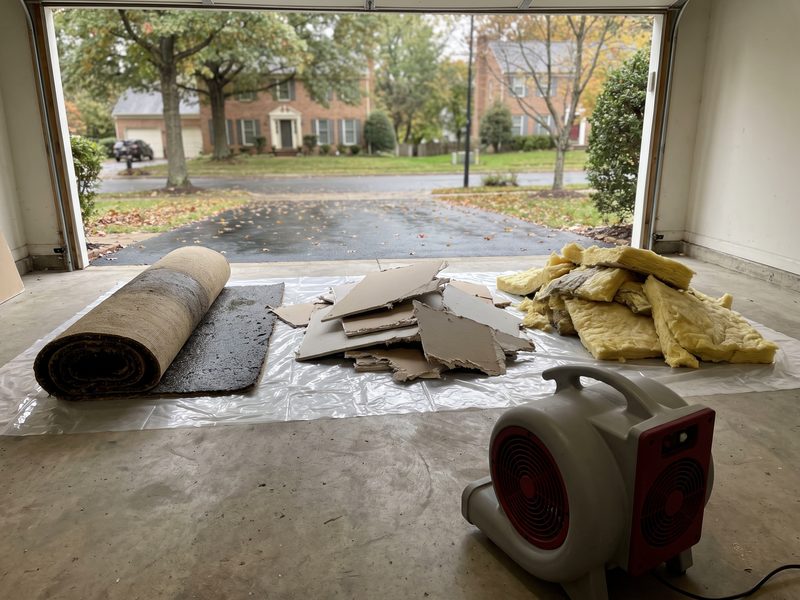
- Remove and bag saturated insulation and any Category 2 or 3 debris
- Dry framing and subfloor with air movers and commercial dehumidifiers
- Verify dryness with a moisture meter — never by look or feel
- Install a vapor barrier and, where needed, a sump pump to prevent recurrence
Why does standing water in a crawl space raise humidity in the whole house?
Standing water in a crawl space raises whole-home humidity because water constantly evaporates upward and, through the stack effect, air from the crawl space rises into your living areas. Warm air escaping through the upper levels of the house pulls replacement air up from below — which means a significant share of the air you breathe on the first floor originated in the crawl space beneath it. Wet ground under the house literally becomes humid air in your bedrooms.
A crawl space with an open dirt floor and standing water can release gallons of water vapor per day into the home above. That moisture load overwhelms your air conditioner, keeps indoor relative humidity elevated, and creates the damp, musty smell homeowners often notice long before anyone looks under the house. Elevated humidity also feeds dust mites and gives mold the moisture it needs to colonize floor joists, subflooring, ductwork insulation, and stored belongings.
This is the core reason crawl space water is a whole-home problem rather than a hidden one. You can have pristine, freshly painted living spaces upstairs and still suffer persistent humidity, cupping hardwood floors, condensation on windows, and allergy symptoms — all driven by an inch of standing water in a space you rarely see. Solving the problem at the source is far more effective than running dehumidifiers upstairs to fight the symptom.

What causes water to pool under a house?
Water pools under a house for a handful of predictable reasons: exterior grading that slopes rain toward the foundation, clogged or missing gutters and downspouts, a seasonally high water table, groundwater seepage through foundation walls, and plumbing or HVAC condensate leaks inside the crawl space itself. In the Virginia, Maryland, and Washington, D.C. region, heavy seasonal storms and clay-heavy soils that drain slowly make groundwater intrusion especially common.
Identifying the true source is critical, because pumping water out without fixing the cause simply resets the clock until the next rain. Our technicians trace the water path first — checking grade, downspout discharge points, foundation cracks, vapor-barrier gaps, and interior plumbing — so the repair addresses why the water arrived, not just the fact that it did.
Sometimes the source is a one-time event, like a burst supply line or a failed water heater. More often in this region it is chronic: the same low corner floods every time it rains hard, or the water table rises each spring and pushes moisture up through the soil. Chronic intrusion is exactly the problem a properly installed vapor barrier and sump system is designed to defeat.
- Negative or flat grading that directs rainwater toward the foundation
- Clogged, disconnected, or missing gutters and downspouts
- A seasonally high water table pushing groundwater upward through the soil
- Cracks or porous block in foundation walls
- A failed sump pump — or no sump system at all
- Leaking plumbing lines or HVAC condensate drains under the house
Is standing water in a crawl space dangerous?
Yes — standing water in a crawl space is dangerous to both your family's health and your home's structure. Within 24 to 48 hours it can begin supporting mold growth on wood framing — the same drying window EPA sets for water-damaged areas — and contaminated water can carry bacteria, sewage, or other pathogens that make the space a biohazard. Left alone, chronic moisture rots joists and subflooring, corrodes ductwork and metal fasteners, and attracts pests and wood-destroying insects like termites and carpenter ants.
The health risk is real because crawl space air moves upward into the home through the stack effect. Mold spores, bacteria, and musty microbial volatile organic compounds ride that airflow into bedrooms and living rooms, aggravating asthma, allergies, and general respiratory irritation, effects EPA describes on its mold and health page. Anyone in the home with a compromised immune system, and infants and the elderly, face higher risk from that exposure.
The water's source also determines its danger level. Under ANSI/IICRC S500, water from a sanitary source is Category 1 — but water that has contacted soil or sewage, or that has sat long enough to support microbial growth, escalates to Category 2 or Category 3. Standing crawl space water frequently qualifies as contaminated, which means it requires containment, personal protective equipment, and the removal — not the drying — of porous materials like fiberglass insulation.
| Category | What it means | Typical crawl space example | Insulation & porous materials |
|---|---|---|---|
| Category 1 | Water from a clean, sanitary source | Fresh supply-line break; clean condensate | May often be dried in place if addressed quickly |
| Category 2 | Significantly contaminated ('gray') water | Water that has sat and begun supporting microbial growth, or contacted soil | Usually removed and disposed of |
| Category 3 | Grossly contaminated ('black') water | Sewage backup or floodwater entering from outside | Removed and disposed of under biohazard protocols |

How does a vapor barrier and sump pump fix a wet crawl space?
A vapor barrier and sump pump fix a wet crawl space by working together: the sump pump removes water that collects, and the vapor barrier stops ground moisture from evaporating up into the home. The barrier is a heavy polyethylene sheet laid across the dirt floor — and often run up the foundation walls with sealed seams, as DOE Building America guidance specifies — that isolates the soil so it can no longer feed humidity into your house. The sump pump sits in a pit at the crawl space's low point and automatically ejects any water that accumulates before it can spread.
Think of it as offense and defense. The vapor barrier is defense: it blocks the constant, slow evaporation that drives whole-home humidity even when there is no visible flooding. The sump pump is offense: it actively removes bulk water during storms and high-water-table periods before it can pool against your foundation and framing. Together they convert a chronically wet crawl space into a dry, stable one.
For homes with severe or recurring intrusion, full encapsulation goes further by sealing the entire crawl space — floor and walls — and pairing the seal with a dedicated crawl space dehumidifier so the space stays dry year-round regardless of weather. But even a properly sealed vapor barrier plus a working sump pump eliminates the majority of crawl-space-driven humidity in this region's homes. Our team scopes the right level of protection based on the water source we trace during the initial assessment, so you're not paying for encapsulation when a barrier and pump will do — and not installing a barrier alone when bulk water demands a pump.
- Vapor barrier: seals the soil so ground moisture can't evaporate into the home
- Sump pump: automatically ejects water that collects in the pit at the low point
- Sealed seams and wall attachment: prevent moisture bypass at the edges
- Optional encapsulation plus dehumidifier: a full seal for chronic or severe cases
What are the steps in professional crawl space water removal and drying?
Professional crawl space water removal follows a defined S500 sequence: inspect and classify the loss, extract standing water, remove contaminated and saturated materials, dry the structure with controlled airflow and dehumidification, verify dryness with instrument readings, and install prevention. Each step is documented so you have a complete record of what was done, when, and to what standard.
The drying phase is where psychrometry matters. Air movers create the airflow that accelerates evaporation from wood and soil surfaces, while commercial dehumidifiers remove that moisture from the air so it doesn't simply condense back onto cooler surfaces. Technicians monitor temperature, relative humidity, and material moisture content daily until the framing reaches its dry standard — typically within a few percentage points of comparable unaffected wood in the same structure. Most structural dry-outs run several days, though a large or heavily saturated crawl space can take longer.
Throughout the project, we document everything with CompanyCam photos, daily moisture logs, and a full Xactimate scope. If you decide to file a claim, that documentation becomes a carrier-ready claim file you can hand your adjuster. Importantly, Restoration Doctor bills you, the homeowner, directly — we work for you, not your insurance company — so our scope reflects what your home actually needs rather than what a carrier program allows. You can read more about how that model protects you on our insurance claims page.
| Step | What happens | Typical timing |
|---|---|---|
| Inspection & classification | Locate the source, classify the water category, scope the damage | Day 1, first visit |
| Extraction | Pump standing water; extract residual moisture from soil and low spots | Day 1 |
| Material removal | Bag and remove wet insulation and any Category 2/3 debris | Days 1–2 |
| Structural drying | Air movers plus dehumidifiers, with daily monitored readings | Roughly 3–7 days, depending on saturation |
| Verification | Confirm the dry standard with moisture meters | Final drying visit |
| Prevention | Install vapor barrier and/or sump pump | After dry-out is verified |

Can I remove crawl space water myself, or do I need a professional?
You can handle minor, clean-water pooling yourself if the water is clearly Category 1, the volume is small, and you can identify and stop the source — for example, a slow supply-line drip you've already shut off. In that case a wet/dry vacuum or small utility pump, fans, and a dehumidifier may be enough, provided you verify with a moisture meter that the wood has actually dried rather than trusting that it feels dry to the touch.
You need a professional when the water is contaminated, when it returns after every storm, when insulation and framing are saturated, or when you already smell mold. Category 2 and Category 3 water require personal protective equipment, containment, and proper disposal — not a shop vac. And drying to a verified standard means measuring moisture content inside the wood, which DIY efforts almost never do. The result is a space that feels dry while the framing stays wet enough to grow mold for weeks.
The bigger risk with DIY is treating the symptom and missing the cause. If you pump the water out but the grading, gutters, or missing vapor barrier still let water in, you'll be back under the house after the next storm — and the wood will have endured another wetting cycle in the meantime. A professional assessment traces the source and installs the right prevention so the problem is actually solved. If you're unsure which situation you're in, call Restoration Doctor at 1-888-293-5663 — we provide 24/7 emergency response across the Virginia, Maryland, and Washington, D.C. tri-state area and can tell you quickly whether this is a DIY job or something that needs equipment and containment.