What Is the IICRC S500 Standard, and Why Should You Care?

BYSteve Jafari, General ManagerNORTHERN VIRGINIA, MARYLAND & D.C.

The IICRC S500 standard is the water-damage restoration industry's consensus reference for how to safely and effectively dry a building after a loss. It defines three water contamination categories, four drying classes, and the documentation practices that protect your structure from hidden moisture and mold. Hiring a contractor who works to the IICRC S500 standard also protects your insurance claim, because it produces the measurable, dated, defensible proof carriers expect — moisture logs, photo documentation, and a scope tied to real readings rather than guesswork.
Call 1-888-29-FLOODWhat is the IICRC S500 standard?
The IICRC S500 standard is the widely recognized reference document that tells water-damage restoration professionals how to properly inspect, categorize, and dry a water-damaged building. Its full name is the ANSI/IICRC S500 Standard for Professional Water Damage Restoration, and it is the closest thing the industry has to a rulebook for doing the job correctly.
In plain homeowner terms: when water floods your basement, backs up from a toilet, or drips silently inside a wall, someone has to decide how contaminated that water is, how far it spread, what can be saved, and how to dry everything back to a safe condition. The IICRC S500 standard is the science-based framework that answers all of those questions in a consistent, repeatable way instead of relying on a technician's guesswork.
The standard is grounded in psychrometry — the science of how air, temperature, and moisture interact. It explains how to use moisture meters, thermal imaging, air movers, and dehumidifiers together so a structure is dried to a documented, verifiable endpoint rather than simply looking dry on the surface. At Restoration Doctor, every job we perform is aligned to the IICRC S500 standard, and it shapes everything from the first inspection to the final dry-out verification.

Who created the IICRC S500 standard, and is it a law?
The IICRC S500 standard was created by the Institute of Inspection, Cleaning and Restoration Certification (IICRC), a non-profit standards-development organization, and it is published as an ANSI-approved consensus document. It is not a law, so no one is prosecuted for ignoring it — but it is the accepted standard of care that courts, insurers, and industry professionals point to when evaluating whether water damage was handled properly.
Because it carries the ANSI (American National Standards Institute) designation, the standard reflects broad agreement among restorers, scientists, equipment manufacturers, and insurance representatives about best practices. That consensus status is exactly why it matters to you: when a claim is disputed or a mold problem surfaces months later, the question is almost always whether the work met the recognized standard of care.
In practice, this means a reputable restoration company treats the IICRC S500 standard as a baseline, not an aspiration. When you hire a contractor who genuinely follows it, you get work that can withstand scrutiny from an adjuster, a home inspector, or a future buyer. When you hire someone who cuts corners, the gap between what they did and what the standard requires is often what fuels denied claims and recurring damage.
What are the water categories under the IICRC S500 standard?
The IICRC S500 standard sorts water damage into three categories based on how contaminated the water is, and that category drives nearly every decision that follows. Category 1 is clean water from a sanitary source, Category 2 is significantly contaminated "gray" water, and Category 3 is grossly contaminated "black" water that can carry harmful bacteria, sewage, or other pathogens.
Getting the category right matters enormously because it determines what materials can be dried and saved versus what must be removed and discarded. A soaked carpet from a clean supply-line break may be salvageable, while the same carpet soaked by sewage almost always has to go. The standard also recognizes that water degrades over time — clean water left sitting can deteriorate into a higher, more contaminated category as it picks up soils and feeds microbial growth. That's one more reason speed matters after any water loss.
Here is how the three categories break down in practical terms.
| Category | Common name | Typical sources | General approach |
|---|---|---|---|
| Category 1 | Clean water | Supply lines, faucets, falling rainwater, water heater lines | Often dried in place if handled quickly |
| Category 2 | Gray water | Dishwasher/washing machine overflow, aquarium leaks, toilet overflow with urine only | Requires cleaning, antimicrobial treatment, and selective removal |
| Category 3 | Black water | Sewage backups, rising floodwater from rivers/storms, standing water supporting microbial growth | Aggressive removal of porous materials and biohazard protocols |

What are the drying classes in the S500 standard?
Beyond categorizing how contaminated the water is, the IICRC S500 standard also defines four classes of water intrusion that describe how much water is present and how difficult it will be to evaporate. Categories tell you about contamination; classes tell you about the drying challenge. Together, they let a technician design the right equipment plan for your specific loss.
Class determination guides how many air movers and dehumidifiers are needed and how long drying will take. A small spill on a tile floor is a very different problem from water wicked two feet up drywall and trapped inside wall cavities, even if both started as clean water. Matching equipment to the class is what separates a genuine dry-out from a rented fan pointed at a wet spot.
The four drying classes generally break down as follows.
- Class 1: The least amount of water absorption and evaporation load, affecting only part of a room or materials that hold little moisture — the fastest to dry.
- Class 2: A significant amount of water affecting an entire room, including carpet and cushion, with moisture wicking up walls less than about two feet.
- Class 3: The greatest evaporation load, often from an overhead source, saturating ceilings, walls, insulation, carpet, and subfloors.
- Class 4: Specialty drying situations involving deeply held moisture in low-evaporation materials like hardwood, concrete, plaster, or masonry, requiring specialized methods and longer timelines.
How does the S500 drying process actually work?
Under the IICRC S500 standard, drying is a measured, monitored process — not just running fans until things feel dry. The technician establishes a drying goal based on dry, unaffected reference materials, then uses moisture meters and psychrometric readings each day to confirm the structure is actually reaching that goal.
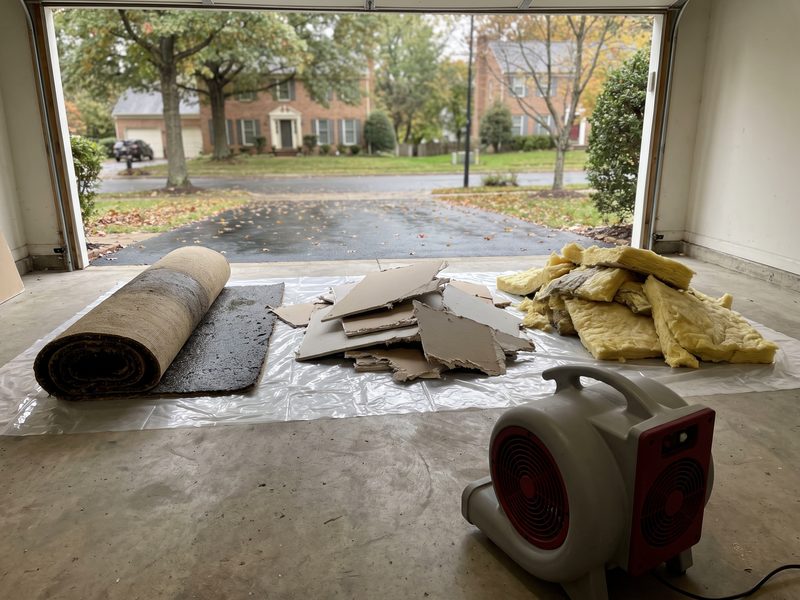
The process follows a logical sequence: stop the water source, extract standing water, remove unsalvageable materials, and then create the right balance of airflow, dehumidification, and temperature to pull moisture out of the remaining structure. The standard emphasizes extracting as much liquid water as possible first, because mechanical extraction is far faster and more efficient than evaporating that same water into the air and condensing it back out with dehumidifiers.
Daily monitoring is the part homeowners rarely see but should insist on. A crew that follows the standard records moisture content readings every day, adjusts equipment as materials dry, and only removes equipment when readings confirm the structure has reached its documented drying goal. Our typical structural dry-out runs about 4.5 days, monitored daily against those verified dry standards — but the exact timeline depends on the category, class, and materials involved.
This is also where hidden moisture gets caught. Water travels through wall cavities, under flooring, and into subfloors where the surface looks perfectly fine. Thermal imaging and penetrating moisture meters, used the way the standard describes, are what reveal that trapped water before it becomes tomorrow's mold problem.
- Identify and stop the water source before drying begins.
- Extract standing water mechanically to speed the process.
- Remove contaminated or unsalvageable porous materials.
- Deploy air movers and dehumidifiers matched to the drying class.
- Record moisture readings daily and adjust equipment accordingly.
- Verify a documented drying goal before removing equipment.

Why does hiring to the S500 standard protect your insurance claim?
Hiring a contractor who follows the IICRC S500 standard protects your claim because the standard produces exactly the kind of measurable, dated, photographic evidence that insurance carriers require to approve payment. When a job is documented to the standard, your adjuster sees moisture logs, a defensible scope, and before-and-after proof instead of a vague invoice.
The single biggest reason legitimate water-damage claims run into trouble is thin documentation. The S500 standard closes that gap. It calls for recording water categories, affected materials, daily moisture readings, and the reasoning behind what was removed versus dried — the same information an adjuster needs to justify the payout to their own company.
It's also important to understand how we handle the money: Restoration Doctor bills the homeowner directly and hands you documentation you may share with your insurer, including an Xactimate scope, CompanyCam photo documentation, and daily moisture logs. We are hired by the property owner under a written agreement. That claim file, built on S500-aligned work, is what gives you leverage in a claim negotiation rather than hoping the carrier takes your word for it. You can read more about how we support that process on our insurance claims page.
There's a defensive benefit too. If mold appears months later or a buyer's inspector flags moisture during a future sale, S500-standard documentation is your proof that the loss was handled to the recognized standard of care. Without it, you're exposed to the argument that the original repair was inadequate — and that argument can cost you far more than the original claim.
How can you tell if a contractor actually follows the IICRC S500 standard?
You can tell a contractor genuinely follows the IICRC S500 standard by watching whether they measure and document rather than guess. Real S500 work involves moisture meters, a written scope tied to water categories and classes, and daily monitoring logs — not a technician who eyeballs the room and drops off a few fans.
Ask direct questions before you sign anything. A company working to the standard can tell you what category your water is and why, which materials they plan to remove versus dry and the reasoning behind each call, what drying goal they're targeting, and how they'll document progress. Vague answers or reluctance to put the plan in writing are red flags.
Credentials matter, but behavior matters more. IICRC training tells you a crew knows the standard; daily moisture logs and dated CompanyCam photos tell you they're actually applying it on your job. Use the checklist below when you're vetting a restoration company.
- Do they identify and document the water category and drying class in writing?
- Do they use moisture meters and thermal imaging during the inspection, not just a visual check?
- Will they leave equipment in place and monitor moisture daily until a verified drying goal is met?
- Do they provide dated photo documentation and moisture logs you can hand to your adjuster?
- Are they licensed, insured, and working to ANSI/IICRC S500 (and ANSI/IICRC S520 for any mold remediation)?
- Do they bill you directly and give you documentation you may share with your insurer, keeping you in control of the process?

What happens if water damage isn't dried to S500 standards?
When water damage isn't dried to the IICRC S500 standard, the most common result is hidden moisture that fuels mold growth, structural decay, and a second, more expensive round of repairs. Surfaces can feel dry to the touch while wall cavities, subfloors, and framing stay wet enough to support microbial growth, which is why water-damaged materials should be dried within 24 to 48 hours of a loss.
Mold is the biggest downstream risk. Once trapped moisture crosses the line into a mold problem, you're no longer just drying a structure — you're dealing with remediation under the separate ANSI/IICRC S520 Standard for Professional Mold Remediation, which involves containment, air filtration, and controlled removal of affected materials. That's why the fastest, most economical path is almost always a thorough, standard-compliant dry-out the first time. You can learn more on our mold remediation page.
There are financial and legal consequences too. Inadequate drying can void a restoration warranty, complicate or reduce your insurance recovery, and surface during a future home sale when an inspector finds elevated moisture or staining. In each case, the absence of S500-standard documentation weakens your position and shifts cost and blame back to you.
This is exactly why speed and standards go together. Restoration Doctor responds 24/7 across the Virginia, Maryland, and Washington, D.C. tri-state area, because the sooner proper drying begins, the smaller the category, the class, and the eventual repair bill tend to be. The pattern is consistent across the thousands of losses this industry handles every year: standard-compliant work done quickly is what keeps a water loss from becoming a mold loss. If you're dealing with active water right now, our emergency water damage team is available around the clock at 1-888-293-5663.