Frozen Pipe Burst: What To Do When It Happens in Northern Virginia

BYSteve Jafari, General ManagerNORTHERN VIRGINIA, MARYLAND & D.C.

If a frozen pipe bursts, immediately shut off your home's main water valve, then cut power to any wet areas at the breaker, and call a restoration and plumbing professional. A burst half-inch supply line under normal household pressure can release several hundred gallons per hour, and materials that stay wet past 24 to 48 hours are at risk for mold growth — so the faster you kill the water source and start extraction, the less structural damage and demolition you face. Restoration Doctor answers 24/7 at 1-888-293-5663 with a median 47-minute arrival across Northern Virginia, and we serve the Virginia, Maryland, and Washington, D.C. tri-state area.
Call 1-888-29-FLOODFrozen pipe burst — what should you do first?
The moment you discover a frozen pipe has burst, do three things in order: shut off your home's main water supply, cut electrical power to any flooded or wet area at the breaker panel, and call a 24/7 restoration team. Stopping the water source is the single most important action — every minute a broken supply line runs, it adds gallons to your floors, walls, and the ceilings below.
Do not wait for the water to "slow down" on its own. A burst pipe under household pressure keeps flowing until the main valve is closed, and the water follows gravity into subfloors, wall cavities, and lower levels where you often can't see it. Once the water is off, move valuables and electronics off wet floors, lift furniture onto blocks or foil if you can, and open cabinet doors to release trapped moisture.
A word on the electrical step: never stand in water that could be in contact with outlets, cords, or appliances. If the breaker panel itself is in a wet area, stay out and let the professionals handle it. Water conducts electricity, and a flooded basement with live circuits is an electrocution hazard before it's a property problem.
In the Northern Virginia core, Restoration Doctor arrives on-site in a median of 47 minutes and follows the ANSI/IICRC S500 water-damage standard to extract, dry, and document the loss. Call 1-888-293-5663 or start at our /emergency-water-damage page — the sooner professional extraction begins, the smaller the eventual repair.
- Shut off the main water valve — a lever handle turns a quarter-turn crosswise to the pipe; a wheel handle turns clockwise until it stops.
- Cut power to wet areas at the breaker before stepping into standing water.
- Call 24/7 for emergency extraction: 1-888-293-5663.
- Move electronics, documents, and valuables off wet floors.
- Open cabinets and interior doors to let trapped water escape and air circulate.

Where is your main water shutoff — and how do you find it before a hard freeze?
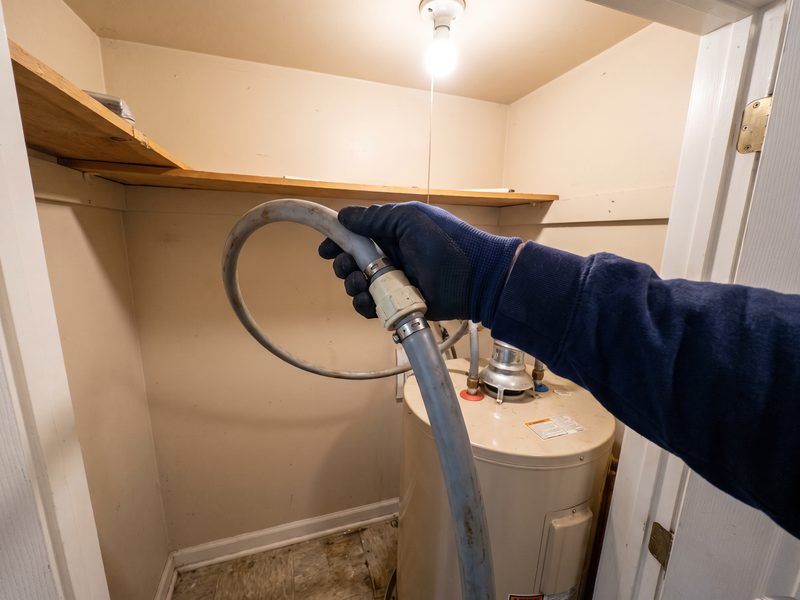
Your main water shutoff is usually where the water line enters the house — commonly on a basement or crawlspace wall facing the street, near the water heater, or inside a utility closet on a slab-foundation home. In many Northern Virginia homes with basements, it's on the front foundation wall within a few feet of where the service line comes in. Find it now, before a cold snap, because searching for it while water pours through your ceiling costs you the most expensive minutes of the whole event.
There are two common valve types. A ball valve has a lever handle — turn it a quarter-turn so it sits perpendicular (crosswise) to the pipe to shut it off. A gate valve has a round wheel — turn it clockwise several full rotations until it stops. Tag the valve, make sure everyone in the household knows where it is, and confirm it actually turns; old gate valves can seize and should be exercised or replaced before winter.
If you can't locate or operate the main, there is usually a curb stop at the street-side meter box that requires a water meter key to close. Knowing this backup matters during a hard freeze, especially if your interior valve fails — and in an emergency, your water utility can also shut service at the curb.
| Home type | Likely shutoff location | Valve type |
|---|---|---|
| Basement (older brick/colonial) | Front foundation wall near where the service line enters | Gate valve (wheel) |
| Slab foundation | Utility closet, garage, or near water heater | Ball valve (lever) |
| Townhome / condo | Utility closet or under kitchen/bath sink | Ball valve (lever) |
| Crawlspace home | Where the line enters the crawlspace wall | Gate or ball valve |
Which pipes freeze first in Northern Virginia homes?
The pipes that freeze first in NoVA are the ones running through unheated or poorly insulated spaces: exterior hose bibs, pipes in unconditioned crawlspaces and attics, supply lines in exterior walls, and plumbing in garages or unheated basements. Kitchen and bathroom pipes on outside walls are especially vulnerable because they combine cold exterior exposure with a closed cabinet that blocks warm room air.
Our region's freeze-thaw pattern is what makes bursts so common here. Temperatures often hover near freezing overnight and rebound during the day, so ice forms, expands, and cracks a pipe — but the leak may not show until the thaw, when the ice plug melts and pressurized water escapes through the crack. That delay is why a pipe can "burst" on a mild afternoon days after the actual freeze.
Northern Virginia's housing stock sees failures on both ends of the age spectrum: mid-century homes with uninsulated crawlspaces and rim joists, and newer construction with long supply runs through unconditioned garages. Pay closest attention to any pipe near a spot where you can feel cold air moving.
- Outdoor hose bibs and sprinkler/irrigation lines
- Pipes in unheated crawlspaces, attics, and garages
- Supply lines inside exterior walls (kitchen/bath fixtures on outside walls)
- Basement lines near foundation vents or rim joists
- Plumbing in vacant or rarely used rooms where the heat is turned down

How do you safely thaw a frozen pipe that hasn't burst yet?
If a pipe is frozen but hasn't burst, open the affected faucet first, then apply gentle heat starting at the faucet end and working back toward the frozen section. Opening the faucet gives melting ice somewhere to go, relieves pressure inside the line, and tells you the moment flow returns. Use safe heat sources only: a hair dryer, a heat lamp, towels soaked in warm water, or a portable space heater kept a safe distance from anything flammable.
Never use an open flame, blowtorch, propane heater, or any device with a live flame to thaw a pipe — it's a serious fire risk and can damage the pipe or its fittings. Don't leave a space heater unattended, either. If you can't reach the frozen section, if it's inside a wall or ceiling, or if flow doesn't return after a reasonable effort, stop and call a plumber rather than forcing it.
While thawing, keep your hand near the main shutoff. Frozen pipes often crack while frozen and only leak once the ice melts, so be ready to close the main the instant you hear or see water escaping. If one pipe froze, check the rest of the house — the conditions that froze one line usually threaten others.
- Open the faucet before applying heat to relieve pressure.
- Warm from the faucet end back toward the frozen area.
- Use a hair dryer, heat lamp, warm towels, or a safely placed space heater.
- Never use a torch, open flame, or propane heater.
- Stay near the main shutoff in case the thaw reveals a crack.
How can you tell if a frozen pipe has already burst?
The clearest signs a frozen pipe has already burst are water where it shouldn't be — stains or bulges on ceilings and walls, dripping or pooling near plumbing, a sudden hissing or rushing sound, and a drop in water pressure at your fixtures. A spike in your water bill or a meter that keeps running when no water is in use is another strong indicator of a hidden break.
During a freeze, a telling clue is a faucet that produces only a trickle or nothing at all while other fixtures work normally — that points to an ice blockage, and the pipe behind it may already be cracked. When the thaw comes, that crack becomes an active leak. Discoloration, a musty smell, or unexplained cold or damp spots on drywall can signal water tracking inside a wall cavity.
If you suspect a burst inside a wall, ceiling, or floor, shut off the main immediately and call for professional moisture detection. Restoration Doctor uses thermal imaging cameras and calibrated moisture meters to map hidden water before it turns into rot and mold — you can reach our /services/water-damage-restoration team any time. Hidden moisture is the kind that costs the most later, because by the time it's visible on the surface, the materials behind it have often been wet for days.
- Water stains, bulging drywall, or dripping ceilings
- Hissing, rushing, or dripping sounds behind walls
- Low or no water pressure at one or more fixtures
- Unexplained jump in the water bill or a meter that runs with all fixtures off
- Musty odor, discoloration, or cold, damp spots on walls

How much damage can a burst pipe cause, and how fast?
A single burst half-inch supply line under normal household pressure can release several hundred gallons of water per hour, so a break that runs unnoticed overnight can flood multiple rooms and levels. Water migrates fast — it soaks into subfloors, wicks up drywall, saturates insulation, and pools in the lowest part of the structure within minutes to hours.
The bigger problem is what water does after the flow stops. Clean supply-line water starts as Category 1 under the IICRC S500 standard, but the longer it sits in contact with building materials, the more it degrades toward Category 2 — and lingering moisture is what feeds mold, which is why EPA guidance is to dry water-damaged areas and items within 24 to 48 hours to prevent mold growth. That's why professional extraction and structural drying matter as much as fixing the pipe itself.
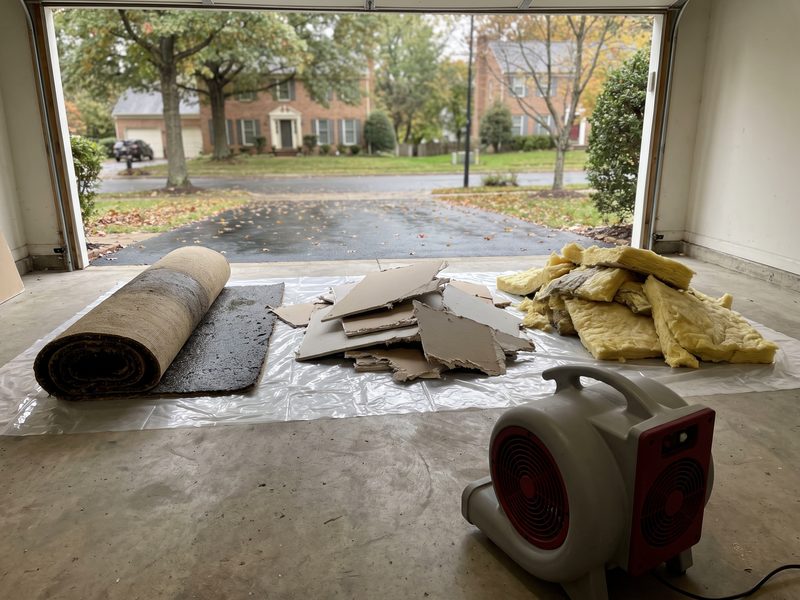
Professional drying isn't just fans. Following S500, technicians extract standing water first (extraction removes far more water than evaporation can), then position air movers and low-grain refrigerant dehumidifiers to pull the remaining moisture out of materials, verifying progress daily with moisture meters and psychrometric readings. Restoration Doctor completes a typical structural dry-out in about 4.5 days, monitored daily until materials reach verified dry standards. Across over 10,000 completed restoration projects in Virginia, Maryland, and D.C., the pattern is consistent: fast water shutoff plus fast extraction equals dramatically less demolition and cost.
| Time after burst | What's happening | Restoration impact |
|---|---|---|
| 0–1 hour | Water spreads across floors, into subfloor and wall cavities | Extraction can save most flooring and materials |
| 1–24 hours | Drywall wicks moisture upward, insulation saturates | Many materials still salvageable with rapid drying |
| 24–48 hours | Surfaces still damp are at risk for mold growth | Mold remediation may be required alongside drying |
| 48+ hours | Rot, swelling, spreading microbial growth | More demolition and reconstruction needed |
Should you file an insurance claim for a burst frozen pipe?
In most cases, yes — sudden and accidental water damage from a burst pipe is one of the most commonly covered losses under standard homeowner policies. About 83% of our customers file an insurance claim, and the biggest factor in a smooth claim is thorough documentation from day one: photos of the source, moisture readings, and an itemized scope of the damage. Be aware that policies typically require you to maintain heat or drain the plumbing in an unoccupied home, so freeze losses in vacant houses can face extra scrutiny.
Here's how billing works with Restoration Doctor: we bill you, the homeowner, directly — we never invoice your insurance carrier. What we do is hand you a carrier-ready claim file: an Xactimate scope your adjuster recognizes, CompanyCam photo documentation, and daily moisture logs proving the drying process. We work for you, not your insurance company, so the file is built to support your claim.
Before you touch anything, photograph the burst pipe, the standing water, and affected belongings. Then start mitigation — limiting further damage is a policyholder responsibility under most policies, and beginning professional extraction quickly actually strengthens your claim rather than jeopardizing it. Save the failed pipe section if the plumber removes it; adjusters sometimes want to see the point of failure. Learn more on our /insurance-claims page.
- Photograph the source, standing water, and damaged contents before cleanup.
- Report the loss to your carrier promptly.
- Keep receipts for emergency repairs and any temporary lodging.
- We invoice the homeowner and provide a carrier-ready file: Xactimate scope, CompanyCam photos, and daily moisture logs.
- Fast mitigation supports coverage — carriers expect you to limit further damage.

How do you prevent frozen pipes during a NoVA cold snap?
To prevent frozen pipes when a hard freeze is forecast, keep interior heat at 55°F or higher even when you're away, let vulnerable faucets drip, open cabinet doors under sinks on exterior walls, and disconnect garden hoses from outdoor bibs. Moving water and warm air reaching your pipes are your two best defenses — a dripping faucet keeps water moving and relieves pressure between the faucet and any ice blockage that does form.
For the pipes that freeze first in our region — those in crawlspaces, garages, attics, and exterior walls — add foam pipe insulation sleeves or thermostatically controlled heat cable rated for the application. Seal drafts near the rim joist and foundation vents where cold air reaches plumbing. Before you leave town in winter, know exactly where your main shutoff is; if the house will be empty for days, shutting off the water at the main and draining the lines removes the risk almost entirely. For a deeper checklist, see our guide at /blog/how-to-prevent-frozen-pipes.
These small steps prevent the majority of freeze bursts we respond to each December through February across the Virginia, Maryland, and Washington, D.C. tri-state area. If prevention fails, don't wait — call Restoration Doctor (legal entity: VA Water Damage LLC), 8609 Westwood Center Dr, Ste 110-1062, Vienna, VA 22182, 24/7 at 1-888-293-5663, or reach us through /contact.
- Keep the thermostat at 55°F or higher, even when away.
- Let faucets served by exterior-wall pipes drip during hard freezes.
- Open sink cabinet doors so warm room air reaches the pipes.
- Disconnect and drain garden hoses; insulate or cover outdoor bibs.
- Add pipe insulation or thermostatic heat cable in crawlspaces, garages, and attics.
- Shut off the main and drain water lines before extended winter travel.