Hardwood Floor Water Damage: Can It Be Saved?

BYSteve Jafari, General ManagerNORTHERN VIRGINIA, MARYLAND & D.C.

Hardwood floor water damage can often be saved if drying begins within 24–48 hours using specialty methods like drying mats and injection systems that pull moisture from below the boards. Mild cupping frequently flattens as the wood re-equilibrates to its normal moisture content, but buckling, blackened boards, or Category 3 water usually means replacement. Crowning is often caused by sanding a floor before it is verified dry, so refinishing decisions should wait for documented meter readings. The single biggest factor in whether your floor survives is how fast professional drying starts.
Call 1-888-29-FLOODCan water-damaged hardwood floors actually be saved?
Yes — many water-damaged hardwood floors can be saved, especially when professional drying begins within the first 24 to 48 hours. Wood is hygroscopic: it naturally absorbs and releases moisture with its environment. If the floor is dried correctly and brought slowly back to its normal moisture content, the boards often return close to their original shape.
The outcome depends on three things: how clean the water was, how long the wood stayed wet, and how quickly specialized drying started. Clean supply-line water caught fast has a very good chance of full recovery. Water that sat for days, seeped between and beneath boards, or came from a sewage backup dramatically lowers the odds.
At Restoration Doctor, our median on-site arrival across Northern Virginia is 47 minutes, and that speed matters more with hardwood than with almost any other material. Every hour of delay lets moisture migrate deeper into the tongue-and-groove joints and the subfloor, which is where damage becomes permanent. If your floor is wet right now, the honest advice is: stop reading long enough to call 1-888-293-5663, then come back. Response times vary based on crew availability and demand.

What is cupping and crowning, and what do they tell me?
Cupping and crowning are two opposite warping patterns, and each one tells you where the excess moisture is. Cupping is when the edges of each board rise higher than the center, creating a wavy, concave surface across the floor. It means the bottom of the wood is wetter than the top — the classic signature of water coming up from below or from a spill that soaked through the finish and into the joints.
Crowning is the reverse: the center of each board sits higher than the edges. Crowning usually appears later in the timeline, often when a cupped floor was sanded flat too soon or when the top surface dried out while the core stayed wet. Because crowning frequently results from premature refinishing, it's a strong argument for patience and proper moisture verification before anyone touches sandpaper.
Buckling is the most severe stage, where boards lift completely off the subfloor and separate. It signals prolonged saturation and almost always means those boards are lost. Reading these patterns correctly guides the entire recovery plan, which is why our technicians map moisture with meters and document a full picture before deciding on an approach.
- Cupping (edges high, center low): moisture is greater on the underside — the most common pattern and often reversible.
- Crowning (center high, edges low): usually caused by drying or sanding too early — avoidable with patience.
- Buckling (boards lifted and detached): severe, prolonged saturation — typically requires replacement.
How does specialty drying save a hardwood floor?
Specialty hardwood drying saves floors by pulling trapped moisture out from underneath the boards rather than just blowing air across the top. Standard air movers dry the visible surface, but the water in a cupped floor is hiding in the subfloor and the underside of the planks — surface-only drying can leave that moisture trapped and make cupping worse. The solution is a controlled system that moves air through and beneath the flooring assembly.
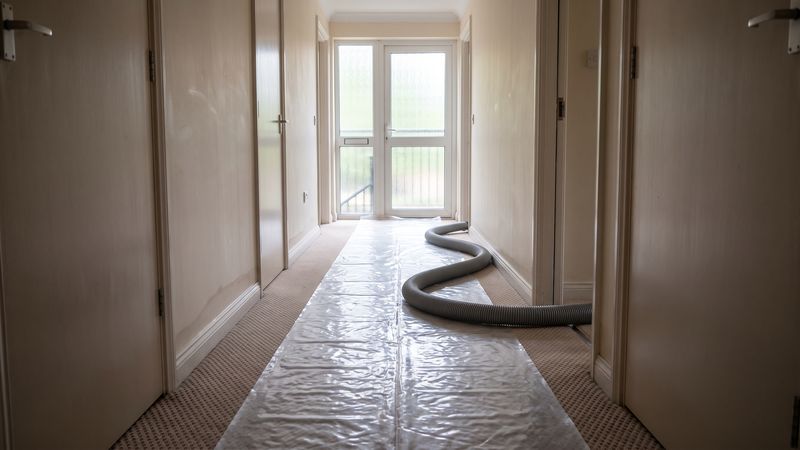
The two workhorses are drying mats and injection systems. Drying mats are sealed panels laid on top of the floor and connected to a high-vacuum blower that draws moisture up through the wood. Injection (interstitial) drying pushes dry air into the cavity between the floor and subfloor through small ports, actively evaporating the hidden water. Both are paired with dehumidifiers so the surrounding air stays dry enough to keep pulling moisture out of the wood instead of re-wetting it.
Throughout the process we monitor with pin and pinless moisture meters and log readings daily, following the ANSI/IICRC S500 Standard for Professional Water Damage Restoration. The goal isn't 'looks dry' — it's a documented moisture content that matches unaffected wood elsewhere in your home. A typical structural dry-out runs about 4.5 days, but hardwood specifically is dried slowly and deliberately, because rushing it is exactly what causes crowning and checking.
- Drying mats: sealed vacuum panels that pull moisture up through the board faces.
- Injection systems: force dry air beneath the floor to evaporate hidden subfloor moisture.
- Desiccant or low-grain refrigerant dehumidifiers: control room air so the wood keeps releasing moisture.
- Daily moisture logs: verify progress against a documented dry standard, not guesswork.

How fast do I have to act to save wet hardwood?
You should begin professional drying within 24 to 48 hours to give hardwood the best chance of full recovery. Wood begins absorbing water almost immediately, and once moisture penetrates the finish and works into the joints and subfloor, cupping starts within a day or two. The clock isn't just about warping — it's also about mold, since EPA guidance is to dry water-damaged materials within 24 to 48 hours to prevent growth on damp cellulose.
Caught within the first day, mild cupping often flattens back out with proper drying. After several days of saturation, you move into permanent deformation, adhesive failure in engineered flooring, and blackened tannin staining that no amount of drying will reverse. Standing water that sits over a weekend is often the difference between a dry-out and a tear-out.
This is why we run 24/7 emergency response with on-site arrival in as little as 60 minutes across the Northern Virginia core. If you discover a wet floor, the meaningful actions are to stop the water source, lift standing water, and get a moisture assessment started — not to wait and 'see if it dries on its own.' Passive drying almost never reaches the underside of the floor in time. Response times vary based on crew availability and demand.
When is refinishing enough, and when do I need full replacement?
Refinishing is enough when the boards have dried flat and stable but the surface is left with light residual cupping, dull spots, or minor staining — sanding and recoating restores a floor that is structurally sound. Replacement is required when boards have buckled, cracked, separated at the seams, developed mold underneath, or absorbed Category 3 contaminated water that cannot be safely sanitized.
A key distinction is solid versus engineered hardwood. Solid hardwood can typically be sanded and refinished several times over its life, so a dried solid-wood floor with surface damage is a strong refinishing candidate. Engineered hardwood has a thin real-wood veneer over a layered core; once that core delaminates or the veneer swells and peels, refinishing isn't possible and those planks must be replaced.
Give a dried floor time before deciding on cosmetics. Many floors that look badly cupped while wet relax significantly in the weeks after they reach their dry standard, and refinishing done too early can lock in crowning. We verify moisture content first, allow the wood to acclimate, and only then recommend sanding, spot board replacement, or full replacement based on measured results — not on how the floor looked the day of the loss.
| Scenario | Water type | Typical outcome |
|---|---|---|
| Mild cupping, dried within 48 hours | Clean (Cat 1) | Dry in place, often flattens; may recoat |
| Moderate cupping, solid wood | Clean/gray (Cat 1–2) | Dry, acclimate, then sand and refinish |
| Crowning after early sanding | Any | Re-dry fully, then re-sand once stable |
| Buckled or separated boards | Any | Replace affected boards or floor |
| Engineered floor, delaminated core | Any | Replace — veneer cannot be refinished |
| Sewage or flood contamination | Cat 3 | Remove and replace; sanitize subfloor |

Does the type of water matter for saving the floor?
Yes — the category of water is one of the biggest factors in whether a hardwood floor can be saved. Under ANSI/IICRC S500, water is classified into three categories, each carrying a different level of contamination that directly changes what's salvageable. Clean water gives you room to dry and restore; contaminated water often forces removal for health reasons, even if the wood itself might have dried.
Category 1 is clean water from a sanitary source such as a supply line, faucet, or water heater — with fast drying, hardwood exposed to Cat 1 water has the best recovery odds. Category 2 ('gray water') contains significant contamination, such as discharge from dishwashers or washing machines; it can sometimes be dried if addressed quickly, but the window is shorter and cleaning requirements are higher. Category 3 ('black water') includes sewage backups, toilet overflows containing waste, and rising floodwater — it is grossly contaminated with bacteria and other pathogens, and porous flooring that absorbs it generally cannot be sanitized and must be removed under Category 3 protocols.
Time also makes water worse: Category 1 water left sitting can deteriorate to Category 2, and Category 2 to Category 3, as temperature, contact with building materials, and microbial growth degrade it. That deterioration is another reason speed protects your floor. A supply-line leak caught in an hour is a very different job than the same leak discovered after a week away.
How does insurance work for hardwood floor water damage?
Coverage depends on your policy and your insurer's decision. Questions about coverage belong with your insurer, your agent, or a licensed public adjuster or attorney. About 83% of our customers file an insurance claim, so this is familiar territory, and the key to a smooth claim is documentation that proves the loss was sudden and that the response was appropriate.
It's important to understand how we operate: Restoration Doctor is hired by the property owner under a written agreement. We bill the homeowner directly and hand you documentation you may share with your insurer — a detailed Xactimate scope, CompanyCam photo documentation, and daily moisture logs — so you have everything needed to pursue reimbursement from your carrier. We invoice the property owner; you stay in control of the claim.
That evidence trail matters especially for hardwood, because adjusters often scrutinize whether flooring truly needed replacement versus drying. Our daily moisture readings and dry-standard verification create an objective record of what the wood did and why each decision was made. You can learn more on our insurance claims page, and we're glad to walk you through the process before you ever file.

What should I do the moment I find water on my hardwood floor?
The moment you find water on hardwood, stop the source, remove standing water, and get professional drying started — in that order, and fast. The first hour is the highest-leverage window you'll have, because you can still limit how far moisture migrates into the joints and subfloor where it does lasting harm. Don't rely on fans and open windows alone; surface airflow won't reach the water hiding beneath the boards.
Do use towels or a wet/dry vacuum to lift as much surface water as possible, wipe down the boards, and pull up area rugs so nothing keeps re-wetting the floor. Don't crank up the heat trying to force-dry it, don't rent a big-box sander to 'fix' the cupping, and don't wait several days to see if it flattens on its own — all three commonly turn a savable floor into a replacement.
Then call for a professional moisture assessment so drying decisions are based on meter readings, not appearance. Our teams respond 24/7, arrive with a median of 47 minutes across Northern Virginia, and serve homeowners throughout the Virginia, Maryland, and Washington, D.C. tri-state area. You can reach Restoration Doctor any time at 1-888-293-5663 or through our emergency water damage page. Response times vary based on crew availability and demand.
- Do: shut off the water source and lift standing water immediately.
- Do: remove rugs and wipe boards so nothing keeps re-wetting the wood.
- Don't: use high heat or a space heater to force-dry — it causes cracking and crowning.
- Don't: sand or refinish before the floor is verified dry to standard.
- Don't: wait days to 'see if it dries' — get a moisture assessment first.