Mold After Basement Flood: Next Steps in the First 48 Hours

BYSteve Jafari, General ManagerNORTHERN VIRGINIA, MARYLAND & D.C.
The most important next step after a basement flood is to dry everything to a verified standard within 48 hours, because mold needs only moisture, a food source, and time to colonize wet drywall, carpet pad, and framing. Pull out saturated porous materials, run commercial air movers and dehumidifiers continuously, and monitor moisture daily with meters until the structure matches a documented dry standard. If the water sat for days or came from sewage or rising groundwater, treat it as a contamination job under IICRC S500 Category 3 protocols and call a professional before mold spreads behind your walls.
Call 1-888-29-FLOODWhat are the first steps after mold appears following a basement flood?
The first step after a basement flood is to stop the water source and get the space dry within 48 hours, because that is the window where mold either takes hold or doesn't. Mold spores are already present in every basement; they only need moisture, an organic food source like paper-faced drywall, and time to turn into visible growth. Remove the moisture fast and you starve the colony before it starts.
If you already see fuzzy or discolored growth, the 48-hour window has likely passed in some materials, and the job shifts from simple drying to controlled mold remediation. That means containing the affected area so spores don't spread to the rest of the home, removing contaminated porous materials, and cleaning salvageable surfaces under the ANSI/IICRC S520 standard. The two situations look similar but are handled very differently, and treating a remediation job like a dry-out is how mold ends up spreading to rooms that were never wet.
Before you touch anything, make a quick safety and documentation pass. Shut off power to the flooded area at the breaker if water is near outlets or the panel, photograph everything with timestamps, and note how long the water sat. Those details drive both your drying plan and your insurance claim, and they are far easier to capture now than to reconstruct later.
- Stop the source: shut off the supply line, address the sump failure, or seal the entry point if it's groundwater.
- Kill power to the wet area at the breaker if water is near outlets or electrical.
- Photograph every wall, floor, and stored item before you move anything.
- Note the water category (clean, gray, or sewage) and how long it sat.
- Start removing standing water and saturated porous materials immediately.
How fast does mold grow on wet drywall after flooding?
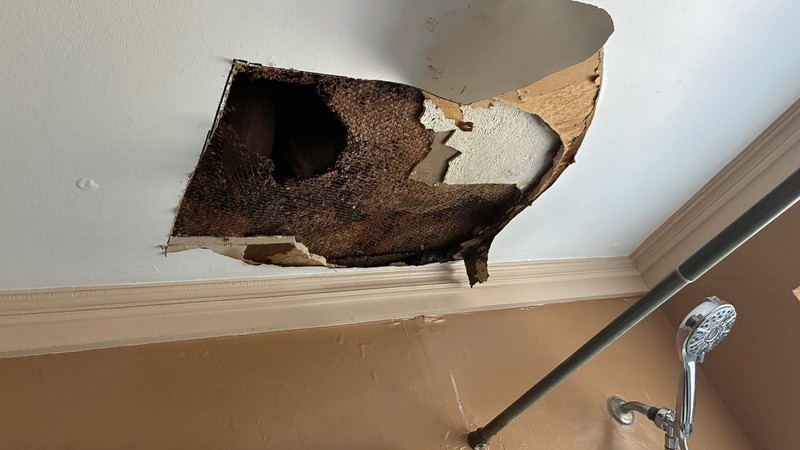
Mold can begin growing on wet drywall in 24 to 48 hours under the right conditions, which is exactly why the first two days after a basement flood are so critical. Paper-faced drywall is one of the most mold-friendly materials in your home: the gypsum core holds water and the paper facing is pure cellulose food. Once it stays wet and warm, colonization is a matter of hours, not weeks.
The exact speed depends on temperature, humidity, and how porous the material is. A warm, humid basement in a Virginia summer can push visible growth faster than a cool, dry one in winter. This is why pulling wet materials and dropping the humidity quickly matters more than any single product or spray.
Different materials sit on very different timelines, and knowing which ones are racing the clock helps you prioritize what to pull first.
| Material | Mold risk window | Typical outcome |
|---|---|---|
| Paper-faced drywall | 24-48 hours | Usually cut out and replaced once saturated |
| Carpet padding | 24-48 hours | Almost always discarded after a flood |
| Carpet (face) | 48-72 hours | Sometimes salvageable if clean water and fast drying |
| Wood framing/studs | Days to a week+ | Often dried in place and saved if treated fast |
| Concrete/masonry | Slow (dense, inorganic surface) | Cleaned and dried, rarely needs removal |
| Insulation (fiberglass/cellulose) | 24-48 hours | Typically removed when wet |
What should you pull out of a flooded basement right away?
Pull out anything porous that was soaked and can't be dried fast enough to beat the 48-hour mold window: carpet padding, wet insulation, saturated cardboard, and the lower portion of paper-faced drywall. These materials hold water deep inside, dry slowly, and feed mold readily, so removing them is almost always faster and safer than trying to save them. When in doubt, porous and saturated means out.
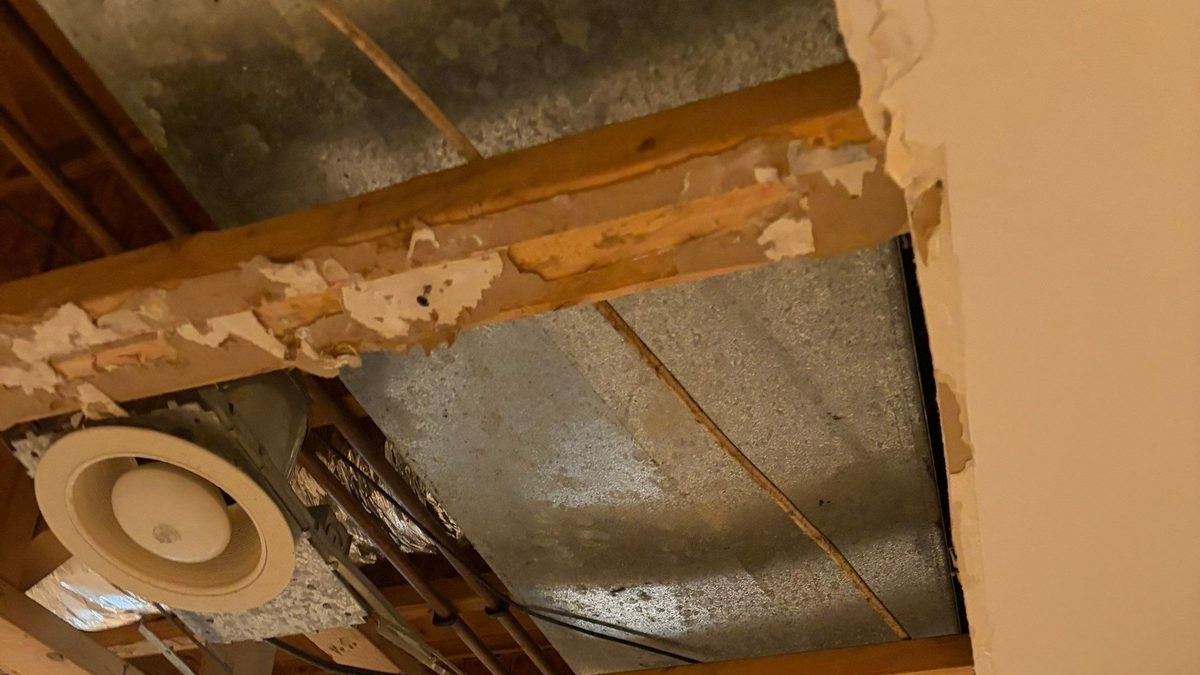
Saturated drywall is usually removed in a flood cut, typically 12 to 24 inches above the visible waterline or up to a convenient 2- or 4-foot seam, which exposes the wall cavity so framing and the back side of the wall can actually dry. Trapped moisture behind intact drywall is one of the most common reasons a flood turns into a hidden mold job weeks later. Insulation inside that cavity wicks water upward and must come out with it.
Hard, non-porous items are a different story. Solid wood furniture, metal, glass, and sealed concrete can typically be cleaned, disinfected, and dried rather than discarded. Semi-porous items like upholstered furniture or particle-board cabinets are judged case by case, based on the water category and how long they stayed wet.
- Pull now: carpet pad, wet fiberglass or cellulose insulation, soaked cardboard and paper goods.
- Flood-cut: paper-faced drywall from the waterline up 12 to 24 inches, or to the nearest seam.
- Evaluate: upholstered furniture, mattresses, particle-board furniture, laminate flooring.
- Usually save: solid wood, metal, glass, sealed concrete, and non-porous plastics after cleaning.
What equipment actually dries a basement and stops mold?
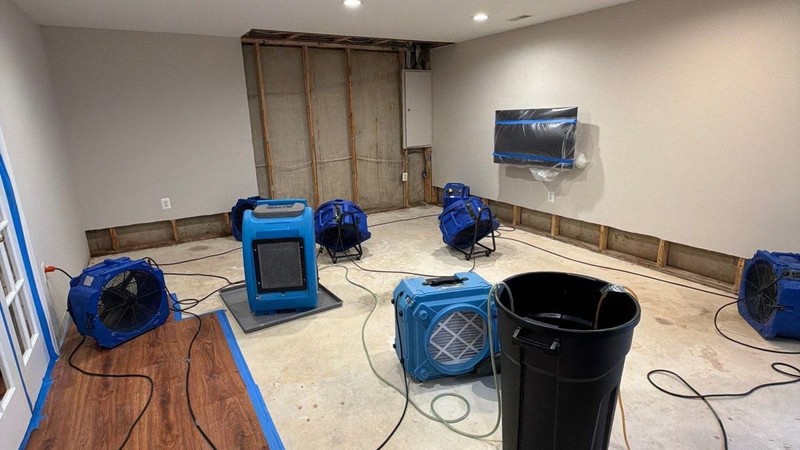
Commercial air movers and low-grain refrigerant (LGR) or desiccant dehumidifiers are what actually dry a basement to a mold-safe standard, not household box fans and an open window. Air movers push high-velocity air across wet surfaces to speed evaporation, while the dehumidifier pulls that evaporated moisture out of the air before it re-condenses into your walls and framing. The two work as a system; one without the other just moves moisture around the room.
This is applied psychrometry, the science of controlling temperature and humidity to force water out of materials in a measurable way. Professionals calculate how many air movers and how much dehumidification capacity a space needs based on the size of the affected area, the class of water intrusion, and how much material is wet, following the IICRC S500 standard. Guessing usually produces a basement that feels dry on the surface but still reads wet inside the studs.
A professional structural dry-out typically runs three to five days of continuous equipment operation, monitored daily and verified against a documented dry standard, not pulled early because a surface feels dry to the touch. Opening windows can actually make things worse on a humid mid-Atlantic day by bringing more moisture in, which is why controlled dehumidification beats fresh air during drying.
- Air movers: high-velocity airflow to accelerate surface evaporation.
- Dehumidifiers (LGR or desiccant): remove airborne moisture so it can't re-wet materials.
- Air scrubbers with HEPA filtration: capture airborne spores if mold is already present.
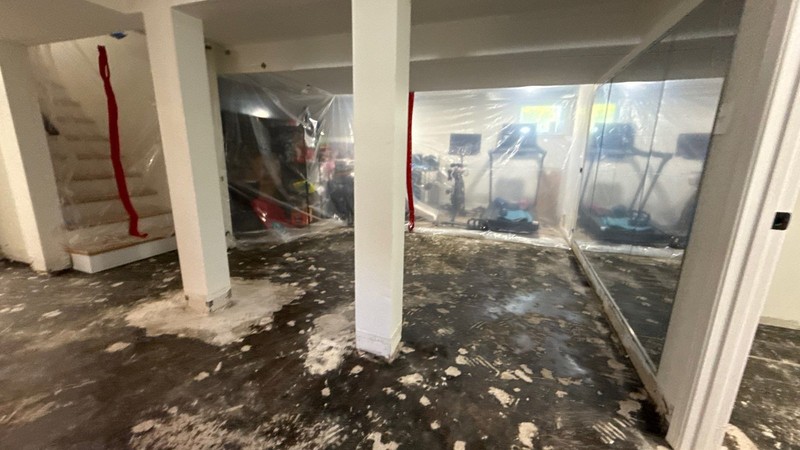
- Containment barriers: poly sheeting and negative air pressure to keep spores from spreading.
- Moisture meters and thermo-hygrometers: measure progress instead of guessing.
How do you know when the basement is actually dry?
A basement is actually dry when moisture readings in the drywall, framing, and subfloor return to a documented dry standard, confirmed with meters rather than by feel. Surfaces can feel dry while the core of a stud or the back of a wall still holds enough moisture to support mold growth. The only reliable answer comes from instruments, measured over several days.
Professionals establish a dry standard by taking readings from unaffected materials of the same type elsewhere in the home, then dry the flooded materials until they match. Penetrating and non-penetrating moisture meters check moisture inside and at the surface of materials, while a thermo-hygrometer tracks the temperature and relative humidity of the air. Those numbers go into daily moisture logs so there is a verifiable record that the structure reached dry, not just looked dry.
That daily log serves two purposes. It confirms the drying equipment is actually working and tells you when it can safely come out, and it becomes part of a carrier-ready claim file if you file with your insurance. Pulling equipment too early is the single most common reason mold appears weeks after a flood that seemed handled.
- Compare readings to a dry-standard baseline from unaffected materials of the same type.
- Measure inside drywall, studs, and subfloor, not just the surface.
- Track air temperature and relative humidity daily with a thermo-hygrometer.
- Keep a daily moisture log until all affected materials reach the dry standard.
- Only then remove the air movers and dehumidifiers.
When should you call a professional instead of drying it yourself?
Call a professional when the water was contaminated, when it sat for more than 48 hours, when it covers a large area, or when you already see or smell mold. A small, clean-water spill caught immediately can sometimes be handled with rented equipment, but once contamination, time, or square footage enters the picture, DIY drying usually can't beat the mold clock or be done safely. The cost of getting it wrong is hidden mold inside your walls.
Water category is the biggest deciding factor. Clean water from a broken supply line is Category 1; water with significant contamination, like washing machine or dishwasher discharge, is Category 2 (gray water); and sewage backups or rising groundwater and floodwater are Category 3, which carries bacteria and pathogens and requires biohazard protocols. A basement flood that includes sewage or groundwater should never be handled as a simple dry-out. Our mold remediation crews work under ANSI/IICRC S520, and our water crews follow IICRC S500, with Category 3 contamination procedures when the source demands it.
Speed is where professional response pays off most. Restoration Doctor targets on-site arrival within 60 minutes across the Virginia, Maryland, and Washington, D.C. tri-state area, with a median of 45 minutes, which often means equipment is running inside the 48-hour mold window. In our experience across thousands of projects in the region, the flooded basements that stayed mold-free are overwhelmingly the ones where professional drying started fast.
- The water was sewage, groundwater, or any Category 3 source.
- Water sat longer than 48 hours or you don't know how long.
- More than a small area is affected, or multiple rooms are involved.
- You already see visible mold or smell a musty, earthy odor.
- The flood reached electrical, HVAC, or the water heater.
Does homeowners insurance cover mold from a basement flood?
Homeowners insurance often covers mold when it results from a sudden, covered water event like a burst pipe, but typically excludes mold caused by long-term seepage, neglect, or deferred maintenance. The deciding factor is usually the cause and the timeline: carriers want to see that you acted quickly to mitigate the damage, and most policies require reasonable mitigation as a condition of coverage. Many policies also carry a separate, lower sublimit specifically for mold, so coverage amounts vary widely from policy to policy.
This is exactly why fast documentation matters. Timestamped photos, a record of when the flood happened, and a professional daily moisture log all help establish that you responded promptly and that any mold grew from a covered event rather than ongoing neglect. Note that groundwater flooding itself is generally excluded from standard homeowners policies and falls under separate flood insurance, so the source of the water shapes the whole claim.
It's also important to understand how billing works. Restoration Doctor bills you, the homeowner, directly and hands you a carrier-ready claim file complete with an Xactimate scope, CompanyCam photo documentation, and daily moisture logs. We work for you, not your insurance company, which means our job is to document the damage thoroughly and accurately so you can pursue what your policy owes. Our team can walk you through the process on our insurance claims page, or by phone at 1-888-293-5663.
What's the biggest mistake people make after a basement flood?
The biggest mistake is assuming the basement is dry because the surfaces feel dry, then closing up the walls while moisture is still trapped inside. That trapped water in framing and wall cavities is invisible, and it's the leading cause of mold that shows up weeks or months after a flood everyone thought was handled. Drying to how it feels instead of to a measured standard is the error that creates a second, bigger job.
The second most common mistake is waiting too long to start drying at all. People mop up the visible water, run a couple of household fans, and assume that's enough, while the 48-hour clock runs out on the drywall and insulation. By the time a musty smell appears, mold is usually already established behind the walls.
A few other avoidable missteps round out the list. Reusing saturated carpet pad, leaving wet insulation inside walls, opening windows on humid days, and skipping containment when mold is already present all turn a manageable situation into a worse one.
- Sealing walls before interior moisture readings hit the dry standard.
- Relying on box fans and open windows instead of air movers and dehumidifiers.
- Leaving wet insulation or carpet pad in place to 'dry out' on its own.
- Ignoring a musty smell, which signals active mold even when you can't see it.
- Skipping containment, letting spores spread to unaffected rooms.