Water Damage Smell in Car vs House: Which Do You Need?

BYSteve Jafari, General ManagerNORTHERN VIRGINIA, MARYLAND & D.C.

To settle the water damage smell in car vs house question, isolate the odor: if the musty smell is strongest when you sit in your parked vehicle with the doors closed, it's the car; if it lingers in specific rooms, closets, or near baseboards even after your car is gone, it's the house. A house-based musty odor usually signals hidden moisture or microbial growth inside drywall, subfloor, or HVAC — and mold can begin establishing on wet porous materials within 24 to 48 hours, so that needs professional drying and remediation, not just air freshener.
Call 1-888-29-FLOODWater damage smell in car vs house — how do you tell which one it is?
The fastest way to answer the water damage smell in car vs house question is to separate the two environments and smell them one at a time. Sit inside your parked car with the windows up and the engine off for two minutes — if the musty odor is intense and closed-in there, the moisture source is your vehicle. Then walk through your house at a time when the car is parked outside and away; if the smell persists in hallways, closets, near baseboards, or when the HVAC kicks on, the source is inside your home.
A musty, earthy, or damp-basement smell is the odor of microbial volatile organic compounds (MVOCs) — the gases released when mold and bacteria feed on wet organic material. Those compounds cling to fabric, hair, and skin, which is exactly why the smell seems to follow you from your car to your kitchen to your bedroom. That transfer effect is what makes people misdiagnose the source.
The distinction matters because the fixes are completely different. A car odor is usually a detailing, drying, and cabin-filter problem. A house odor that smells like old water is frequently a sign of trapped moisture behind walls, under flooring, or inside your HVAC system — the kind of hidden water damage that calls for structural drying under the ANSI/IICRC S500 standard and, if mold has already established, remediation under ANSI/IICRC S520.

What does a water damage smell actually indicate?
A water damage smell almost always means there is, or recently was, standing or absorbed moisture feeding microbial growth. Mold and bacteria don't need a flood — they need moisture, an organic food source (drywall paper, wood, upholstery, carpet backing), and time. Within 24 to 48 hours of getting wet, most porous materials can begin to support growth, and that's when the odor starts.
The smell is a symptom, not the problem. You can mask it with fragrance, ozone, or an odor bomb and it will come right back, because the moisture and the colony producing MVOCs are still there. The only durable fix is to find the water source, dry the materials to a verified dry standard, and remove anything that can't be salvaged.
In a house specifically, a persistent musty smell often points to one of a handful of usual suspects: a slow supply-line or drain leak, past flooding that was never fully dried, condensation inside walls, a wet crawlspace or basement, or contaminated HVAC components. Identifying which one is the whole job — and it's why moisture mapping with meters and thermal imaging beats guessing.
It also helps to understand why humid air makes everything worse. Warm, moist air holds more water vapor, and when that air contacts a cool surface — a foundation wall, ductwork, the back of a closet — it can condense and keep materials damp indefinitely. That's basic psychrometry, and it explains why some musty odors intensify in summer even with no active leak: the building itself is slowly wetting from the air.
How do I know if the musty smell is coming from my house and not my car?
The smell is coming from your house if it stays even after your car is gone, gets stronger in specific locations, or intensifies when your heating or air conditioning runs. A car odor travels with the car; a house odor stays anchored to rooms, materials, and airflow. Run this simple isolation test over one day to be sure.
Start by parking your car well away from the house — down the driveway or on the street — and leave it there for several hours. Then walk the house slowly and note where the smell is strongest. House-based water damage odor tends to concentrate near the floor (baseboards, carpet edges), inside closets and cabinets, near plumbing walls, in the basement, and at HVAC vents.
Pay attention to timing and triggers as well. If the odor spikes the moment the furnace or AC turns on, you likely have moisture or growth inside the ductwork, the drain pan, or the air handler. If it's worst after rain, suspect the foundation, crawlspace, or roof. These patterns are the difference between a nuisance and a structural moisture problem.
- The smell persists for hours after the car is parked far away — points to the house.
- Odor is localized to certain rooms, closets, or the basement — points to the house.
- Smell intensifies when HVAC runs — suspect ductwork, drain pan, or air handler.
- Odor worsens after rain — suspect crawlspace, foundation, or roof intrusion.
- Baseboards, cabinet bottoms, or carpet edges smell strongest — hidden absorbed water below.

What are the signs the water damage smell is coming from my car?
The odor is coming from your car if it's dramatically stronger inside the sealed cabin than anywhere in your house, and if it fades once you've been out of the vehicle for a while. Car-based musty smells usually come from water that got into the carpet, floor padding, seats, or ventilation system and never fully dried.
Common vehicle sources include a leaking door or windshield seal, a clogged sunroof or cowl drain, a wet floor mat left in place, spilled drinks soaking into padding, or a plugged AC evaporator drain that lets condensate pool under the dash. The tell-tale sign is damp carpet or padding under the floor mats — press firmly and feel for moisture.
A frequent culprit is the cabin air filter and the AC evaporator. When the evaporator stays damp and the filter is dirty, mold grows there and blows a sour, musty smell out of the vents every time you turn on the fan. If the smell is worst in the first 30 seconds after starting the climate system, that's a strong vehicle-HVAC signature — not a house problem.
- Odor is far stronger inside the closed car than in any room of the house.
- Damp carpet or padding when you press under the floor mats.
- Musty smell blasts out of the vents in the first seconds of running the fan or AC.
- Foggy windows or condensation inside the car that won't clear.
- Recent spill, leaky seal, clogged sunroof drain, or a flood/deep-puddle event.
Car vs house water damage smell: what's the side-by-side difference?
Here's a direct comparison to help you place the odor quickly. In general, car odors are enclosed, travel with the vehicle, and spike with the vehicle's fan; house odors are anchored to rooms, spike with the home's HVAC, and often correlate with weather. Use the table as a fast triage tool, then confirm with the isolation test above.
| Clue | More likely the CAR | More likely the HOUSE |
|---|---|---|
| Where it's strongest | Sealed cabin with doors shut | Specific rooms, closets, basement, near baseboards |
| Timing trigger | When the car's fan/AC turns on | When the home's furnace/AC runs, or after rain |
| Does it move? | Follows the vehicle wherever it's parked | Stays put even when the car is away |
| Visible clue | Damp carpet/padding under floor mats, foggy glass | Water stains, warped flooring, peeling paint, dark spots |
| Typical source | Leaky seal, clogged drain, wet padding, dirty cabin filter | Hidden leak, past flood, wet crawlspace, HVAC moisture |
| Right fix | Detailing, drying, cabin filter, evaporator cleaning | Professional moisture mapping, structural drying, remediation |

Why does the musty smell seem to follow me from room to room?
The smell follows you because MVOCs and mold spores absorb into porous materials — your clothes, hair, upholstered furniture, and carpet — and then re-release into the air wherever you go. This is why a homeowner can be convinced the odor is "everywhere" when the actual moisture source is a single wet wall cavity or a damp closet.
Your home's air handler makes this worse. Central HVAC pulls air from odor-heavy areas and redistributes it through every supply vent, so a musty basement or a wet spot behind one wall can perfume the entire house evenly. That even distribution is often mistaken for a whole-house problem or, when it clings to clothes, a car problem.
The practical takeaway: don't chase the smell room by room. Find the wettest, most consistent source, dry it, and address any material that has already grown mold. Once the source is gone, the traveling odor disappears within days because there's nothing left to re-release. If the odor keeps returning after cleaning, you almost certainly have unresolved hidden moisture.
When should I call a professional for a house water damage smell?
Call a professional when a musty smell in your house persists after cleaning, keeps coming back, or comes with any visible sign of moisture — stains, warped flooring, bubbling paint, or dark spots. A recurring water damage smell means the moisture source is still active, and hidden moisture inside walls, subfloor, or HVAC is not something surface cleaning can reach.
At Restoration Doctor, we start with moisture mapping using penetrating and non-penetrating meters plus thermal imaging to find exactly where water is trapped. We then dry the structure to verified dry-standard readings under ANSI/IICRC S500, with daily monitoring — most structural dry-outs take roughly three to five days depending on materials and conditions. If inspection shows established microbial growth, we contain and remediate it under ANSI/IICRC S520, and if the water was contaminated, we follow Category 3 protocols for gray or black water.
Timing matters because mold can begin within 24 to 48 hours of materials getting wet. We respond 24/7 across the Virginia, Maryland, and Washington, D.C. tri-state area, so a small hidden leak doesn't have days to become a whole-room remediation. You can reach us any time at 1-888-293-5663 or through our emergency water damage page.
One more point that gives homeowners peace of mind: many of our customers end up filing an insurance claim, and we make that process straightforward. We work for you, not your insurance company — we bill you directly and hand you a carrier-ready claim file with an Xactimate scope, CompanyCam photo documentation, and daily moisture logs so you can submit a clean, well-supported claim. Learn more on our insurance claims page.

How can I get rid of a water damage smell for good?
To eliminate a water damage smell permanently, you must remove the moisture and the microbial growth producing it — not just mask the odor. Fragrance sprays, ozone treatments, and odor bombs give temporary relief, but the smell returns because the wet material and the colony are still there. The durable sequence is: find the water, stop it, dry to a verified standard, remove unsalvageable materials, and clean the air.
For your car, that means pulling floor mats, drying carpet and padding thoroughly (sometimes lifting seats), replacing the cabin air filter, cleaning or treating the AC evaporator, and confirming the drains and seals aren't still leaking. If padding is heavily contaminated, it may need replacement — you can't dry your way out of established mold in foam.
For your house, follow the professional process below. The goal at every step is a documented dry standard confirmed by moisture-meter readings compared against dry-standard reference materials — not a subjective "it feels dry." That verification is the difference between the smell being gone and the smell coming back next month.
Verification is also where professional equipment earns its keep. Air movers accelerate evaporation from wet surfaces, but without dehumidification the moisture just moves into the air and re-condenses elsewhere. A proper dry-down balances both, tracks temperature and relative humidity daily, and only demobilizes equipment once affected materials read at or near their dry standard. Skip that step and you leave enough residual moisture for the odor — and the mold — to return.
- Locate and stop the water source (leak, seepage, condensation, HVAC).
- Map moisture with meters and thermal imaging to find hidden wet areas.
- Dry structural materials to a documented dry standard, monitored daily.
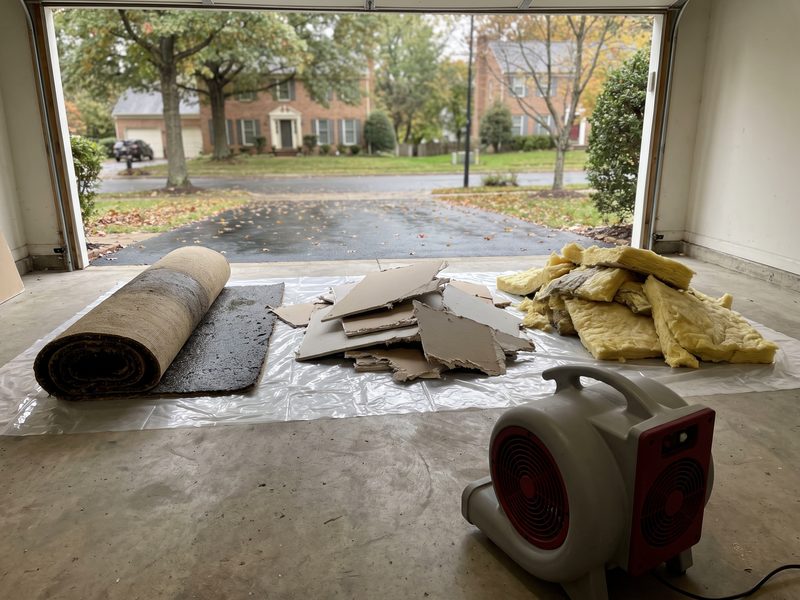
- Remove and replace materials too contaminated to salvage (some drywall, padding, insulation).
- Contain and remediate any mold under S520 before rebuilding.
- Clean and, if needed, treat HVAC components so ducts stop redistributing odor.