Water-Damaged Drywall: Repair or Replace?

BYSteve Jafari, General ManagerNORTHERN VIRGINIA, MARYLAND & D.C.

Water-damaged drywall can often be dried in place if it was wetted by clean (Category 1) water, has not lost structural integrity, and returns to a verified dry standard within a few days. It should be cut out and replaced when it was contaminated by Category 2 or 3 water, stays saturated, sags or crumbles, or shows mold. The deciding factors are the water category, how saturated the board is, and daily moisture-meter readings—not just how it looks.
Call 1-888-29-FLOODCan water-damaged drywall be dried in place or does it need replacing?
It depends on three things: the category of water that touched it, how saturated the drywall became, and whether it dries back to a verified dry standard. Water-damaged drywall that was soaked by clean water, kept its structural integrity, and dries within a few days can usually be saved in place. Drywall exposed to contaminated water, or that stays wet, sags, or crumbles, needs to be cut out and replaced.
Drywall (gypsum board) is a paper-faced, porous material that acts like a sponge. When it wicks up moisture, water travels upward through the gypsum core and the paper facing, sometimes well above the visible waterline. That is why a quick visual check is never enough—two walls that look identical can have completely different moisture profiles inside.
At Restoration Doctor, we make the repair-or-replace call using the ANSI/IICRC S500 Standard for Professional Water Damage Restoration rather than guesswork. That means classifying the water, mapping how far moisture has migrated with meters, and monitoring the drying every day until the material reaches a documented dry target. Only then is a wall confirmed salvageable.
This matters because the wrong decision is expensive in both directions. Tearing out drywall that could have been dried wastes money and extends the disruption in your home. Drying in place drywall that should have come out traps moisture and contamination behind the wall, which is at risk for mold if it stays wet past 24 to 48 hours.
What water category is affecting your drywall—and why does it matter?
The water category is the single most important factor in whether drywall can be saved. Under IICRC S500, water is classified into three categories based on its level of contamination, and that classification often decides the outcome before any moisture reading is taken.
Category 1 is water from a sanitary source—a supply line, a burst pipe, an overflowing sink with no contaminants, or in some cases rainwater. Drywall wetted by Category 1 water is a strong candidate for drying in place, provided it is still structurally sound and can be dried quickly. Category 2, often called gray water, contains significant contamination that could cause discomfort or sickness if ingested—think washing-machine or dishwasher discharge, or aquarium water. Category 3, or black water, is grossly contaminated: sewage backups, toilet overflows containing feces, rising floodwater from outside, or any water carrying harmful pathogens or toxins.
For porous materials like drywall, Category 2 and Category 3 water generally means removal. The paper facing and gypsum core absorb contaminants that cannot be reliably cleaned once they penetrate the material. Category 3 water in particular triggers strict safety protocols, and the affected drywall is treated as unsalvageable and removed under containment.
One critical detail: category is not static. Category 1 water that sits for 48 to 72 hours, or that migrates through contaminated building cavities, can degrade to Category 2 or 3. This is why fast response changes outcomes—our median on-site arrival across Northern Virginia is 47 minutes, and reaching the water while it is still Category 1 is often the difference between drying a wall and demolishing it. Response times vary based on crew availability and demand.
- Category 1 (clean): drywall is usually a candidate for drying in place
- Category 2 (gray): drywall is often removed, especially if saturated
- Category 3 (black): drywall is removed under strict containment protocols—no drying in place
- Time degrades category: clean water left standing can deteriorate to a higher category within 48-72 hours

How do moisture readings tell you if drywall can be saved?
Moisture meters tell you whether drywall is actually wet, how far the water has migrated, and whether it is drying—information the eye cannot see. Restoration professionals use two meter types together: non-invasive (pinless) meters that scan for elevated moisture behind the surface, and invasive (pin) meters that measure moisture content at depth. Comparing readings to dry, unaffected materials of the same type in the same home establishes the baseline dry standard.
The process starts by finding the true extent of the water, not just the visible stain. We scan above, below, and to the sides of the obvious damage to map where moisture has wicked. Gypsum can pull water 12 to 24 inches above a waterline, so the wet zone is almost always larger than it looks. That map defines what needs drying equipment aimed at it and what is already dry.
From there, the decision hinges on the trend, not a single reading. If daily moisture measurements fall steadily toward the dry standard within a reasonable timeframe, the drywall is drying and can stay. If readings plateau at elevated levels despite proper airflow and dehumidification, the material is holding water it cannot release—a strong signal it needs to come out.
Every reading is logged. We document daily moisture logs alongside CompanyCam photos so there is an evidence trail of where the wall started, how it responded, and when it hit the verified dry target. That record protects both the drying decision and any insurance claim tied to it.
What are the signs water-damaged drywall must be cut out and replaced?
Drywall must be replaced when it has lost structural integrity, was contaminated by Category 2 or 3 water, or refuses to dry to standard. These signs override an otherwise hopeful moisture reading—no amount of drying restores drywall that has physically broken down.
Physical failure is the clearest signal. Drywall that sags, bulges, feels soft or spongy, crumbles when pressed, or has visibly delaminated paper is done. The gypsum core has lost its bond and will not regain strength. Likewise, drywall with mold growing on or behind it—black or green staining, a persistent musty odor—is removed rather than cleaned, because mold hyphae penetrate porous material and cannot be reliably extracted from it.
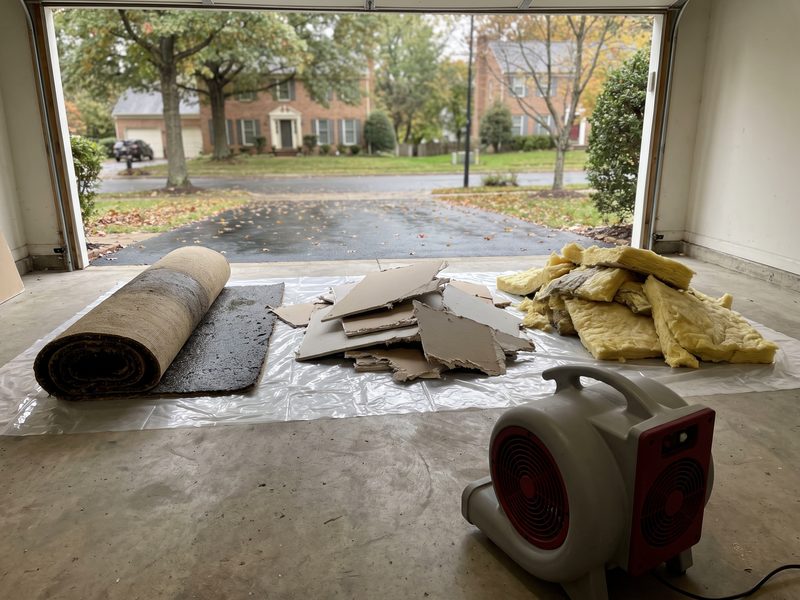
Location and contamination also force removal. Any drywall touched by sewage or rising floodwater is cut out regardless of how dry it later reads. Insulation behind wet drywall is another factor—wet fiberglass or cellulose insulation holds water against the back of the board and rarely dries in place, so both often come out together.
When we do cut, we cut deliberately to a clean, straight line above the moisture zone so the replacement is a tidy patch, not a ragged demolition. The goal is to remove exactly what must go and preserve everything that can be dried.
- Sagging, bulging, soft, or spongy board
- Crumbling gypsum or peeling, delaminated paper
- Visible mold, dark staining, or persistent musty odor
- Contact with Category 2 or Category 3 water
- Wet insulation trapped in the wall cavity
- Moisture readings that plateau and won't reach the dry standard

How does drying water-damaged drywall in place actually work?
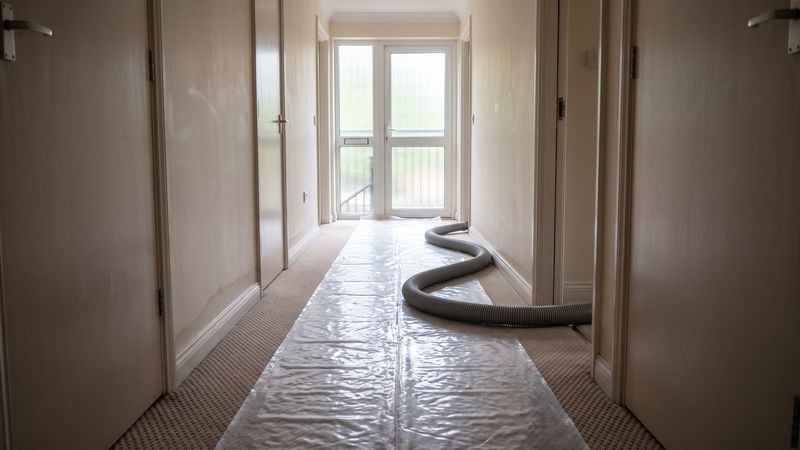
Drying drywall in place uses controlled airflow and dehumidification to pull moisture out of the gypsum and the wall cavity, monitored daily until the material reaches its dry standard. It is a scientific process governed by psychrometry—the relationship between temperature, humidity, and evaporation—not just pointing a fan at the wall.
First, the source of water is stopped and any standing water extracted. Then we create an efficient drying environment: air movers direct high-velocity airflow across wet surfaces to accelerate evaporation, while commercial dehumidifiers remove that evaporated moisture from the air so it doesn't simply re-condense elsewhere in the structure. Temperature is managed because warmer air holds more moisture and speeds evaporation.
For water trapped inside a wall cavity, drying in place often means creating small, controlled access—drilling weep holes near the base of the wall or removing the baseboard to inject and circulate air behind the drywall. This vents the cavity without demolishing the whole wall, preserving the board when the situation allows.
Throughout, moisture readings are taken every day and compared to the dry standard, and equipment placement is adjusted based on the data. A typical structural dry-out runs about 4.5 days—but the meters, not the calendar, declare the wall dry. Learn more about how we approach this on our water damage restoration page.
When should a flood cut be used, and how high should you cut?
A flood cut is a horizontal cut across the drywall—typically 12 to 24 inches above the waterline—used when the lower portion of a wall is contaminated or too saturated to save. It removes the compromised drywall and any wet insulation behind it while preserving the intact drywall above, giving crews access to dry the cavity and framing.
The cut height is guided by how far moisture wicked upward, confirmed with meters, plus a margin above the highest wet reading. The cut is always made above the highest point where the meter still shows elevated moisture, and often at a clean line such as 2 feet or 4 feet to make replacement easier. Cutting to a stud line at a level height keeps the new board manageable to install and finish.
Flood cuts are especially common with Category 2 and 3 events, where the lower wall must go regardless of drying potential, and with insulated exterior walls where trapped wet insulation would otherwise hold moisture indefinitely. Removing the lower band exposes the studs, bottom plate, and cavity so they can be cleaned, treated if needed, and dried thoroughly.
The upside of a flood cut is that it saves the majority of the wall and speeds drying dramatically by opening the cavity. It is a controlled, surgical removal—not a sign that the whole wall is lost.
| Factor | Lean toward drying in place | Lean toward cut-out and replace |
|---|---|---|
| Water category | Category 1 (clean) | Category 2 or 3 (contaminated) |
| Structural condition | Firm, holds shape | Sagging, soft, crumbling, delaminated |
| Moisture trend | Falling daily toward dry standard | Plateaued at elevated readings |
| Insulation behind wall | Dry or none | Wet insulation trapped in cavity |
| Mold | None present | Visible growth or musty odor |
| Time wet | Caught early (hours) | Saturated for days |

How long does it take to dry water-damaged drywall?
Most water-damaged drywall that can be dried in place reaches its dry standard in about three to five days, with our typical structural dry-out averaging around 4.5 days under daily monitoring. The exact timeline depends on how saturated the material became, the size of the affected area, humidity, temperature, and how quickly drying began.
Speed matters for more than convenience. Wet drywall should be dried within 24 to 48 hours to prevent mold growth, so the window to dry rather than replace is short. The sooner professional drying equipment is running, the more likely the drywall stays on the dry-in-place side of the decision. We can be on-site in as little as 60 minutes across the Northern Virginia core, which protects that window. Response times vary based on crew availability and demand.
Drying is not finished when the surface feels dry to the touch—that can happen while the core and cavity are still wet. Completion is defined by moisture meters reading at or below the dry standard, established by comparing to unaffected materials in the same structure. We verify and document that endpoint before any wall is closed up or refinished.
If readings stall for two to three days despite proper equipment and airflow, that plateau is itself the answer: the material or cavity is not releasing moisture, and a targeted cut-out is the responsible next step to prevent hidden mold.
What does water-damaged drywall repair cost, and does insurance cover it?
Water-damaged drywall repair costs vary widely based on the water category, the square footage affected, whether insulation and framing are involved, and how much drying versus replacement is required. Drying a small, clean-water area in place costs far less than a Category 3 removal with containment, so any honest estimate is a range—never a single fixed price—until the damage is assessed on site.
Because pricing depends on the actual scope, we assess the affected area, classify the water, and provide a documented estimate built in Xactimate—the same estimating platform insurance carriers use. Speaking that common language reduces friction when a claim is involved.
About 83% of our customers file an insurance claim. Here is how billing works: Restoration Doctor bills the homeowner directly and hands you documentation you may share with your insurer—an Xactimate scope, CompanyCam photo documentation, and daily moisture logs. We are hired by the property owner under a written agreement. Coverage depends on your policy and your insurer's decision. Questions about coverage belong with your insurer, your agent, or a licensed public adjuster or attorney.
The documentation is what turns a stressful claim into a straightforward one. When your file shows the water category, the extent mapped by meters, the daily drying progress, and photos at every stage, the adjuster has what they need. You can read more on our insurance claims page, and we're glad to walk you through it.

Can you prevent mold in water-damaged drywall?
Yes—the most reliable way to prevent mold in water-damaged drywall is to dry it completely to the verified dry standard, starting within 24 to 48 hours, or to remove contaminated and saturated board that can't be dried in time. Mold needs moisture, a food source (the paper facing and organic content in drywall), and time; remove the moisture fast enough and you remove the opportunity.
Speed and thoroughness are everything. Surface-dry drywall with a wet cavity behind it is a classic setup for hidden mold, which is why cavity drying and daily verification matter so much. Partial or DIY drying that stops when the wall feels dry often leaves enough residual moisture inside the wall for growth where you can't see it.
If mold has already established—visible growth, staining, or a persistent musty smell—the affected drywall is removed and remediated under the ANSI/IICRC S520 Standard for Professional Mold Remediation, using containment to prevent spores from spreading to clean areas. Drying alone does not fix drywall that already has mold established in it.
When you catch water damage early, drying wins more often than not. When you're unsure whether what's behind your wall is dry or growing, a moisture assessment answers the question. You can reach Restoration Doctor any time at 1-888-293-5663 through our emergency water damage service—we respond 24/7 across the Virginia, Maryland, and Washington, D.C. tri-state area.