Can Wet Carpet Padding Be Saved? The 24-Hour Rule and What Replacement Costs
BY RESTORATION DOCTOR · NORTHERN VIRGINIA, MARYLAND & D.C.
Carpet padding is an open-cell sponge sitting on a cold slab, so it absorbs and holds far more water than the carpet above it and is almost always replaced even when the carpet is saved. This guide gives the 24-hour decision window, the category rules that make the pad non-negotiable, what floating the carpet involves, and how the replacement cost compares with replacing both layers.
Call 1-888-29-FLOODCan wet carpet padding be saved, or does it always come out?
Can wet carpet padding be saved? Usually not. In most water losses the pad comes out, because it is an open-cell foam sponge pressed against a cold slab and it holds water long after the carpet face above it feels dry to the hand. The carpet is often the survivor and the pad is the casualty, which surprises homeowners because the carpet is the part they can see.
The field rule is simple: if clean water sat in the pad for more than roughly a day, or the water was anything other than clean, the pad is cut and binned. The exceptions are narrow and all depend on catching the loss early.
The reason is drying physics, not squeamishness. Pad sits between two vapor-blocking surfaces: a latex-backed carpet above, a slab or subfloor below. Air movers blow across the carpet face and almost none of that air reaches the trapped layer. Pad is also one of the cheapest materials in the room and one of the slowest to dry, so spending extra equipment days on it is a bad trade. A contractor who removes pad on day one is usually saving you money.
- Pad can stay: a small clean-water spill found within a few hours, metering back to the dry standard.
- Pad can stay: closed-cell rubber slab pad under clean water, lifted, wiped down and metered dry.
- Pad comes out: any gray or black water, sewage backup, or storm and surface runoff that ran across the ground before it came inside.
- Pad comes out: clean water that sat overnight, or pad already gone soft, crumbly or discolored.
- Pad comes out: fiber, jute or felt pad in any water event, because organic material cannot be verified clean.
What is carpet padding actually made of, and why does it hold water the carpet does not?
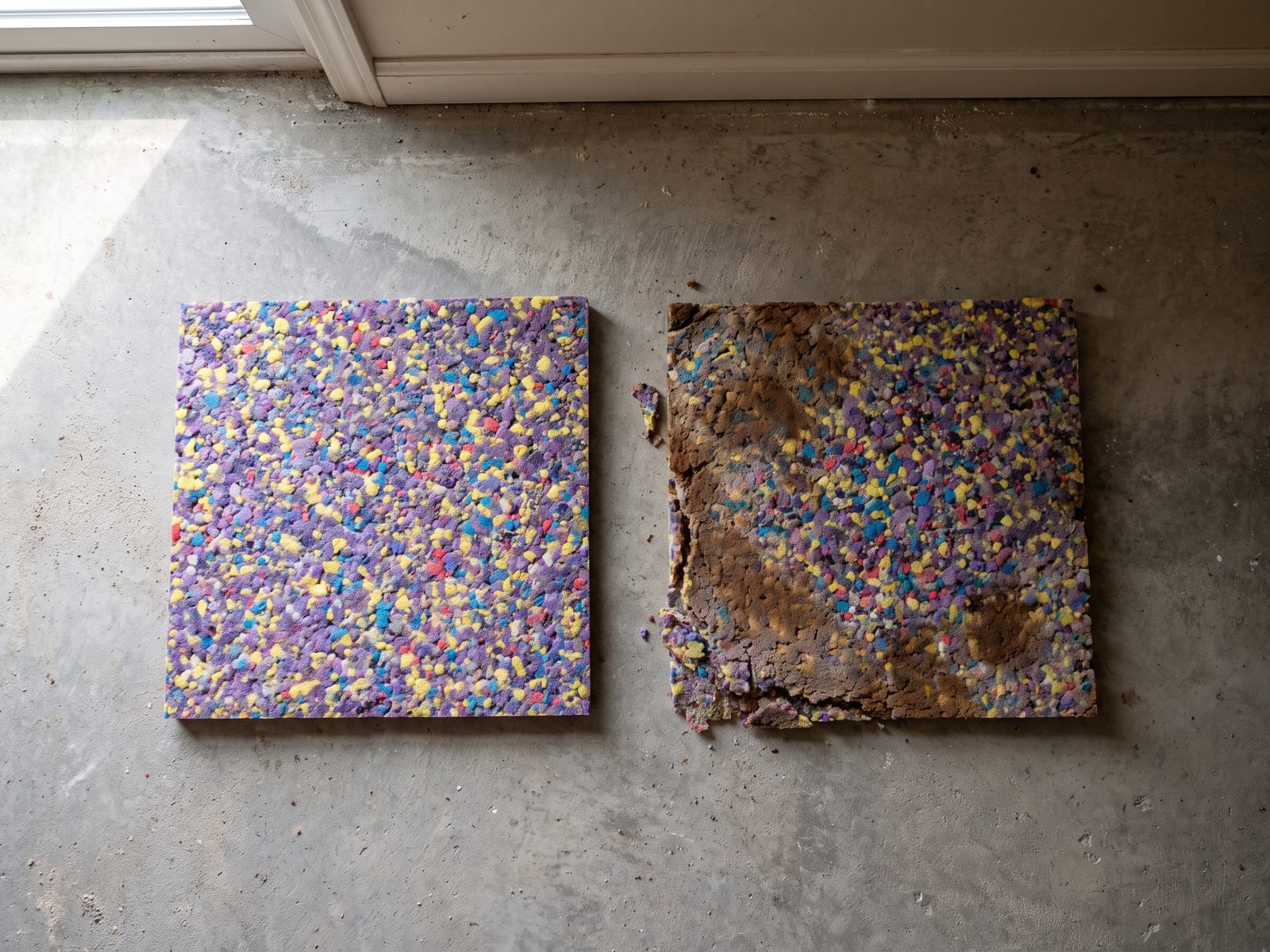
The pad under a Northern Virginia basement carpet is almost always rebond: shredded scraps of polyurethane foam bonded into a multicolored slab. Rebond is millions of connected air pockets. Water moves into those pockets by capillary action and stays there. A square yard of saturated rebond holds pounds of water that surface airflow will not pull out at any useful speed.
The other pads rarely behave better. Prime foam is lighter and gives up its water no faster. Rubber waffle pad sheds water reasonably well, but the cups trap standing water underneath. Fiber, jute and felt pads are organic, so they feed mold the moment they are wet.
The carpet face is the opposite. Nylon, polyester and olefin fibers are synthetic and hold very little water, so most of what lands on a carpet drains straight through the face into the pad. That is why a technician can extract a carpet to nearly dry in one pass and still find the meter pinned when the probe goes under it.
How long do you have before the decision is made for you?
You have about 24 hours of real choice, and 48 hours before the choice is gone. The EPA says that when wet materials are dried within 24 to 48 hours of a leak or spill, in most cases mold will not grow. Rebond pad is wet, sits on dust and organic soil, and holds a stable temperature under a finished basement floor. It is close to an ideal incubator.
The clock runs faster than people expect in a below-grade room. A Fairfax or Burke basement slab sits at ground temperature year round, so the pad stays cool and evaporation from it is slow. Warm humid air from upstairs meets that cool wet layer and condenses instead of drying it. A day and a half in, the pad has lost little water and gained a smell.
Past a point, category matters more than the clock. Water that started as Category 1 is commonly treated as Category 2 once it has sat in wet pad for a day or more. The window counts down to a reclassification, not to a repair.
- Hours 0 to 6: extract standing water, lift furniture onto blocks, and meter through the carpet into the pad.
- Hours 6 to 24: decide. Clean water, small area and falling readings can justify drying in place with the carpet lifted.
- Hours 24 to 48: the pad is a mold risk regardless of source, and the odor usually starts here.
- Past 48 hours: plan on pad removal and on checking the tack strip, baseboard and bottom plate behind it.
Does the water category change the answer for the pad and for the carpet?
Category changes everything. The IICRC S500 standard sorts water into three categories by how contaminated it is at the moment of loss, and the two layers get different verdicts in each. Category 1 is clean water from a supply line or a tank toilet. Category 2 carries real contamination, such as washing machine discharge, or clear seepage water that came up through a failed sump pit. Category 3 is grossly contaminated: sewage, toilet water with solids, waste-line backflow from beyond a trap, and surface water that ran across the ground before it came inside.
The carpet face can often be cleaned and disinfected through Category 2 because the fibers are synthetic and both sides can be reached. The pad cannot. There is no way to clean the inside of a sponge and stand behind the result. In Category 3 both layers go, and no antimicrobial or deodorizer changes that. Anyone offering to sanitize a sewage-soaked carpet and pad back to safe is selling you a problem you will smell again in July.
Category also drives what happens to the room around the floor. Gray and black water reach the tack strip, the drywall bottom edge, the base trim and often the bottom plate. Pulling the pad starts that inspection rather than ending the job.
| Water source | Category | Carpet face | Padding |
|---|---|---|---|
| Supply line or tank toilet, found within 24 hours | Category 1, clean | Usually saved, dried in place and re-stretched | Removed in almost every case; kept only on a very small spill that meters dry |
| That same clean water after 24 to 48 hours | Category 1 degrading toward 2 | Usually saved with cleaning and an antimicrobial | Removed |
| Washing machine discharge, clear seepage from a failed sump pit, toilet overflow with no solids | Category 2, gray | Often saved if both faces are cleaned and disinfected promptly | Removed, no exceptions |
| Sewage backup, toilet water with solids, storm water across soil | Category 3, black | Removed and disposed of | Removed and disposed of |
| Water of any source left long enough to grow visible mold | Category 3 by condition | Removed under containment | Removed under containment |
What does floating the carpet mean, and when is it the right call?
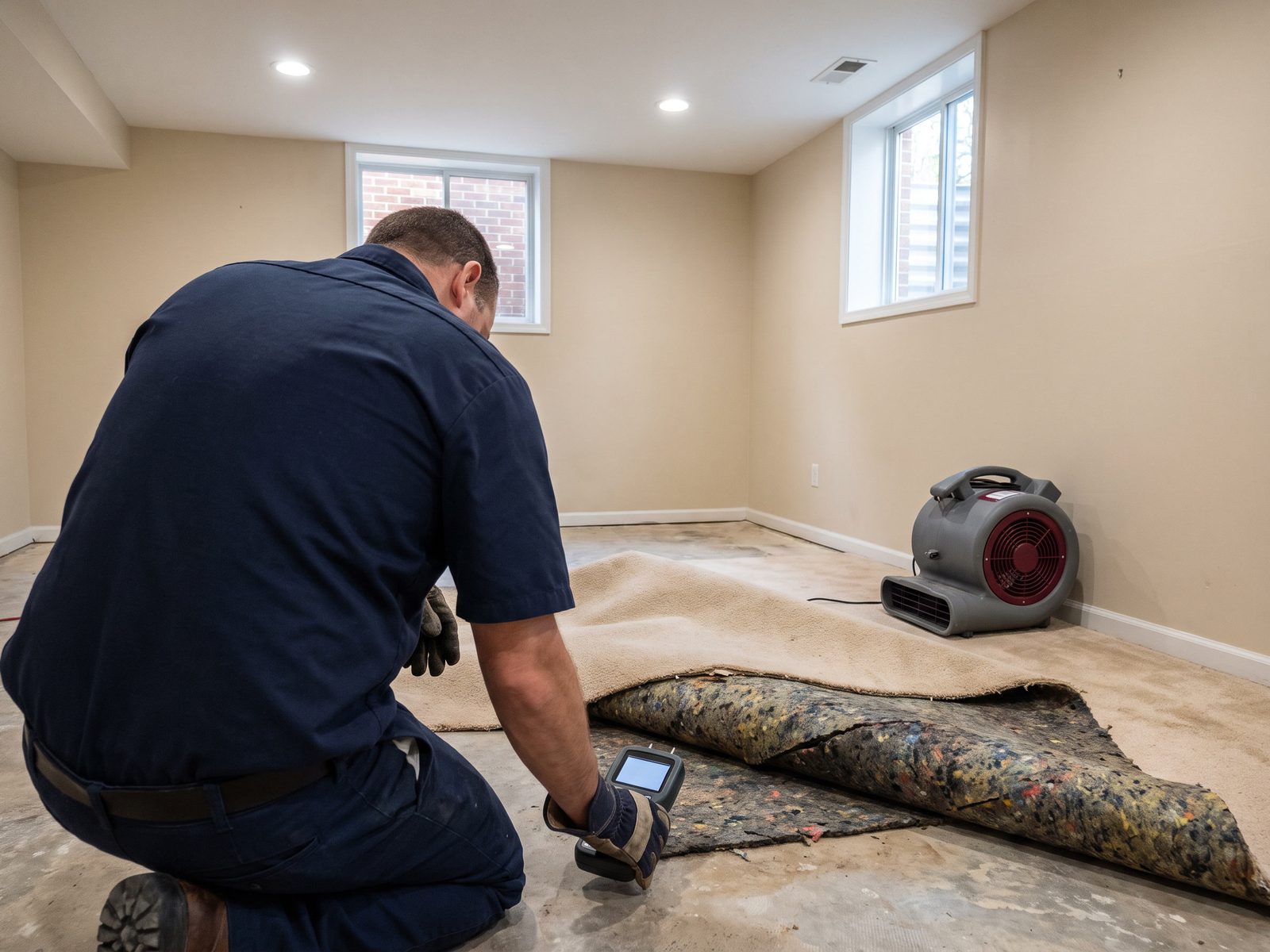
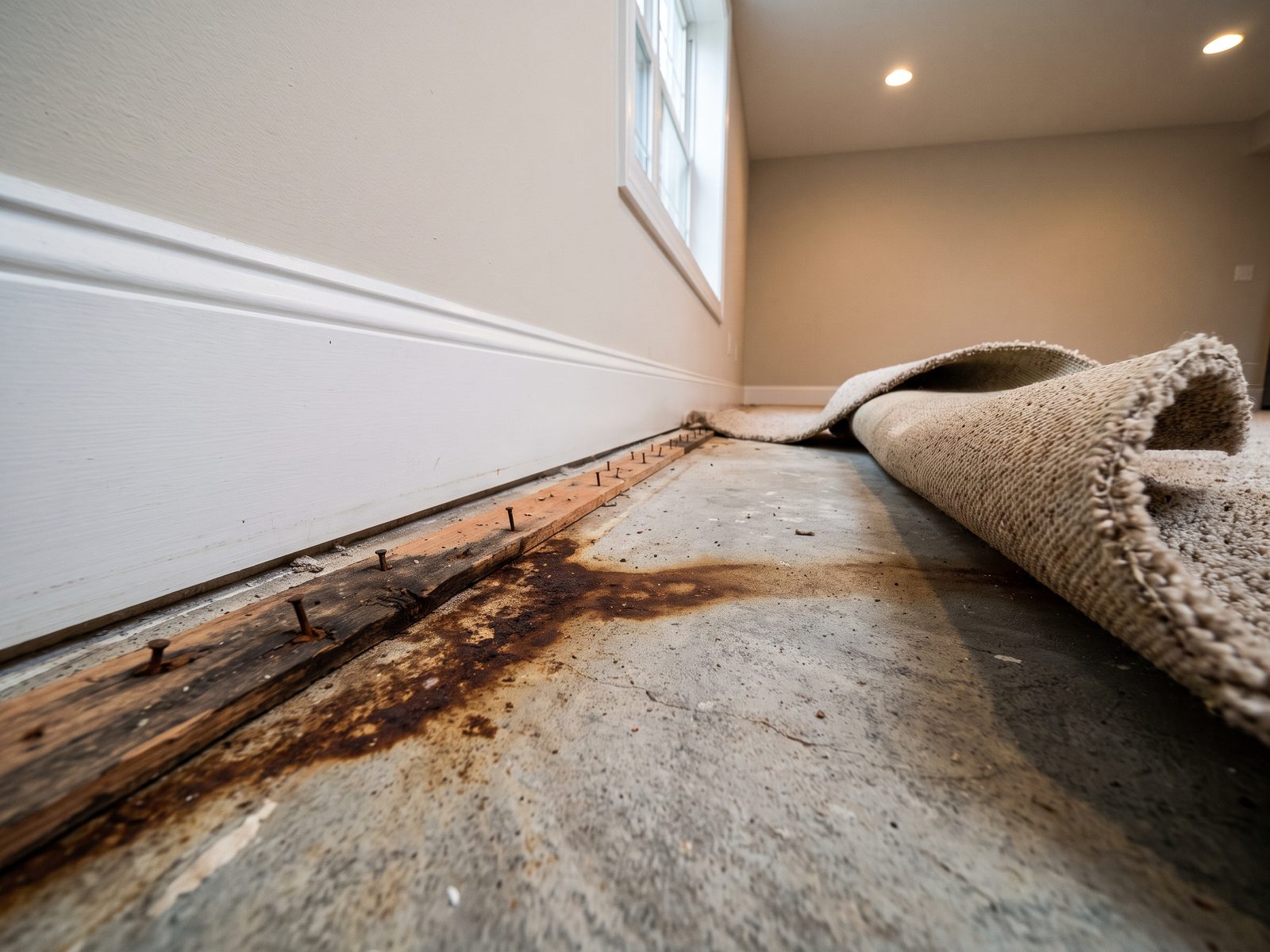
Floating is the technique that lets the carpet survive while the pad leaves. A technician releases the carpet from the tack strip along one or two walls, folds it back, cuts the wet pad out in strips, and lays the carpet back over the bare slab. An air mover wedged at the edge inflates the carpet and pushes dry air across the underside and the slab at once.
Done properly it dries three surfaces at once: the carpet backing, the slab and the room air. Blowing air over an undisturbed carpet dries only the fiber tips, which is how a floor feels dry on Tuesday and smells on Friday.
Floating is right when the carpet is worth keeping and the water was Category 1 or a promptly handled Category 2. It is wrong when the backing has delaminated, when the water was Category 3, or when the carpet is old enough that re-stretching will tear it. Our average dry-out runs close to 4.5 days, and a floated carpet usually comes back down near the end of that window, after the slab passes a moisture check.
- The carpet is pulled off the tack strip, not cut, so it can be re-stretched and re-laid.
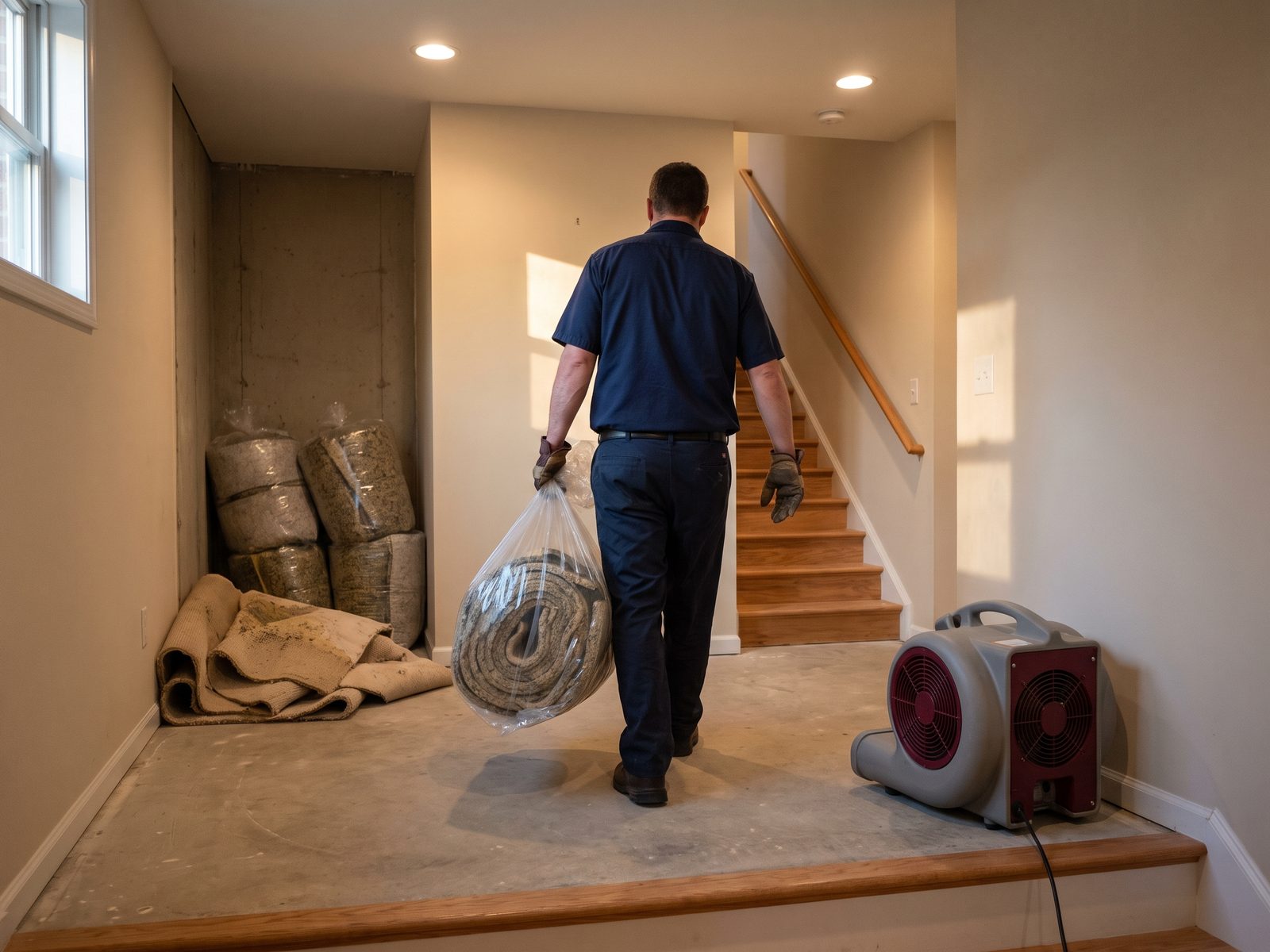
- All pad in the affected area comes out, plus a margin past the visible water line, because wicking outruns what you can see.
- The slab is cleaned, and in gray-water losses disinfected, before anything goes back down.
- New pad goes in only after the slab meets a dry standard, verified with a meter rather than by touch.
How do you tell delaminated pad from pad that is merely wet?
Pull up a corner and handle it. Wet pad is heavy, cold and darker than the dry pad beside it, but it holds together as a sheet and springs back a little. Delaminated pad has lost the bond between the foam chips. It tears under its own weight, leaves crumbs on your glove, and stays compressed where you pressed it.
The carpet has its own version of the same failure. Carpet delamination is the secondary backing separating from the primary backing, felt as a loose rippling layer that slides when you push the pile sideways. A delaminated carpet will not re-stretch without buckling, so it goes out with the pad.
Meters settle the rest. What matters is the comparison against an unaffected area of the same material in the same room. That dry reference is the standard the job is dried back to, and it belongs in your contractor's daily log.
- Squeeze: dry pad springs back, wet pad weeps, delaminated pad crumbles at the edge.
- Color: even darkening is water; blotchy brown or gray staining with a musty smell is microbial.
- Smell: a sour or earthy odor that returns as the room warms is coming from the pad, not the carpet.
- Meter: readings that will not fall over two days mean the material will not dry in place.
What does it cost to replace the pad versus replacing carpet and pad together?
Pad is the cheap half of the floor. Standard rebond costs a small fraction of what mid-grade carpet costs, so replacing the pad alone is a modest line item. The labor is where the money sits: cutting and bagging the wet pad, cleaning the slab, laying new pad, then re-stretching the carpet. Ask any quote to break those steps out.
Replacing both layers costs several times more than pad alone. Carpet that has been down for years has faded and worn, so a partial replacement rarely matches. A floated and saved carpet is often the better outcome. Prices move with material grade and local labor, so get a written number from a flooring supplier in your area.
One cost people miss is the tack strip. Water-damaged strip rusts, stains the new carpet from underneath and loses its grip. In a gray or black water loss it is replaced as a matter of course.
- Cost drivers for pad only: affected square footage, pad density and grade, disposal, slab cleaning, and the re-stretch.
- Cost drivers for carpet and pad: the same list plus material grade, seam layout and stair work.
- Add-ons in a wet basement: tack strip replacement, baseboard removal and transition strips.
Will homeowners insurance pay for new padding?
Often, when the water event itself is covered. Many homeowners policies respond to sudden and accidental discharge from plumbing or an appliance, and the pad is then treated as damaged property like any other material. Groundwater and surface flooding are a different question, because standard homeowners policies exclude flood.
Read your declarations page before you assume either way. Your deductible, any water backup endorsement and any sub-limit on mold all sit there, and they decide more about your out-of-pocket cost than the pad does. Many carriers want photographs of the wet material before it leaves the property, plus moisture readings that justify the removal.
Photograph the folded-back carpet, the dark pad, the meter in place and the marked-out removal area before anything is bagged. That file is what an adjuster reviews.
What happens if you dry the carpet and leave the pad in place?
You get a floor that looks finished and stays wet. Air movers dry the pile in hours, so the room passes the hand test while the pad underneath still holds pounds of water against the slab. That moisture feeds odor-producing bacteria, wicks into the base of the drywall and the tack strip, and raises the humidity of the whole basement for weeks.
The smell is the first complaint and it follows a pattern: fine in the morning, sour by evening, worse after warm weather. That is microbial growth in the pad responding to temperature, and no shampoo or deodorizer reaches it.
The second complaint arrives later. Mold on the paper face of drywall behind the baseboard, cupped trim, and on slab floors a white efflorescence line where moisture carried salts to the surface. Every one of those repairs costs more than the pad would have.
When should you stop and call a restoration contractor instead?
Call when the wet area is bigger than a closet, when the water was not clean, when it has been more than a day, or when the carpet is worth saving. A shop vacuum and a box fan handle a spilled bucket. They do not handle a supply line that ran overnight into a finished basement, because that needs extraction, a dehumidifier sized to the space and daily readings that prove the slab is drying.
Restoration Doctor works out of Vienna and sees this scenario constantly in Fairfax, Burke, Springfield, Woodbridge, Arlington, Alexandria, Loudoun and Prince William. If you are already smelling the room, the decision has been made for you. Get the carpet up, get the pad out, and let a meter rather than a hand decide when the slab is dry.
The standards and guidance behind this article:
- ANSI/IICRC S500, Standard for Professional Water Damage Restoration, the source of the water categories used above: https://iicrc.org/s500/
- EPA, A Brief Guide to Mold, Moisture and Your Home, the source of the 24 to 48 hour drying guidance: https://www.epa.gov/mold/brief-guide-mold-moisture-and-your-home
- FEMA, on flood insurance and what a standard homeowners policy does not cover: https://www.fema.gov/flood-insurance