Mold Exposure Symptoms: When Should You Worry?
BY RESTORATION DOCTOR · NORTHERN VIRGINIA, MARYLAND & D.C.

The most common mold exposure symptoms are nasal congestion, sneezing, coughing, itchy eyes, throat irritation, wheezing, headaches, and fatigue that improve when you leave the building and return when you go back inside. Infants, older adults, people with asthma, and people with weakened immune systems are most at risk. If symptoms line up with a persistent musty smell or visible growth, it's time for a professional inspection and remediation aligned with the ANSI/IICRC S520 standard.
Call 1-888-29-FLOODWhat are the most common mold exposure symptoms?
The most common mold exposure symptoms are respiratory and allergic reactions: nasal congestion, sneezing, a runny or stuffy nose, coughing, wheezing, throat irritation, and itchy, watery, or red eyes. Many people also report headaches, sinus pressure, fatigue, and skin irritation. For most healthy adults these symptoms are uncomfortable but not dangerous, and they often feel like a lingering cold or a bout of seasonal allergies that never fully clears.
The telltale pattern with mold is timing and location. If your symptoms flare when you're inside a particular room, basement, or the whole house — and ease off when you leave for work, travel, or spend time outdoors — mold or another indoor allergen is a strong suspect. This location-linked pattern is one of the most reliable everyday clues that what you're breathing indoors is the problem.
Mold affects people through three main routes: allergic response (the most common), irritation from spores and the microbial compounds mold releases, and — far less commonly — infection in people with seriously compromised immune systems. Understanding which category you fall into helps you gauge how urgently to act.
- Nasal and sinus: congestion, sneezing, runny nose, post-nasal drip, sinus pressure
- Respiratory: coughing, wheezing, chest tightness, shortness of breath
- Eyes and skin: itchy or watery eyes, redness, skin rash or irritation
- Whole-body: headaches, fatigue, difficulty concentrating, a general 'run-down' feeling

Who is most at risk from mold exposure?
The people most at risk from mold exposure are infants and young children, adults over 65, people with asthma or chronic lung conditions, those with diagnosed mold allergies, and anyone with a weakened or suppressed immune system. For these groups, the same exposure that gives a healthy adult a stuffy nose can trigger serious asthma attacks, sinus infections, or — in rare cases involving severe immune suppression — invasive fungal infection.
People with asthma are especially vulnerable because inhaled mold spores and fragments can directly inflame the airways and set off attacks. Those undergoing chemotherapy, organ-transplant recipients on immunosuppressants, and people with conditions like cystic fibrosis face the highest risk and should stay away from any known mold contamination entirely until it's professionally removed.
If someone in a high-risk category lives in your home and you suspect mold, treat it as a priority rather than a wait-and-see situation. The safest move is to keep the vulnerable person out of the affected area and arrange a professional inspection quickly.
| Group | Typical response | Recommended action |
|---|---|---|
| Healthy adults | Cold-like or allergy-like symptoms | Address the moisture source and remediate mold; symptoms usually resolve |
| Children & older adults | More pronounced respiratory and allergy symptoms | Limit exposure; schedule a prompt inspection |
| Asthma / lung conditions | Wheezing, chest tightness, asthma attacks | Avoid the area; make professional remediation a priority |
| Immunocompromised | Risk of infection, not just allergy | Avoid the space entirely; remediate before re-entry |
How do I know if my symptoms are from mold and not a cold or allergies?
The clearest sign that mold — not a cold or ordinary allergies — is behind your symptoms is that they persist for weeks, follow you to specific locations, and improve when you're away from the building. A cold typically runs its course in seven to ten days. Mold-related symptoms linger as long as you keep breathing the contaminated air, then quietly fade during a weekend away or a vacation.
Another distinguishing clue is the combination of health symptoms with environmental signs: a persistent musty or earthy odor, visible discoloration on walls or ceilings, peeling paint, warped baseboards, or a history of water damage, leaks, or humidity problems. Cold viruses don't come with a musty smell. When symptoms and a musty odor appear together in the same space, mold moves to the top of the list.
Seasonal allergies tend to track with the outdoor pollen calendar and improve when you go indoors — the opposite of indoor mold. If your time inside makes things worse, that reversal is meaningful. A doctor can confirm a mold allergy with skin or blood testing, but you don't need a lab result to act on an obvious moisture and odor problem in your home.
- Lasts longer than 10 days and never fully resolves
- Gets better when you leave the house, worse when you return
- Comes paired with a musty smell, visible growth, or past water damage
- Multiple household members feel it in the same room or on the same floor

What does a musty smell actually mean?
A persistent musty, earthy, or damp-basement smell almost always means active mold or bacterial growth is present, even if you can't see it. That odor comes from microbial volatile organic compounds (mVOCs) — gases that mold releases as it grows and feeds on damp materials like drywall, wood, carpet padding, and insulation. In other words, if it smells like mold, something organic is actively growing on a wet surface nearby.
Because mold frequently grows out of sight — behind drywall, under flooring, inside wall cavities, above ceiling tiles, or in the HVAC system — the smell is often your first and only warning before visible staining appears. Don't dismiss it or mask it with air fresheners. The odor is data, and it's telling you there's a moisture problem feeding growth somewhere in the structure.
A musty smell that gets stronger after rain, when the humidity climbs, or when the HVAC kicks on points toward hidden moisture. That's a strong signal to have the source located rather than guessing. Our team follows the ANSI/IICRC S520 standard for professional mold remediation to find the hidden growth and, just as important, the water source feeding it.
When do mold symptoms mean it's time to call a professional?
It's time to call a professional when health symptoms line up with any physical evidence of mold — a musty smell, visible growth, or a known water event — or when symptoms persist despite over-the-counter allergy relief and basic cleaning. Those two signals together mean the problem is environmental and won't resolve until the mold and its moisture source are removed. This is the threshold where DIY cleaning stops being enough.
You should also call promptly if visible mold covers a sizable area, if it keeps coming back after you wipe it away, if it's growing inside your HVAC system, or if anyone in the home is in a high-risk group. Recurring mold almost always means there's an unaddressed moisture source behind the wall or under the floor — cleaning the surface without fixing that source just resets the clock.
At Restoration Doctor we respond 24/7 across the Virginia, Maryland, and Washington, D.C. tri-state area, with a median on-site arrival of 47 minutes in Northern Virginia. When mold is tied to an active leak or flooding, containing the moisture fast is what stops a small problem from spreading through the structure. You can reach us any time at 1-888-293-5663 or through our contact page.
- Symptoms persist for weeks and improve when you leave the home
- A musty smell or visible growth accompanies the symptoms
- Mold keeps returning after you clean it
- Growth is in the HVAC system or larger than a small patch
- A child, older adult, asthmatic, or immunocompromised person lives in the home

Is it safe to clean mold myself, or do I need remediation?
A small patch of surface mold — generally under about 10 square feet on a hard, non-porous surface — can often be cleaned safely by a homeowner with proper protection and ventilation. Anything larger, anything on porous materials like drywall or carpet, anything recurring, or any growth tied to sewage or contaminated water calls for professional remediation. The line isn't just about size; it's about whether spores will spread and whether the moisture source has actually been fixed.
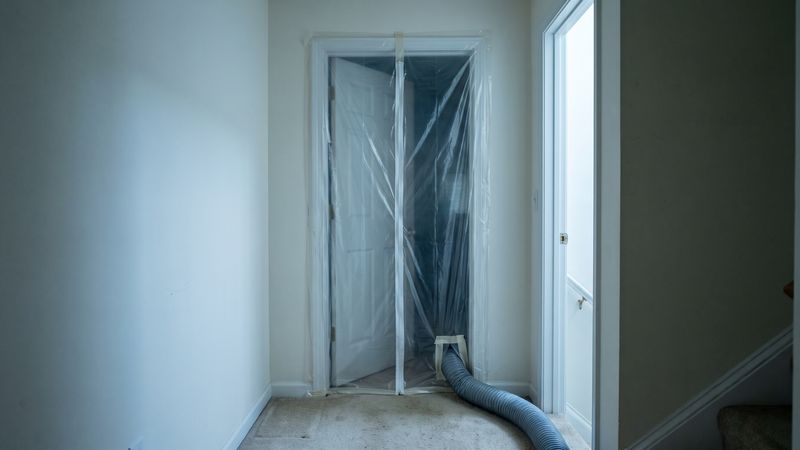
The biggest risk with DIY cleaning is disturbing mold without containment, which sends spores airborne throughout the home and can worsen symptoms or spread contamination to clean areas. Professionals use negative-air containment, HEPA filtration, and controlled removal specifically to prevent that spread. Bleach also gives a false sense of security — it can lighten surface staining without addressing growth rooted inside porous materials, and the water in a bleach solution can even add moisture that feeds regrowth.
Professional remediation under ANSI/IICRC S520 does three things a wipe-down can't: it isolates the work area so spores don't migrate, it removes contaminated porous materials that can't be salvaged, and it verifies the space is dry and clean before rebuild. Critically, it also targets the underlying water problem — because if the moisture returns, so does the mold. Learn more about our approach on our mold remediation page.
| Situation | DIY may be OK | Call a professional |
|---|---|---|
| Area under ~10 sq ft on tile or metal | Yes | — |
| Mold on drywall, insulation, or carpet | — | Yes |
| Recurring growth after cleaning | — | Yes |
| Mold in HVAC or from sewage water | — | Yes |
| High-risk occupant in the home | — | Yes |
How does professional mold remediation actually fix the problem?
Professional mold remediation fixes the problem by finding and stopping the moisture source, containing the affected area, removing contaminated materials, cleaning and HEPA-filtering the space, and drying everything to a verified standard before any rebuild. The order matters: without solving the water problem first, every other step is temporary. That's why our process starts with locating the leak, flood path, or humidity issue feeding the growth.
We follow ANSI/IICRC S520 for mold remediation and ANSI/IICRC S500 for water damage restoration, and we document the entire job for you — CompanyCam photos, moisture readings, and daily drying logs. Structural drying is monitored daily with moisture meters until materials reach verified drying goals rather than a guess; a typical dry-out runs roughly three to five days depending on materials and conditions. When the water involved is Category 3 (grossly contaminated, such as sewage), we apply the appropriate containment and disposal protocols to protect your household.
Because most of our customers end up filing an insurance claim, we build a carrier-ready claim file — including an Xactimate scope, CompanyCam photo documentation, and daily moisture logs — and hand it to you. To be clear about how billing works: we invoice you, the homeowner, directly and give you the documentation to submit to your insurer. We work for you, not your insurance company. You can see how we support that process on our insurance claims page.

What should I do right now if I suspect mold in my home?
If you suspect mold right now, do three things: reduce your exposure, stop the moisture, and get a professional assessment. Keep vulnerable household members out of the affected room, avoid disturbing or scrubbing visible growth (which releases spores), and don't try to mask the smell with air fresheners. If there's an active leak or standing water, shutting off the water source and starting extraction quickly limits how far the problem spreads.
Ventilating with fresh outdoor air and lowering indoor humidity toward the 30–50% range can help in the short term, but these are stopgaps, not solutions. The goal is to hold the line until the source is found and the growth is properly removed. Photograph what you can see and note when symptoms and odors are worst — that record helps both your remediation team and any insurance claim.
Then bring in a professional to inspect, identify the moisture source, and scope the remediation. Restoration Doctor (VA Water Damage LLC, 8609 Westwood Center Dr, Ste 110-1062, Vienna, VA 22182) is licensed, insured, and available 24/7, with crews serving the Virginia, Maryland, and Washington, D.C. tri-state area. Call 1-888-293-5663, check our service areas on our locations page, or reach out through our contact page to get started.
- Keep high-risk family members out of the affected area
- Don't scrub or disturb visible mold — it spreads spores
- Stop active leaks and reduce indoor humidity to 30–50%
- Document what you see and when symptoms are worst
- Schedule a professional inspection to find the moisture source