Water Damage Restoration in Vienna, VA: What Should You Do First?

BYSteve Jafari, General ManagerNORTHERN VIRGINIA, MARYLAND & D.C.

If you have water damage in VA, here's what to do first: stop the water source, kill power to wet areas, move valuables up, and call a licensed restoration crew for extraction within the first hour. Fast professional water damage restoration — extraction, structural drying verified against a measured dry standard, and a documented claim file — prevents mold, secondary damage, and denied insurance claims. Mold can begin growing on wet organic materials in as little as 24 to 48 hours, which is why the first hour matters more than any other.
Call 1-888-29-FLOODWatch a real , VA water damage restoration:
109162228
, VA · WATER DAMAGE · DOCUMENTED ON SITE
What should you do in the first hour of water damage in VA?
In the first hour of water damage, do four things in order: stop the water at its source, shut off electricity to affected rooms, lift furniture and valuables out of standing water, and call a licensed restoration company for emergency extraction. Those first 60 minutes set the entire outcome — water spreads through drywall, subfloor, and framing within minutes, and mold can begin colonizing wet organic material in as little as 24 to 48 hours.
This is the exact sequence a Vienna, VA homeowner followed after a supply line under a second-floor bathroom vanity failed overnight. By morning, water had run down through the ceiling into the living room and pooled across the hardwood floor. They closed the shut-off valve under the sink, cut the breaker to the affected circuits, moved a rug and electronics, and called our 24/7 line. Our crew's median on-site arrival across Northern Virginia is 47 minutes, and getting extraction started that quickly is what kept a bad leak from becoming a gut renovation.
The single biggest mistake homeowners make is waiting to see if it dries on its own. It rarely does. Trapped moisture behind baseboards and under flooring keeps feeding structural materials and creates the humidity mold needs. If you are in an active emergency right now, our emergency water damage response team is the fastest path to stopping the spread.
- Stop the source — close the fixture shut-off or the main water valve.
- Cut power to wet rooms at the breaker before touching anything electrical.
- Move furniture, rugs, electronics, and documents to a dry area.
- Photograph everything before you move or clean it — this supports your claim.
- Call a licensed restoration crew for professional extraction; don't wait to dry it yourself.

Why can't you just mop it up and run a box fan?
You can't fully dry water damage with towels and a box fan because most of the water is where you can't see it — wicked into drywall, wall cavities, subfloor, and framing where surface airflow never reaches. A household fan moves air across a floor but does nothing for the moisture already absorbed several inches up a wall or trapped beneath a hardwood plank. That hidden moisture is what causes warping, cupping, delamination, and mold two weeks later.
Professional structural drying is a controlled psychrometric process governed by the ANSI/IICRC S500 Standard for Professional Water Damage Restoration. Technicians measure moisture content in materials, track humidity in grains of moisture per pound of air, and deploy the right ratio of commercial air movers and dehumidifiers to pull moisture out of the structure — not just off the surface. Moisture readings are logged daily and compared against a drying goal established from unaffected materials in the same home.
In the Vienna project, our crew found the living room ceiling drywall reading well above the home's dry standard even though it looked only faintly stained. Left alone, that ceiling would likely have sagged and supported mold growth within days. Instead, controlled drying returned it to normal moisture content without demolition. That's the difference between mopping up and actually restoring — and it's why we document readings rather than guessing.
How does professional water extraction and structural drying work?
Professional water damage restoration follows a defined sequence: inspection and moisture mapping, water extraction, controlled evaporation and dehumidification, daily monitoring, and final verification that materials have returned to the dry standard. Each stage is measured, not eyeballed, which is what makes the result reliable.
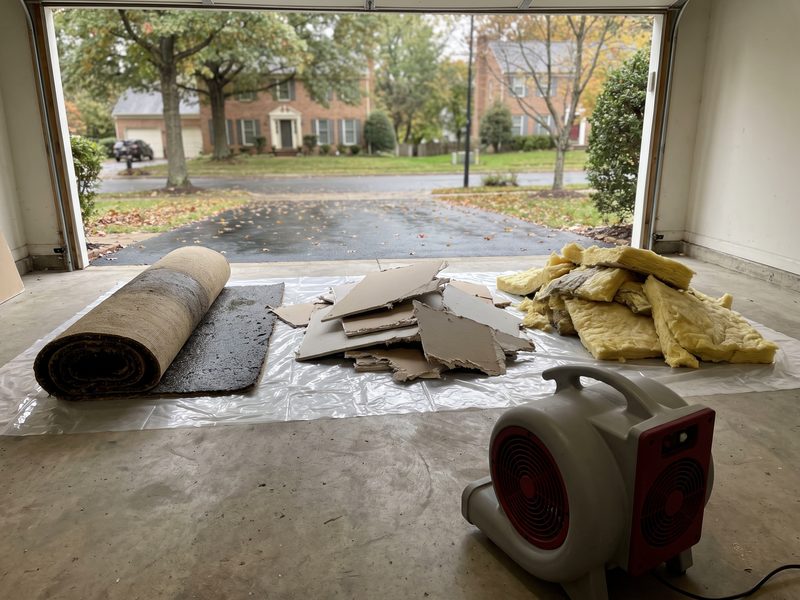
First, technicians categorize the water. Clean water from a supply line is Category 1; water with significant contamination — from appliance discharge, for example, or clean water that has degraded over time — is Category 2; and grossly contaminated water such as sewage or rising floodwater is Category 3, which requires protective protocols and removal of porous materials under IICRC S500 guidelines. The category dictates what can be dried and saved versus what must be removed. Next comes extraction — truck-mounted or portable units pull standing water and deep-extract carpet and pad. Removing bulk water first dramatically shortens drying time, because it is far more efficient to extract liquid water than to evaporate it.
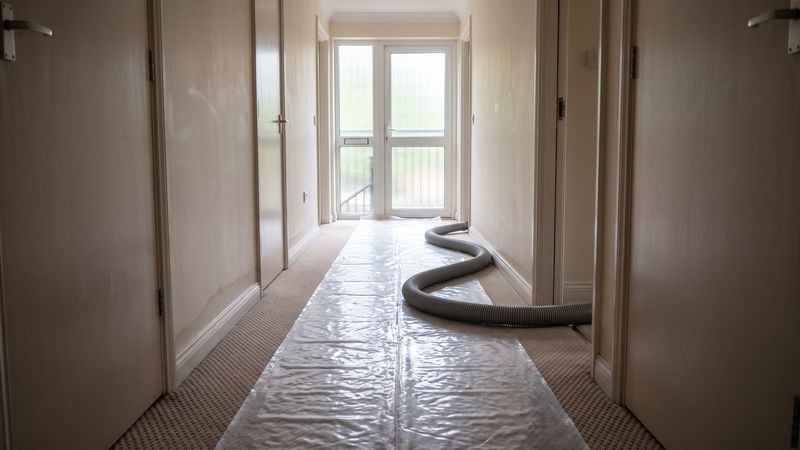
Then the drying environment is engineered. Air movers create high-velocity airflow across wet surfaces to accelerate evaporation, while commercial dehumidifiers remove that evaporated moisture from the air so it doesn't re-absorb into other materials. Technicians take daily moisture readings at fixed points and adjust equipment until every material meets the drying goal. Our full process is detailed on the water damage restoration service page.
| Stage | What happens | Why it matters |
|---|---|---|
| Inspection & moisture mapping | Moisture meters and thermal imaging locate hidden water; water category assigned | Finds water behind walls and under floors before it causes secondary damage |
| Extraction | Standing water removed; carpet and pad deep-extracted | Removes the bulk of water so drying is faster and more complete |
| Structural drying | Air movers + dehumidifiers engineered to the space per IICRC S500 | Pulls absorbed moisture from framing, drywall, and subfloor |
| Daily monitoring | Moisture readings logged and equipment adjusted | Proves materials are actually reaching the dry standard |
| Verification | Final readings confirm the dry standard is met | Prevents mold and confirms the home is truly dry |

How long does water damage restoration take in VA?
A typical structural dry-out takes about three to five days, monitored daily until materials reach a verified dry standard. That timeline covers the drying phase specifically — extraction and equipment setup usually happen the same day the crew arrives, often within the first hour of being on-site.
The exact duration depends on how much water was involved, how long it sat before extraction, the materials affected, and the water category. Clean water caught quickly in a home with drywall and carpet may dry in three to four days. Water that soaked hardwood, dense subfloor, or plaster, or that sat long enough to migrate into wall cavities, can take longer because those materials release moisture slowly. Category 2 and 3 losses add removal and sanitization steps that extend the schedule.
In the Vienna case, the affected ceiling, a section of living room hardwood, and the vanity cabinet were dried and monitored over roughly five days. The homeowner asked — reasonably — why the equipment couldn't come out early. The answer is that pulling air movers and dehumidifiers before readings confirm the dry standard is exactly how hidden moisture turns into a mold claim a month later. Daily monitoring exists to protect the home, not to extend the job.
- Same-day: extraction, equipment setup, moisture mapping
- Days 1–5 (typical): controlled drying with daily monitoring
- Verification: final readings confirm the dry standard before equipment is removed
- Longer timelines: hardwood, plaster, wall-cavity saturation, or Category 2/3 water
What does water damage restoration cost in Vienna, VA?
Water damage restoration costs vary widely because they depend on the affected area, water category, and materials involved — but as general ranges, a small, contained clean-water event often falls in the low thousands, while larger multi-room or contaminated losses can run into the higher thousands or beyond once removal and rebuild are included. We provide a written, itemized scope rather than a flat guess, because every loss is different.
Cost drivers include the volume of water and how many rooms it reached, whether flooring and drywall can be dried in place or must be removed, the water category (Category 3 requires more labor and protective protocols), the number of drying days, and whether reconstruction — new drywall, paint, flooring — follows the dry-out. A fast response usually lowers total cost, because catching water early keeps it a drying job instead of a demolition-and-rebuild project.
Here's how the money side works with us: about 83% of our customers file an insurance claim, and we bill the homeowner directly while handing you a carrier-ready claim file. We work for you, not your insurance company. The estimate is built in Xactimate — the same platform most carriers use to review claims — so the numbers line up with what your adjuster expects. Learn more about how we support the process on our insurance claims page.

How does the homeowner-direct claim file support your insurance claim?
The claim file supports your insurance claim by giving your adjuster clean, standardized documentation of what was damaged, what was done, and proof the home was dried correctly. Because we bill you — the homeowner — directly and hand you that file, you stay in control of your own claim. We work for you, not the carrier.
A strong claim file has three core pieces: an Xactimate scope that itemizes the work in the pricing language adjusters recognize, CompanyCam photo documentation timestamped throughout the project, and daily moisture logs that prove drying was performed to standard. Together they answer the questions adjusters ask before approving a claim — what happened, what was affected, and whether the work was necessary and complete. Missing or sloppy documentation is one of the most common reasons claims stall or get reduced.
For the Vienna homeowner, this mattered directly. The visible ceiling stain was minor, but the moisture logs proved the drywall had been saturated well above the dry standard, and the photos showed the failed supply line and the extraction work. That documentation justified the full scope instead of a lowball 'it's just a stain' assessment. Documentation isn't paperwork for its own sake — it's what turns a fair repair into an approved one.
- Xactimate scope: line-item estimate in the format carriers review
- CompanyCam photos: timestamped visual proof of damage and work performed
- Daily moisture logs: verification that drying met the dry standard
- Homeowner-direct billing: you hold the file and control your claim
When does water damage become a mold problem — and how do you prevent it?
Water damage can become a mold problem within 24 to 48 hours when wet organic materials — drywall paper, wood, insulation — stay damp in a humid environment. Preventing it comes down to speed and thoroughness: extract fast, dry to a verified standard, and don't leave hidden moisture behind. That's the entire logic of professional drying.
Mold needs moisture, an organic food source, and time. Restoration removes the moisture variable. When materials are returned to their dry standard and confirmed with meter readings, mold loses the conditions it needs to establish. The danger zone is the DIY dry-out that looks finished on the surface but leaves wall cavities and subfloor damp — those are the jobs that come back weeks later as a musty smell and visible growth.
If water sat for several days before you noticed, or if there's already a musty odor or visible discoloration, the job may need remediation under the ANSI/IICRC S520 Standard for Professional Mold Remediation rather than drying alone. In that case, containment and safe removal come into play — our mold remediation team handles that side. The best-case scenario is always catching water early enough that drying prevents mold from ever starting.

Why does response time matter so much for water damage?
Response time matters because water damage is progressive — every hour water sits, it migrates farther into the structure, ruins more material, and raises both the repair cost and the mold risk. Fast extraction is the single most controllable factor in how bad a water loss becomes.
This is why we hold a response commitment of on-site within 60 minutes across the Northern Virginia core, with a median arrival of 47 minutes. Across the restoration jobs we've completed throughout the Virginia, Maryland, and Washington, D.C. tri-state area, the pattern is consistent: the losses that stay small are the ones where extraction started fast. A supply-line leak caught in the first hour is a drying job; the same leak left overnight can become a demolition-and-rebuild project.
Water damage does not keep business hours, which is why our emergency line runs 24/7. If you're dealing with active water now, don't wait for morning — call Restoration Doctor at 1-888-293-5663 or reach us through our contact page. The faster we're on-site, the more of your home stays original instead of rebuilt.