Water Under Laminate Flooring: What It Does, and What Has to Come Up

BYSteve Jafari, General ManagerNORTHERN VIRGINIA, MARYLAND & D.C.

Water under laminate flooring does not dry safely on its own, because the floating planks and the foam underlayment hold moisture against the subfloor. EPA guidance is to dry water-damaged areas within 24 to 48 hours to prevent mold growth, so the affected planks have to come up. Lift them, dry the subfloor with professional equipment, and prove it dry with a meter before any new floor goes down.
Call 1-888-29-FLOODWhat happens when water gets under laminate flooring?
Water under laminate flooring does not dry safely on its own. The floating planks and foam underlayment trap moisture against the subfloor, where it has nowhere to evaporate. EPA guidance is to dry water-damaged areas and items within 24 to 48 hours to prevent mold growth, so the affected planks have to come up.
Laminate is a printed decorative layer bonded to a high-density fiberboard core. That core behaves like a sponge. Once moisture reaches it the fibers swell, the locking edges lift, and the printed surface separates from the core. That separation is called delamination, and it is usually permanent.
The bigger problem is the part you cannot see. A laminate floor floats over foam underlayment laid on the subfloor, and that assembly holds water between the planks and the wood or concrete below. The moisture sits against organic material in the dark, which is the exact condition mold needs to start.
What happens next is a sequence rather than a countdown. Water reaches a seam and wicks along it. The core swells wherever it got wet, so plank edges peak and the locking joints loosen. The underlayment stays saturated long after the surface feels dry. The only number worth planning around is EPA's window: dry it inside 24 to 48 hours, or assume mold has started.
- EPA, A Brief Guide to Mold, Moisture and Your Home, on the 24 to 48 hour drying window.

Will water under laminate flooring dry out on its own?
No, not safely. The assembly is a lid. Laminate planks lock to each other and float on foam, so the wet side faces down into the underlayment and the subfloor, where there is no airflow and no light. Running fans over the floor dries the top of the plank, which was never the part holding the water.
That is why drying in place so often looks like it worked and then fails. The floor feels dry underfoot long before the subfloor is. Weeks later the seams peak again, a musty smell comes back after every cleaning, and the subfloor still reads wet on a meter.
Three things are worth doing before anyone opens the floor up.
- Stop the water at its source, whether that is a shut-off valve, an appliance hose or a roof leak
- Get standing water off the surface with a wet vacuum so it stops feeding the seams
- Lift a few planks at the wall, where a floating floor comes apart most easily, and look at the underlayment underneath
- If the underlayment is wet or the subfloor is stained, plan on taking up every plank in the affected area
How can you tell if mold is growing under the floor?
You almost never see it, so you check for the four things a homeowner can detect without tools. A musty or earthy smell that returns after every cleaning is the most reliable, because it means something is still producing it. Dark staining bleeding up through the seams is the second. Planks that peak, warp or feel loose underfoot are the third. Allergy-like symptoms indoors that ease when you leave the house are the fourth.
What the exposure does varies from person to person. CDC lists a stuffy nose, sore throat, coughing or wheezing, burning eyes or a skin rash, with stronger reactions in people who have asthma or a mold allergy. CDC also does not recommend testing the mold. If you can see it or smell it, the work is to remove it and fix the moisture that fed it.
EPA gives a size threshold that decides whether this is still a homeowner job. If the moldy area is less than about 10 square feet, roughly a 3 foot by 3 foot patch, EPA says most people can handle it themselves. Past that size, or any time the water was sewage or otherwise contaminated, EPA says to call in a professional with experience cleaning and repairing buildings damaged by contaminated water.
A lot of flooring advice online tells you to scrub the subfloor with diluted bleach. EPA says the opposite. Using a chemical or biocide that kills mold, chlorine bleach being the usual example, is not recommended as a routine practice during mold cleanup. EPA also notes that dead mold can still cause allergic reactions, so killing it is not enough. It has to be removed.
That is the logic behind ANSI/IICRC S520, the standard professional mold remediation is performed to. Hidden growth gets physically removed rather than sprayed, porous material that has grown mold gets discarded, and the work happens inside containment so spores do not reach rooms that were never affected.
- EPA, Mold Cleanup in Your Home, on the 10 square foot threshold and on contaminated water.
- EPA, A Brief Guide to Mold, Moisture and Your Home, on why biocides such as chlorine bleach are not routine practice in mold cleanup.
- CDC, Mold, on mold and your health.
- IICRC, S520, the standard for professional mold remediation.

What should you do in the first 24 hours?
In the first 24 hours, stop the water source, get standing water off the floor, and take up the affected planks so the subfloor can start drying. The target is a dry subfloor inside 24 to 48 hours, before mold has the sustained moisture it needs. Speed is the single biggest factor in whether this stays a dry-out or turns into a mold remediation project.
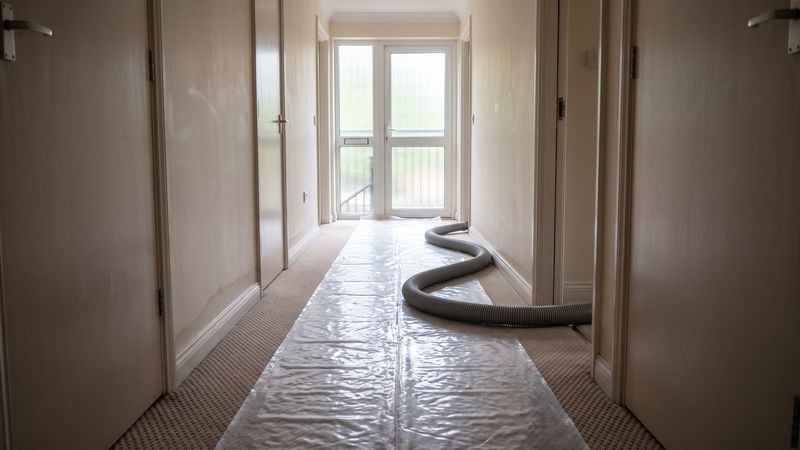
Because laminate floats and is not glued or nailed down, the planks in the wet area can usually be lifted without destroying the whole floor. From there professional equipment does the real work: air movers paired with dehumidifiers sized to the room by psychrometric calculation, pulling moisture out of the structure instead of off the surface.
What if the water came from below? Slab moisture wicking up under a floating floor, a sump pump backup, or groundwater at the footing is a different problem from a spill. The source sits under the floor, so nothing you run on top of it will dry anything. EPA's guidance for sewage and other contaminated water is to call in a professional with experience cleaning and repairing buildings damaged by it.
A flooded floor is also not a one-day job. EPA notes that mold can grow on wood, drywall, carpet and furniture that stay wet for more than 24 hours, and that drying out a wet structure usually takes several days to weeks.
If the water came from a clean supply line you can shut off yourself, start these steps on your own. If it is sewage, a sump backup, or you cannot find the source, treat it as an emergency. Restoration Doctor answers 24/7 across Northern Virginia, Maryland and the District of Columbia, and same-day drying setup matters more with flooring than with almost any other repair. Call 1-888-293-5663 any time.
- Shut off the water source or the main supply valve
- Unplug nearby electronics and switch off power to wet areas if it is safe to do so
- Blot and extract standing water rather than letting it sit overnight
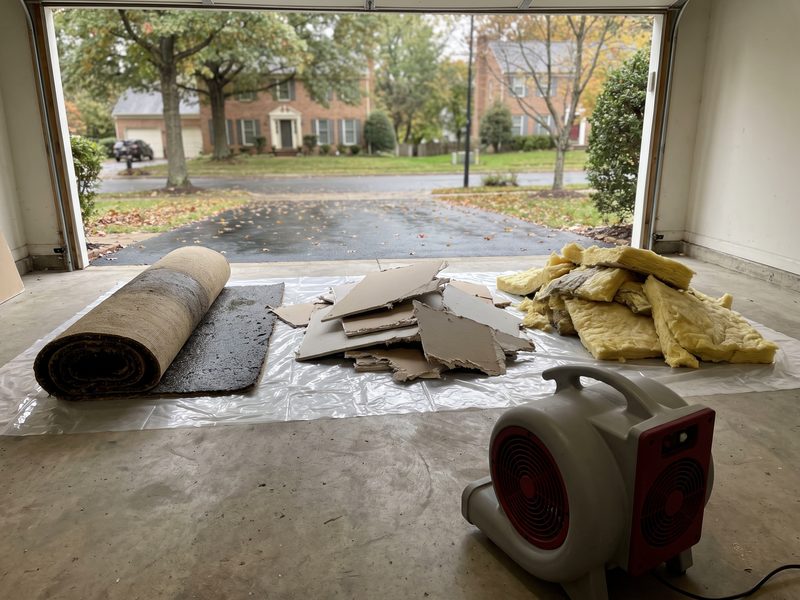
- Lift the affected planks and remove wet underlayment to expose the subfloor
- Photograph everything before you move or discard it, for your records and your claim
- Call a restoration professional to measure moisture levels and set up structural drying
- EPA, Flood Cleanup to Protect Indoor Air and Your Health, on how long wet material takes to dry.
How do professionals dry the subfloor, and how do they prove it is dry?
Professionals take the floating floor and the underlayment out, set calibrated air movers and dehumidifiers on the bare subfloor, then take readings every day until the material reaches a documented drying goal. It is a measured process rather than a judgment call. Technicians compare the wet material against a dry reference reading from an unaffected area of the same material.
A structural dry-out on a floor usually runs a few days with daily monitoring. How long depends on how much water was involved, what the subfloor is made of, and how humid the house is. Psychrometry, which is how air temperature and moisture interact, decides how much equipment goes where. A slab and a plywood subfloor release water at very different rates, and rushing either one leaves pockets of moisture behind.
The half of this job that most advice skips is proving it. On wood the instrument is a moisture meter, and EPA's published threshold is that materials should read 15% or less to be ready for refinishing. On a slab, tape a sheet of clear plastic tightly down, leave it about 16 hours, then look underneath. If moisture shows on the plastic, the slab is still too wet to cover.
Under ANSI/IICRC S500, the standard professional water damage restoration is performed to, a floor is not dry because it feels dry. Restoration Doctor logs the readings daily, photographs the work in CompanyCam and writes the scope in Xactimate, so there is a record of what the material read on the day the equipment came out.
- IICRC, S500, the standard for professional water damage restoration.
- EPA, Flood Cleanup to Protect Indoor Air and Your Health, on the 15% moisture reading and the plastic sheet slab test.

Can the laminate planks be saved, and is LVP any different?
In most cases the laminate planks cannot be saved. The fiberboard core swells once it is saturated and it does not shrink back, so the planks stay warped or buckled even after they dry. Taking them out is usually cheaper than trying to dry them, and it is the only way to reach the subfloor.
How much water laminate can take comes down to where the water got to. A spill wiped up off an intact surface does not reach the seams, so the floor is fine. Standing water, or water that got into the seams, is a different event, because the core behind those seams is not sealed. Water arriving from underneath is the worst case of all.
Luxury vinyl plank behaves differently, because it is PVC and does not absorb water. The plank will not swell or delaminate, so once the assembly beneath it is confirmed dry, LVP can often be lifted, cleaned, then put back down. That is not the same as the floor being fine. LVP floats over an underlayment too, and water still runs along the seams and pools against the subfloor.
What decides it is how dirty the water was and how long it sat. Clean supply water caught quickly gives LVP the best odds. Water that carried contamination soaks the underlayment and the subfloor, which means taking the planks up anyway so the material beneath can be cleaned and disinfected.
| Factor | Laminate | Luxury Vinyl Plank (LVP) |
|---|---|---|
| Core material | High-density fiberboard (absorbs water) | PVC vinyl (waterproof) |
| Plank survives soaking | Rarely | Often, if clean water |
| Swelling / delamination | Common and permanent | Uncommon |
| Subfloor still needs drying | Yes | Yes |
| Best-case outcome | Replace affected planks | Dry, reinstall, keep planks |
When does the subfloor itself have to come out, and what goes back down?
Most subfloors dry and stay. Plywood and OSB give water back up once the floor covering is off them and air is moving across the surface. The subfloor comes out when it has lost structural strength, when it is delaminating in layers, or when mold has grown into the material past the point where cleaning the surface does anything useful.
A concrete slab almost never comes out. Slabs hold water deep and release it slowly, which is why the plastic sheet test matters more there than anywhere else. A slab that reads dry at the surface can still be pushing moisture up from below, with nowhere for it to go once a new floor sits on top.
The classic repeat failure is a new floor laid over a damp subfloor. Weeks or months later the seams peak again, or a smell starts, and the new floor comes up along with the old problem. EPA puts it plainly for flood work: be sure the foundation is dry before you replace the flooring, and if moisture is visible on the plastic sheeting it is still too wet.
So the rule for what goes back down is short. Nothing goes over a subfloor that has not been read with a meter and documented dry. Not laminate, not LVP, not carpet.

Does homeowners insurance cover water damage under laminate flooring?
Homeowners policies commonly cover water damage under laminate flooring when the cause was sudden and accidental, such as a burst supply line, a failed appliance hose or an overflow. They commonly exclude gradual seepage, neglected maintenance and surface flooding from outside. Coverage turns on the cause and on your own policy wording, so what caused the water matters as much as what the water did.
Here is how we fit into that. We work for you, not for your insurance company. Restoration Doctor bills you, the homeowner, directly, and hands you a carrier-ready claim file with a detailed Xactimate scope, CompanyCam photo documentation and daily moisture logs, so your claim is supported by the evidence adjusters expect to see.
That documentation matters more with laminate than with most losses, because most of the damage sits under the planks where nobody can see it. Moisture readings and photographs of the exposed subfloor show the real extent of the loss, so the claim reflects what actually has to be repaired instead of what was visible from standing height.
Should you put laminate back, or switch to LVP?
In a room prone to spills or appliance leaks, which covers most kitchens, bathrooms, laundry rooms and basements, switching from laminate to LVP is usually the better long-term call, because vinyl will not absorb water and swell. Laminate is fine in dry living space where you like how it looks underfoot. It will simply fail again the next time it gets wet.
Neither choice removes the need to dry the subfloor after a leak. What LVP gives you is a real chance to keep the planks after a clean-water event, which laminate almost never does. In a room where something is likely to go wrong eventually, that difference pays for itself the first time it does.
Whatever goes down, do not install it over a subfloor that has not been verified dry with a moisture meter. Checking the number takes minutes. Tearing out a brand-new floor does not.