Why Your Sewer Lateral Backs Up Every Autumn: Tree Roots and Orangeburg Pipe
BY RESTORATION DOCTOR · NORTHERN VIRGINIA, MARYLAND & D.C.
A sewer lateral that backs up every autumn usually has one of two Northern Virginia causes behind it: tree roots working into a pipe joint, or Orangeburg fiber pipe deforming under load. This guide explains where your responsibility for the lateral begins, how the two failures look different on a camera, and how insurance tends to treat the pipe separately from the cleanup.
Call 1-888-29-FLOODWhat is a sewer lateral, and where does your responsibility start and stop?
Your sewer lateral is the private drain line carrying everything that leaves the house out to the public sewer main, and in Fairfax County the property owner is responsible for that pipe along its whole length. That is why a backup caused by tree roots in the sewer line lands on the homeowner rather than the county. The county's wastewater guidance is explicit: the resident or building owner maintains the private line from the building to the county sewer, including the connection, and owns the damages when it blocks.
The boundary is not drawn the same way everywhere. The City of Alexandria runs a sanitary sewer asset renewal program that inspects and rehabilitates city-owned portions of lateral sewers, so part of the run belongs to the city on some properties. Read your own jurisdiction's sewer page before you assume. One more step is worth knowing: Fairfax County asks residents to call its 24-hour customer line when a plumber cleans roots out of a private lateral, so county crews can clean out the county sewer main line as well.
- Fixture to foundation wall: interior drain piping, always the owner's
- Foundation to property line: the lateral, the owner's across most of Northern Virginia
- Property line to the main: still the owner's under Fairfax County's rule, but check your own city
- The main under the street: the county or city utility
- The cleanout cap in the yard: yours, and the most useful fitting on the property
Why do tree roots get into a sewer line at all?
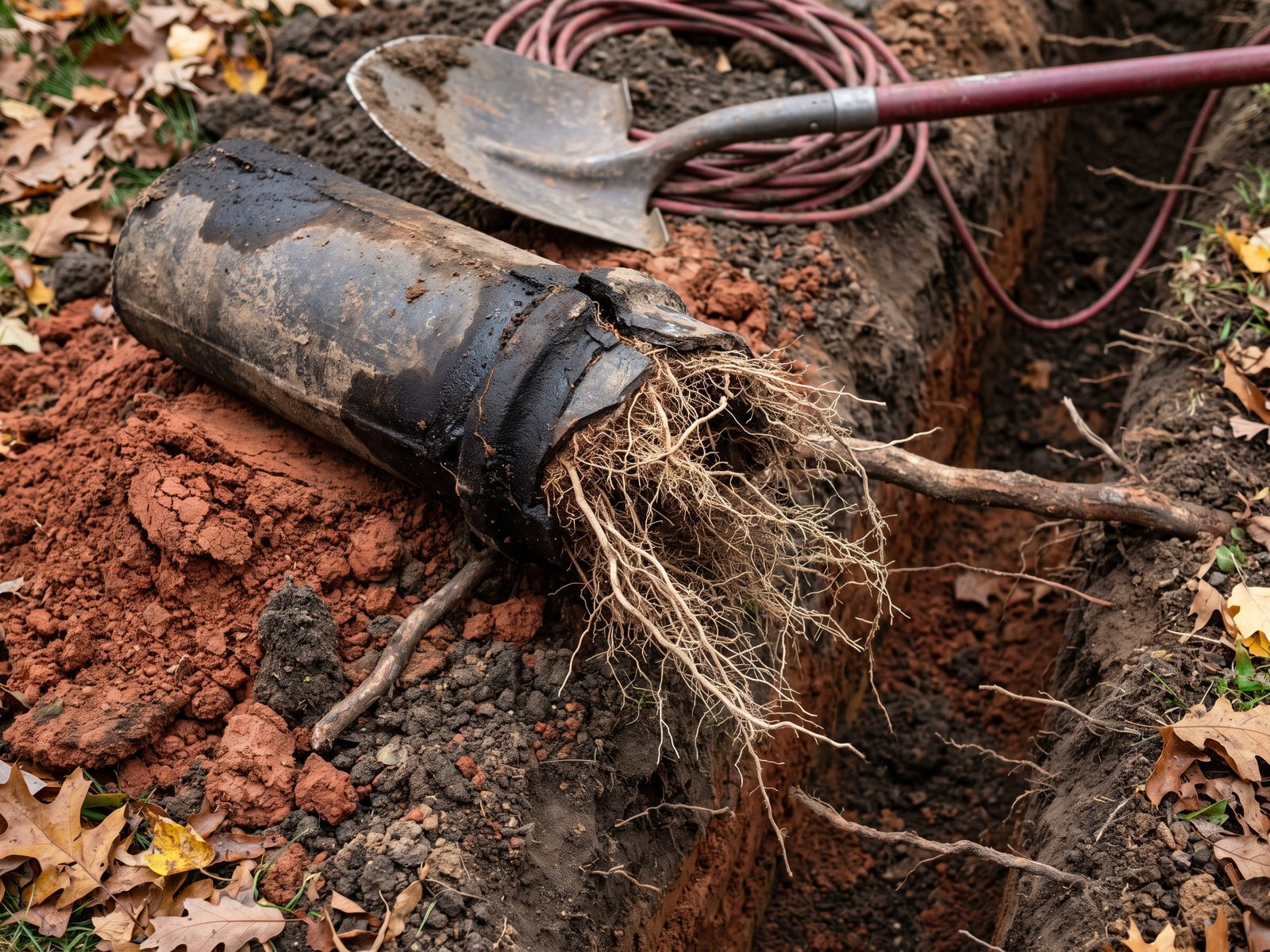
Roots go where the water is. A lateral carries warm, nutrient-rich water and vents moisture vapor into the soil through any gap in the pipe, and a root growing nearby follows that gradient to the source. Fairfax County describes the same mechanism: shrub and tree roots make their way into open sewer joints or cracks, and over time they break the line, letting debris collect until it blocks.
The entry point is nearly always a joint rather than the middle of a pipe section. Older clay laterals were laid in short lengths with collars at every coupling, and those collars crack and shift as the ground moves. A root needs only a hairline gap. Cutting the mat out restores flow the same day, but the opening stays open and the same oak still wants the same water, so the interval between clearings keeps shortening.
What is Orangeburg pipe, and which Northern Virginia houses have it?
Orangeburg is a bituminous fiber conduit: wood pulp fiber wound into a tube and saturated with coal tar pitch. It was cheap and light enough for one worker to carry a full length, and it went into American subdivisions from the late 1940s into the early 1970s, which covers much of the inner Northern Virginia building boom. It was never meant to outlast clay or cast iron, and a great deal of what went in the ground is now past the age at which it starts to give.
It fails by deforming rather than cracking. Soil load slowly squeezes the round section into an oval, flow slows, solids settle in the sag, and the first symptom is a slow drain rather than a break. Nothing inside the house tells you which material you have. Build year narrows it down, since a house finished between roughly 1948 and 1972 in Arlington, Falls Church, the older Fairfax neighborhoods or north Alexandria sits in the window. A camera inspection settles it in a single visit.
- Built late 1940s to early 1970s and never re-piped: Orangeburg is a live possibility
- Built before about 1945: more likely clay or cast iron, with joint-driven root problems
- Built after about 1975: usually PVC or ABS, where offsets and bellies are the failure mode
- A permit record or old plumbing invoice showing a lateral replacement closes the question
How do you tell root intrusion from a collapsed pipe from an ordinary blockage?
The three causes produce different patterns, and the pattern is readable before anyone opens a cleanout. An ordinary blockage is a one-off with a cause you can name, such as wipes or grease. Root intrusion is seasonal and repeats on a shortening interval. A deforming pipe gets worse in a straight line and barely improves after a clearing, because there is no obstruction to remove, only a pipe that has lost its shape.
Use the table as a first read, then confirm with a camera. The distinction matters because the outcomes are completely different: a cleaning, a maintenance cycle with a repair decision behind it, or an excavation.
| What you notice | Most likely cause | What the camera tends to show | What it usually takes |
|---|---|---|---|
| One backup, no history, after a holiday or a party | Ordinary blockage | A discrete mass of wipes or grease with clean pipe either side | A single cleaning, then normal service |
| Backs up most autumns, clears easily, returns sooner each time | Root intrusion at a joint | Fine white root hairs or a dense mat at a coupling, pipe otherwise round | Cutting or jetting now, and a repair decision on the joint |
| Slow drains all year, gurgling, worse after rain, clearing gives little relief | Deformed or collapsed pipe | An oval or flattened section, standing water in a sag, sometimes soil | Excavation or lining of the failed run |
| Sewage appears only during heavy rain, then recedes | Inflow or a surcharged system rather than your pipe | Clear pipe, with water rising from the downstream end | Call the utility, and look at a backflow device |
Why does it happen in autumn, and why does it repeat?
Autumn stacks three things on top of each other. Root systems keep growing after the canopy stops making leaves, because soil stays warm well into November. Soil moisture is usually at its lowest after a long, hot summer, because the canopy has been pulling water out of the ground all season, so roots range further and a leaking sewer joint becomes the best target within reach. Then the leaves come down and the drainage system takes on a load it never carries in July.
Repetition is the tell that separates a lateral defect from bad luck. A pipe that backed up last October and again this October is not having two accidents. Something structural is catching solids at the same point, and the seasonal load is simply what pushes it past the line each year. Once the interval starts shortening, the pipe has usually lost enough inside diameter that a clearing buys months rather than a year.
- Roots keep growing through autumn while soil temperature stays up
- Dry late-summer soil sends roots toward the moisture leaking from a joint
- Leaf fall loads the drainage system in the same weeks
- Holiday cooking adds grease and solids to a line that is already narrow
What does a camera inspection show, and when is it worth doing?
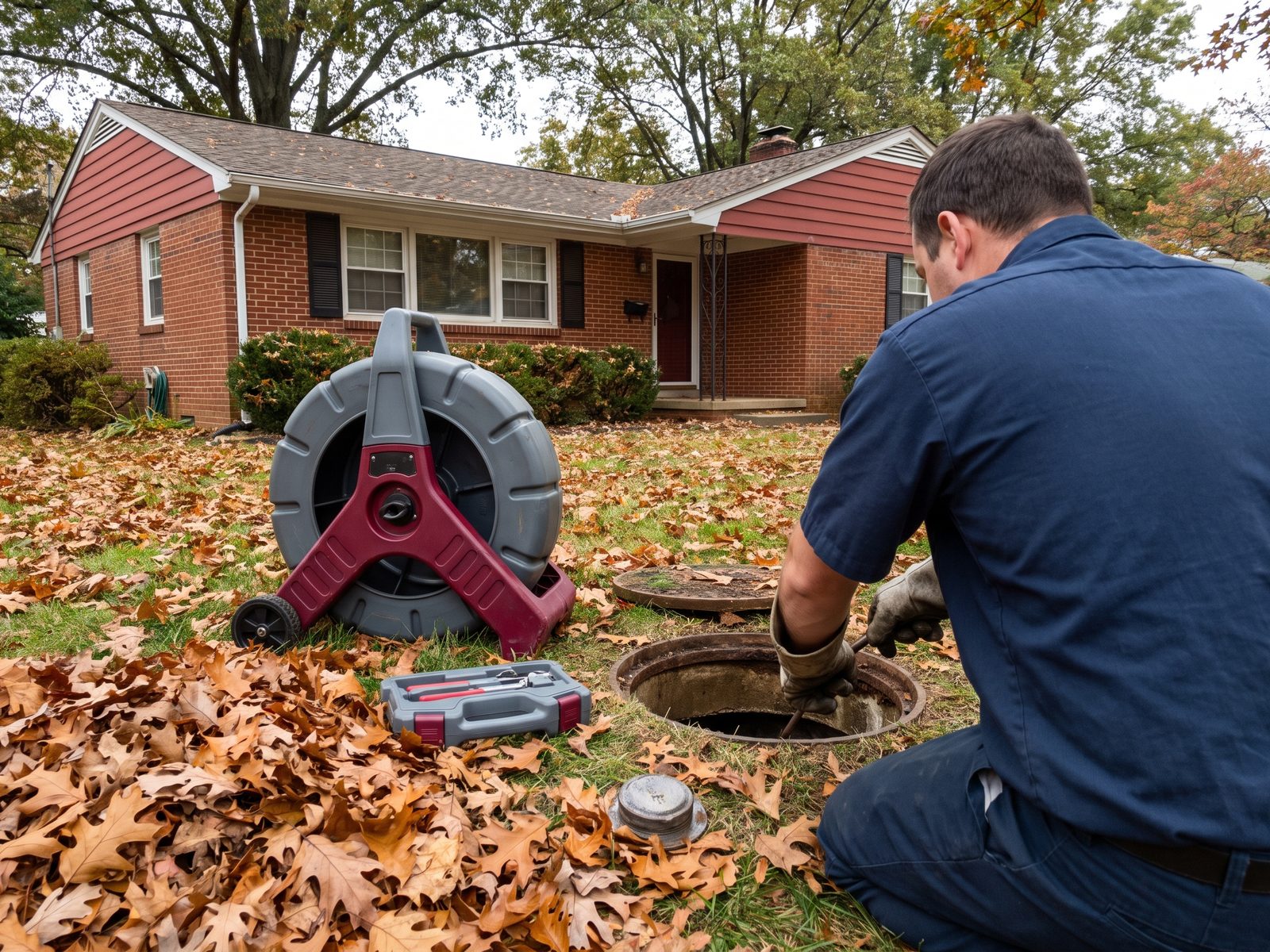
A sewer camera is a small waterproof head on a push rod with a distance counter on the reel. It goes in at the cleanout and runs toward the main. It tells you three things a cable machine cannot: what the pipe is made of, what condition it is in, and how many feet from the cleanout the trouble sits. A locator traces the head from the surface, so a crew can mark the line across the lawn before anyone talks about digging.
It is worth doing the second time a lateral backs up, and before any excavation quote. One backup can be a blockage. Two is a pattern, and paying for a third clearing without knowing what is down there is how people spend repair money on maintenance. Ask for the video file and the footage log rather than a verbal summary. Note the limits too: a line full of standing water shows little until it is cleared, and heavy roots can stop the head before it reaches the main.
- Material identification: clay, cast iron, Orangeburg fiber or plastic
- Distance in feet from the cleanout to each defect
- Joint condition, offsets, and bellies holding standing water
- Root mass, and whether it enters at one joint or many
- A surface mark showing where the line runs, which is rarely where people assume
What are the repair options, and what does the utility require?
There are three broad paths, and a licensed plumbing or utility contractor owns all of them. Mechanical cleaning or hydro-jetting restores flow and buys time. Trenchless methods, meaning a cured-in-place liner or pipe bursting, rebuild the run with limited digging where the host pipe is sound enough to take them. Open excavation replaces the failed section outright, and it is the usual answer for a lateral that has already deformed, because there may be nothing left to line against.
Permits, connection rules and inspection requirements come from your county or city utility, and they are not uniform across the region. Fairfax County publishes its wastewater guidance and a customer line for reporting blockages, and Alexandria runs its own programs, including a partial reimbursement toward a licensed plumber installing a backflow preventer on a lateral. Restoration Doctor does not repair, line or excavate sewer laterals. We handle what the failure does inside the building, which keeps the two scopes and the two sets of paperwork clean.
What happens inside the house when the lateral backs up?
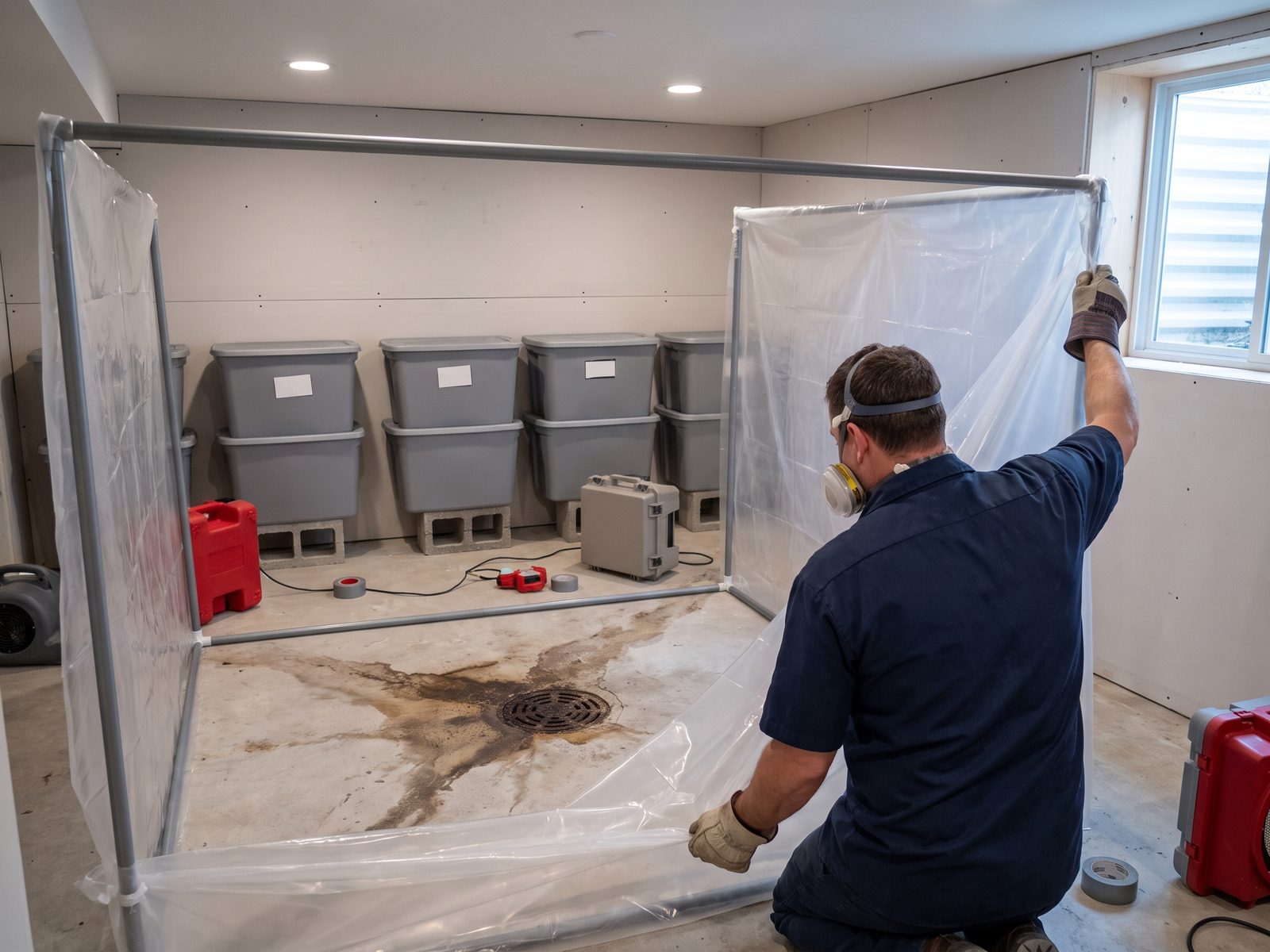
What comes back up through a floor drain is Category 3 water under the ANSI/IICRC S500 standard, meaning grossly contaminated and capable of causing illness. It is handled as a contaminated loss from the first minute. That means containment, negative air where needed, protective equipment, removal of the porous materials that absorbed it, antimicrobial treatment of what stays, and drying to a documented standard rather than to a guess.
Porous materials that took on sewage generally do not come back: carpet and pad, particleboard, insulation, and drywall wicking above the water line. Hard surfaces such as slab, sealed tile and solid wood can often be cleaned and dried in place. The same interior damage can arrive from the opposite direction a few miles away, because a combined system carries sewage and stormwater in one pipe. Our D.C. team wrote up how the District's combined sewer backs up at https://restorationdoctordc.com/blog/sewer-backup-dc-combined-system, which is the same interior loss arriving from a different cause.
Does homeowners insurance cover a lateral failure and the cleanup that follows?
Treat the pipe and the water as two separate questions, because policies almost always do. A standard homeowners policy is built around sudden and accidental damage inside the building, and a buried private line that deteriorated over years usually sits outside that. Sewage coming back up through a floor drain is a different item again. Fairfax County tells residents the same thing: in most cases a special rider related to sewage backup or water damage is needed, the coverage is optional, and it has to be requested.
So there are two names to look for on your declarations page. A water or sewer backup endorsement addresses the cleanup and the damaged property inside the house. A service line endorsement, which some carriers sell, is the usual route to any help with the buried pipe itself. When a backup happens, photograph the water at its high point before anything is moved, and keep the camera video and the plumber's invoice together. If the utility finds the blockage was in the public main, the county directs owners to its Risk Management Division.
- Water or sewer backup endorsement: the cleanup and damaged contents, usually optional
- Service line endorsement: the usual route to any help with the buried pipe
- A deteriorated pipe generally reads as maintenance rather than a covered peril
- Blockage in the public main is a claim against the utility, not your policy
What do you do in the first hour of a sewage backup?
Stop adding water, keep people out, and document the loss before anything is moved. Every flush and wash cycle upstairs feeds a line with nowhere to send it, so tell the household to stop using water entirely. Keep children and pets off the affected floor, because Category 3 water is a health issue and not only a mess. Public guidance from the CDC on floodwater and from the EPA on mold and moisture points the same way: avoid contact, and do not sleep in the affected area.
Do not run a shop vacuum through it and do not start pulling up carpet. Sewage cleanup is a professional scope with containment and protective equipment attached, and a well-meant hour with a mop spreads contamination into rooms that were clean. Call a plumber for the line and a restoration crew for the interior, then ask the plumber to camera the lateral before the equipment leaves. The sources behind the standards and local rules quoted in this guide are listed below.
- Stop all water use in the building, including the washing machine and dishwasher
- Keep people and pets off the affected floor and out of standing water
- Do not touch outlets or panels near the water; cut power at the breaker only from dry ground
- Photograph everything at its worst before anyone moves a box
- Leave HVAC returns in the affected area switched off
- Find the policy and look for a backup endorsement before you call the carrier
| Source | Where to read it |
|---|---|
| Fairfax County, Preventing Backups and Overflows, including private lateral responsibility | https://www.fairfaxcounty.gov/publicworks/wastewater/preventing-backups-and-overflows |
| City of Alexandria, sanitary sewer programs and city-owned lateral portions | https://www.alexandriava.gov/sewers |
| ANSI/IICRC standards, including the S500 water damage restoration standard | https://iicrc.org/iicrcstandards/ |
| CDC guidance on floods and contact with floodwater | https://www.cdc.gov/floods/about/index.html |
| EPA guidance on mold cleanup after water in the home | https://www.epa.gov/mold/mold-cleanup-your-home |